Deepak Gupta | May 1, 2026 |
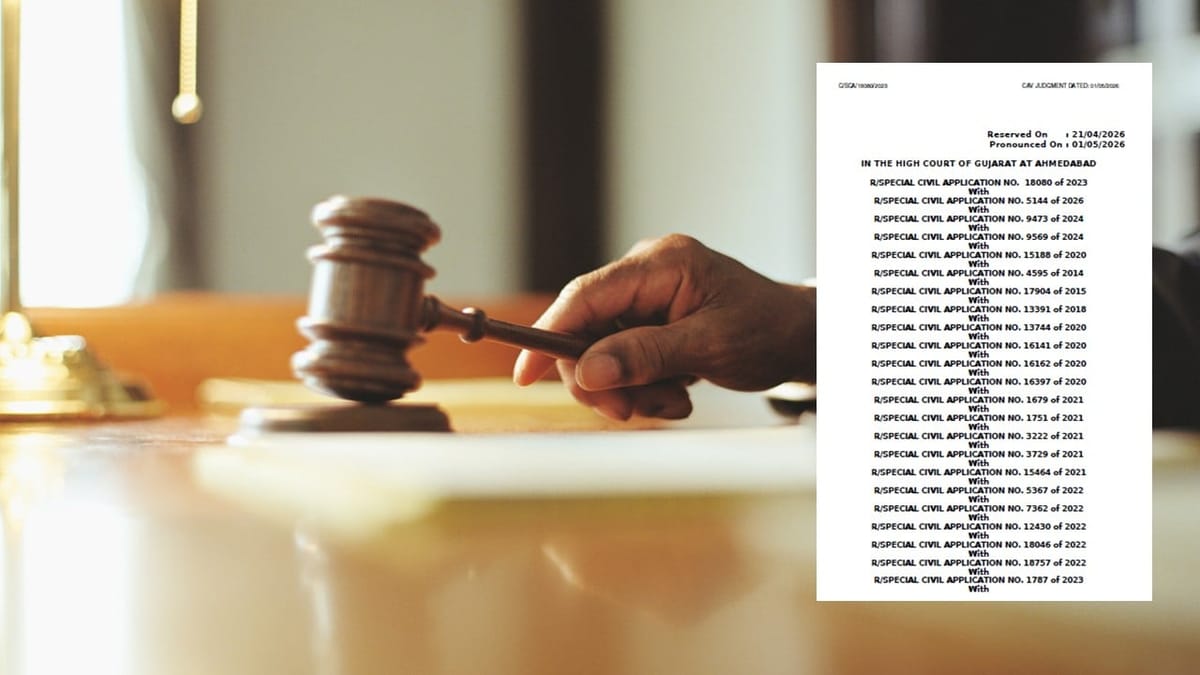

GST: High Court upheld constitutional validity of Section 16(2)(c), asks government to address ITC issues of genuine purchasers
In group of petitions, Gujarat High Court was called upon to examine the vires of the provision of Section 16(2)(c) of the Central Goods and Services Tax Act, 2017 (for short, “the CGST Act”).
Main Question of Petitioner:

It is the case of the petitioners that the provision of Section 16(2)(c) of the CGST Act is arbitrary, ultra vires and violative of Articles 14, 19(1)(g), 265, and 300A of the Constitution of India.
In the alternative, it is prayed that the said provision be read down so as to apply only to such transactions that are found to be fraudulent, collusive or involving connivance between the purchasing dealer and the supplier, thereby excluding those purchasers, who have acted bona fide.
The entire case of the petitioners’ hinges on a sole aspect, namely the default of the supplier in depositing the tax so collected with the government. As a consequence, Input Tax Credit (ITC) is denied to purchasers like the petitioners.

Analysis by Gujarat High Court
Government cannot be deprived of revenue on account of default by the supplier
The Court, upon a plain and literal interpretation of a statutory provision, found that Section 16(2)(c) of the CGST Act is clear, self-explanatory, and unambiguous. Its plain reading does not give rise to any constitutional or legal infirmity. The underlying intent of the provision is that the Government cannot be deprived of revenue on account of illegal or defaulting conduct on the part of the supplier.
CGST Act cannot be equated with the VAT regime
On a close scrutiny of the scheme of the GST regime, it is evident that Section 16(2)(c) of the CGST Act cannot be equated with the VAT regime, particularly with Section 9(2)(g) of the DVAT Act, as examined by the Delhi High Court in On Quest Merchandising India (P) Ltd. (supra). It is also noticed that the Tripura High Court, while following in the case of On Quest Merchandising India (P) Ltd. (supra), has read down Section 16(2)(c) of the CGST Act on the ground of practical impossibility for the purchaser to ensure that the supplier has deposited tax. With respect, we are unable to agree with the said view. The Tripura High Court proceeded on the premise that ITC is intended solely to avoid double taxation under the CGST regime, but did not adequately consider the interplay of Sections 41 and 53 of the CGST Act read with Rule 37A of the CGST Rules, 2017.
Both Buyer and seller must discharge their respective obligations to ensure the integrity of GST framework
71. The non-deposit of tax and claim of ITC by both the supplier and purchaser has a cascading effect on the purchaser who becomes a subsequent supplier and he in turn further supplies the goods. Thus, unless the seller deposits the eligible tax on supply of goods, the subsequent purchaser while further supplying the goods can only apply the credit in case the supplier has deposited the amount so collected in the government. The private transaction between supplier and the purchaser cannot be taken into account by the revenue unless there is a payment of tax in revenue arising from such transaction.
72. Both the supplier and the purchaser are integral to the tax chain and must discharge their respective obligations to ensure the integrity of the GST framework. The scheme of the Act contemplates that a bona fide purchaser must exercise due diligence and, upon becoming aware of non-compliance by the supplier, refrain from further transactions that would perpetuate the credit chain.
73. Section 16(1) of the CGST Act deals with the eligibility of a dealer to avail ITC and clause (a), (b), (c) & (d) of Section 16(2) of the GST Act deal with the conditions for enabling such benefits. Clause (a), (b), (c) & (d) of Section 16(2) of the CGST Act should be read and satisfied together and not separately to avail the benefit of ITC. Clause (c) of Section 16(2) of the CGST Act clearly states that ITC will be available to the purchasing dealer only if the supplier has paid the tax to the Government. It is for the purchasing dealer to prove that the tax collected has been remitted to the Government by the supplier.
Buyer-seller contract should ensure that seller should indemnify buyer in case of GST Default
76. The petitioners have heavily placed reliance on the maxim Lex Non Cogit Ad Impossibilia, which means that the law does not compel a man to do that which he cannot possibly perform, is closely connected to the maxim Impotentia Excusat Legem, which means a disability that makes it impossible to obey the law can be excused. However, the scheme of the GST regime does not strictly attract the intent of the maxim. As previously held by us, the provisions of Section 41 of the CGST Act read with Rule 37A of the CGST Rules, 2017 recognizes that purchaser are not unfairly penalized for a supplier’s default. It is true that the puchasers cannot compel the supplier to deposit tax with the government, thereby seek strict compliance of the provisions of Section 16(2)(c) of the CGST Act, but simultaneously they can avoid the circumstances by due care and caution. The GST regime operates on the contract/agreement between two parties. While entering into an agreement, a purchaser can ensure there is a clause that takes care of the lacuna and holds the supplier liable to indemnify the purchaser if the said purchasing dealer suffers a loss due to a default by the supplier to remit to the government the tax collected from the purchaser. Such clauses can be made part of the agreements covering such situations.
Clauses under sub-section 16(2), from (a) to (d), are to be read conjointly and not independently of each other
80. Thus, the Revenue cannot be directed to stop at clause (b), since eligibility for input tax credit is established only after the receipt of goods or services or both, and upon the tax charged in respect of such supply being duly paid to the Government. A registered person (dealer) cannot be held entitled to claim input tax credit unless all the conditions up to clause (c) are satisfied. As per the provisions of Section 155 of the CGST Act, the burden lies upon the dealer to establish entitlement up to the stage of clause (c), and such benefit cannot be availed by merely satisfying the requirement under clause (b). Hence, the clauses under sub-section (2), from (a) to (d), are to be read conjointly and not independently of each other.
ITC is a concession is given by statute and the conditions thereof are to be strictly complied with
86. The following propositions can be culled out from the aforenoted observations.
a) In interpreting a taxing statute, equitable considerations are entirely out of place.
b) The Court must interpret a taxing statute in the light of what is clearly expressed: it cannot imply anything which is not expressed; it cannot import provisions into the statute so as to supply any assumed deficiency.
c) A provision in the statute is not to be read in isolation; rather, it has to be read along with other related provisions itself, more particularly when the subject matter inter-relates with different Sections or parts of the same statute.
d) A taxing statute is to be interpreted literally, and further, it is in the domain of the legislature as to how much tax credit is to be given under what circumstances.
e) ITC is a form of concession extended to a dealer under the statutory scheme. The concession can be received by the beneficiary only as per the scheme of the statute.
f) Whenever a concession is given by statute or notification, etc., the conditions thereof are to be strictly complied with in order to avail such concession.
Final Order: The High Court upheld the constitutional validity of Section 16(2)(c). However it asked the government to address the issue of genuine purchasers at the earliest.
87. It is not the case of the Government/department that it is destitute or is vulnerable to the inaction of the seller who has not paid the tax. The Act provides the authorities with enough power to proceed against the selling dealer for recovery of tax. Sections 73 and 74 of the GST Act also empower the department to proceed against the defaulting parties in case of non-payment, short payment, and wrongful utilization of credit. A balanced approach is needed, which finds place in the decision expressed by the European Court of Justice (‘ECJ’) in the case of Axel Kittel & Recolta Recycling SPRL (supra). Under this principle, the availment of ITC can be denied only if it is shown that the recipient knew or ought to have known that their purchase was connected with a fraudulent evasion of tax.
88. Albeit, we acknowledge that the provisions of Section 16(2)(c) of the Act are to be viewed from a regulatory standpoint and are anchored in the legitimate objective of maintaining the integrity of the tax chain, preventing systemic revenue loss to the Government; however, it is high time that, in order to resolve the conundrum, the Government undertakes a comprehensive re-evaluation of the dicey situation which purchasers are facing. There is a pressing need for legislative amendments or clarifications to be issued within the GST framework to alleviate the disproportionate financial and administrative burdens currently placed upon purchasers who have an honest claim of ITC. Beyond mere policy changes, the Government should implement a robust, technology-driven tracking mechanism enabling verification of payments made by suppliers against specific invoices in real time, thereby insulating bona fide recipients from the defaults of their vendors. Simultaneously, the Government has to take prompt and immediate steps for recovery of tax from the erring suppliers, instead of compelling the purchasers to avail themselves of alternate cumbersome remedies. In the absence of stringent oversight, unscrupulous sellers could potentially enrich themselves at the expense of both the public exchequer and honest buyers.
89. Since we are not inclined to read down Section 16(2)(c) of the CGST Act, the question of declaring it ultra vires Part III of the Constitution of India, including Article 14 of the Constitution of India, does not arise. However, we expect the Government to address the issue of genuine purchasers at the earliest.

In case of any Doubt regarding Membership you can mail us at [email protected]
Join Studycafe's WhatsApp Group or Telegram Channel for Latest Updates on Government Job, Sarkari Naukri, Private Jobs, Income Tax, GST, Companies Act, Judgements and CA, CS, ICWA, and MUCH MORE!"