Meetu Kumari | May 7, 2026 |
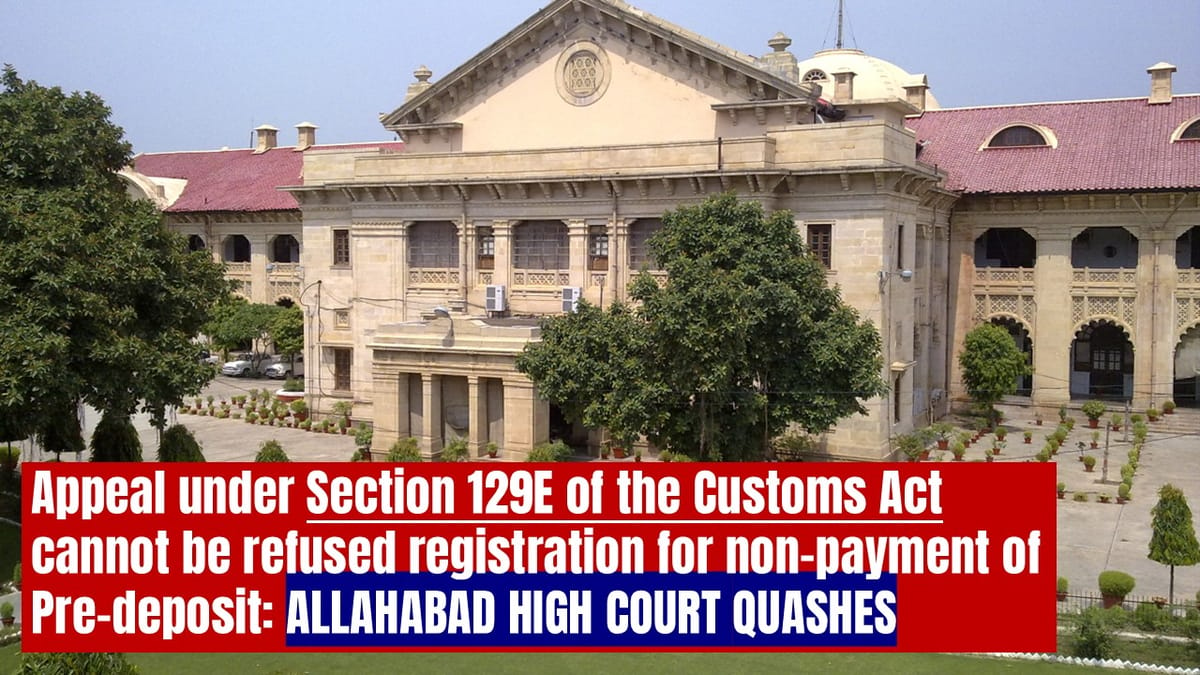

Custom: An Appeal Cannot Be Rejected at the Filing Stage merely For Non-Payment of Pre-Deposit
Petitioners such as M/s Runway Impex & Ors were indulging in business activities regarding the import-export process. Petitioners were under a Common Order in Original issued by the Appellate Authority under the Customs Act, 1962, and were imposed with heavy penalties. The petitioners wanted to take an appeal against these adjudication orders in front of the Commissioner (appeals). They were unable to proceed with their appeals since they had not made the statutory deposit of 7.5% of the amount of the disputed demand under the Act. The petitioners approached the High Court, contending that they should at least be allowed to file and register their appeals and thereafter seek waiver of the pre-deposit condition. The revenue argued that unless the pre-deposit was made, the appeal could not even be entertained or registered.

Issue Raised: Whether an appeal under Section 129E of the Customs Act can be refused registration at the threshold for non-payment of the mandatory 7.5% pre-deposit, or whether it must first be filed and registered (even as defective) before considering such a requirement?
HC Held: The High Court allowed the writ petitions and held that the expression “entertain” used in Section 129E does not mean filing or registration of an appeal but refers to the stage when the appeal is taken up for consideration on merits. Accordingly, the Court ruled that authorities cannot refuse to accept or register an appeal merely because the pre-deposit has not been made at the time of filing. It is noted that there is the possibility that an appeal could be made and registered as a defective one, and at the time when the matter comes before the court for adjudication, it could be decided whether there was compliance with the condition of pre-deposit.

High Court also said that it has been held by the Supreme Court that statutory authorities cannot waive the pre-deposit condition, whereas High Courts can under Article 226 of the Constitution.
Accordingly, the Court directed that the petitioners’ appeals be accepted, numbered, and registered without insisting on pre-deposit at the filing stage, with liberty to consider the issue of compliance at the appropriate stage. It also protected the petitioners from limitation, provided the appeals are filed within four weeks.
To Read Full Judgment, Download PDF Given Below.

In case of any Doubt regarding Membership you can mail us at [email protected]
Join Studycafe's WhatsApp Group or Telegram Channel for Latest Updates on Government Job, Sarkari Naukri, Private Jobs, Income Tax, GST, Companies Act, Judgements and CA, CS, ICWA, and MUCH MORE!"