Meetu Kumari | May 20, 2026 |
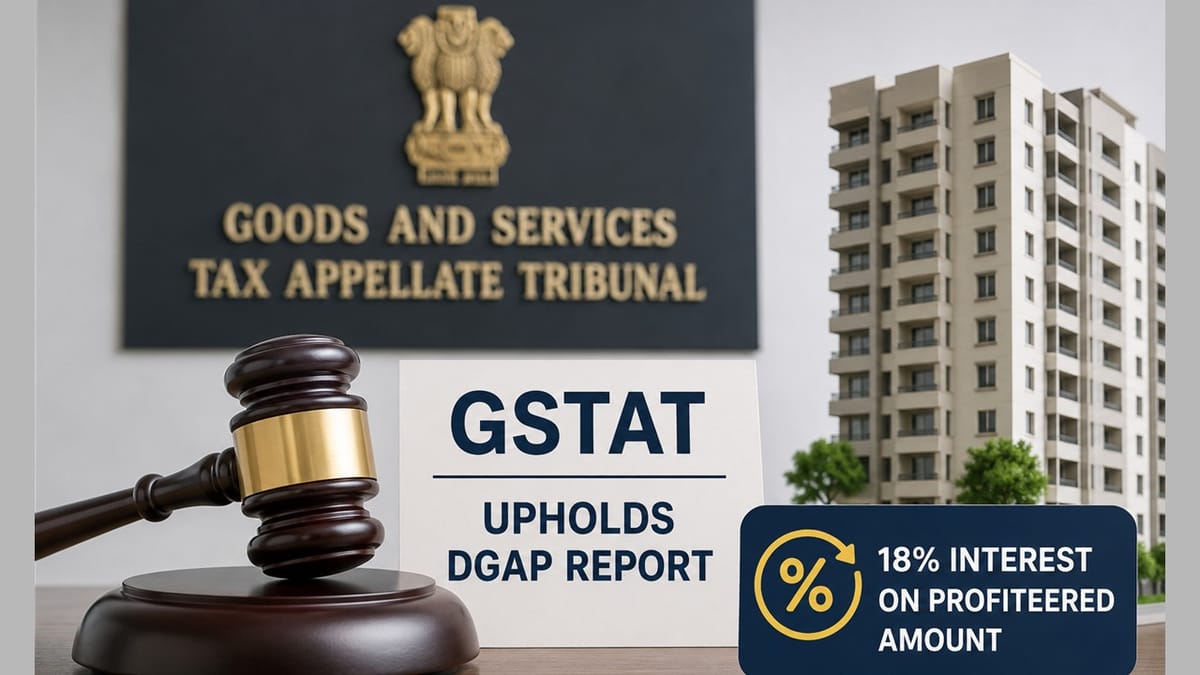

GSTAT Upholds DGAP Report Against builder, Directs 18% Interest On Profiteered Amount
The Principal Bench of the Goods and Services Tax Appellate Tribunal (GSTAT) on 12 May 2026 upheld the anti-profiteering findings against Nandi Infratech Pvt. Ltd. in relation to its “Amaatra Homes” project and accepted the Director General of Anti-Profiteering’s (DGAP) report determining profiteering under Section 171 of the CGST Act, 2017. A Division Bench comprising Justice Mayank Kumar Jain (Judicial Member) and Anil Kumar Gupta (Technical Member) held that the Respondent was liable to pay interest at 18% on the profiteered amount from the date of collection till refund to eligible homebuyers. The Tribunal highlighted that:
“The Respondent is liable to pay interest on the profiteered amount at 18% from the date of collection of the higher amount till the date of the return of such amount as provided under Rule 133(3)(b) of CGST Rules, 2017.”

The proceedings originated from a complaint filed by a homebuyer, Shri Vijay Pal Singh, alleging that Nandi Infratech failed to pass on the benefit of additional Input Tax Credit (ITC) after implementation of GST in respect of Flat No. J-503 in the “Amaatra Homes” project situated at Greater Noida West. The matter was referred for investigation under Rule 128 of the CGST Rules, following which the DGAP conducted an investigation and submitted its report before the erstwhile National Anti-Profiteering Authority (NAA).
The original NAA order dated 31.08.2022 had held the Respondent guilty of profiteering. Subsequently, after the Delhi High Court’s ruling in Reckitt Benckiser India Pvt. Ltd. v. Union of India laid down a revised methodology for real estate anti-profiteering matters, the Competition Commission of India remanded the matter to the DGAP for fresh determination.

The DGAP, in its revised report dated 09.01.2025, examined the project consisting of residential and commercial towers and observed that out of 937 total units, 588 units booked during the pre-GST regime were covered under investigation. It computed the additional ITC benefit available post-GST at 2.88% and determined the profiteered amount at Rs. 1.72 crore. However, after considering documentary evidence such as credit notes and no-dues certificates issued to homebuyers, the DGAP concluded that the Respondent had already passed on Rs. 5.89 crore as ITC benefit and only Rs. 14.79 lakh remained to be passed on to certain eligible buyers.
“Each home-buyer is entitled for commensurate benefit.”
Before the Tribunal, the Respondent challenged the methodology adopted by the DGAP and argued that ITC cannot automatically be treated as profit. It also contended that inflation, cost escalation, stage-wise construction, transitional credit adjustments and ITC reversals were ignored during computation. However, during the proceedings, the Respondent ultimately submitted that, without prejudice to its rights and only to bring quietus to the prolonged dispute, it was willing to accept the DGAP report.
The Tribunal observed that the grievances raised by certain buyers relating to cancellation of allotment, retention of money and interest claims did not fall within the scope of Section 171 of the CGST Act and such disputes could be agitated before appropriate forums like RERA or consumer authorities.
Accepting the revised DGAP findings, the GSTAT held that the Respondent had contravened Section 171 of the CGST Act by indulging in profiteering and confirmed the liability to pass on the remaining benefit along with interest.
To Read Full Order, Download PDF Given Below.

In case of any Doubt regarding Membership you can mail us at [email protected]
Join Studycafe's WhatsApp Group or Telegram Channel for Latest Updates on Government Job, Sarkari Naukri, Private Jobs, Income Tax, GST, Companies Act, Judgements and CA, CS, ICWA, and MUCH MORE!"