ITAT holds share losses taxable under the capital gains head, recognising long-standing investor status.
Meetu Kumari | Jun 12, 2026 |
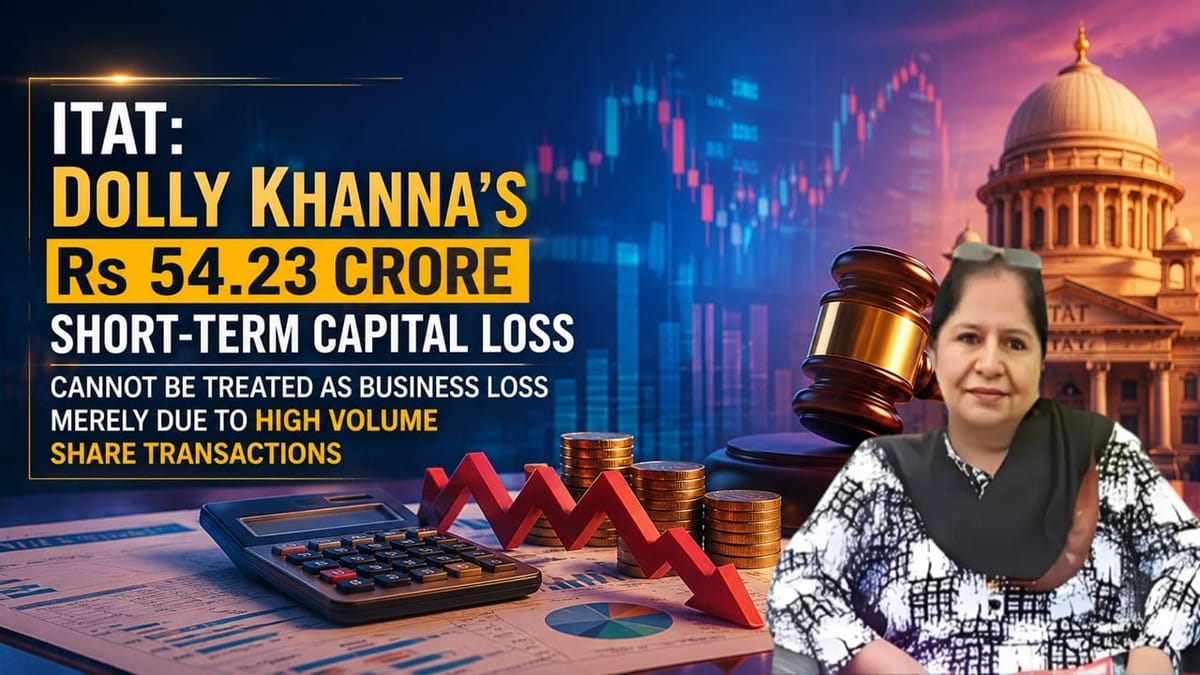

ITAT: Dolly Khanna’s Rs 54.23 Crore Short-Term Capital Loss Cannot Be Treated as Business Loss Merely Due to High Volume Share Transactions
The assessee, Dolly Khanna, a long-time investor in shares, securities and mutual funds, filed her return for AY 2020-21 declaring income of Rs 14.26 crore. During scrutiny, the Assessing Officer noticed that she had reported a short-term capital loss of Rs 54.23 crore and a long-term capital loss of Rs 37.35 crore. According to the department, the large volume and frequency of transactions indicated that she was engaged in share trading rather than investment activity. On this basis, the AO reclassified the short-term capital loss as a business loss while continuing to treat the long-term capital loss under the head “Capital Gains“. The CIT(A) upheld the action, even observing that the assessee was a well-known stock market expert and actively involved in stock trading.

Before the Tribunal, the assessee argued that for more than twenty-five years she had consistently treated shares as investments and reported gains or losses under the head “Capital Gains”. The department had accepted this position in earlier years, including scrutiny assessments. She further pointed out that all investments were made from her own funds, no business infrastructure or trading set-up existed, no business expenditure or STT deduction had ever been claimed, and the average holding period of the portfolio was about 580 days. The assessee also explained that the unusually high transactions in March 2020 were triggered by the COVID-19 market crash and were undertaken merely to minimise losses and protect the investment portfolio.
The Tribunal found substantial merit in the assessee’s case. It noted that the Revenue had consistently accepted her status as an investor for several years and there was no change in facts warranting a different view for the year under consideration. Relying on principles laid down in cases such as Radhasoami Satsang v. CIT and CIT v. Gopal Purohit, the Tribunal held that the rule of consistency applied squarely. It further observed that CBDT Circular No. 6/2016 permits taxpayers to consistently treat listed shares as investments and that such a stand cannot be disturbed without valid reasons.

The Tribunal also held that volume and frequency of transactions alone cannot convert an investor into a trader. The shares were consistently shown as investments in the books, no borrowed funds were used, no business establishment existed, and all transactions were delivery-based. The explanation regarding panic selling during the COVID-19 market collapse was found reasonable and consistent with prudent investment management rather than trading activity.
A significant factor noticed by the Tribunal was the internal inconsistency in the assessment order itself. While the AO treated the short-term capital loss as business loss, the long-term capital loss arising from the same investment portfolio was accepted as capital loss. According to the Tribunal, both could not be viewed differently when they originated from the same investment activity.
The Tribunal also criticised the CIT(A) for relying on a “Google search” to describe the assessee as a renowned stock market expert without confronting such material to the assessee. It held that reliance on extraneous material collected behind the assessee’s back violated principles of natural justice and had no relevance in determining the correct head of income.
Thus, the Tribunal held that the assessee was an investor and not a trader in shares and securities. The short-term capital loss of Rs 54.23 crore was directed to be assessed under the head “Capital Gains” and allowed to be carried forward in accordance with law. The appeal of the assessee was allowed.
To Read Full Order, Download PDF Given Below.

In case of any Doubt regarding Membership you can mail us at [email protected]
Join Studycafe's WhatsApp Group or Telegram Channel for Latest Updates on Government Job, Sarkari Naukri, Private Jobs, Income Tax, GST, Companies Act, Judgements and CA, CS, ICWA, and MUCH MORE!"