A practical guide explaining when tax audit is applicable under Section 44AB, and how it interacts with presumptive taxation provisions like Sections 44AD, 44ADA, and 44AE.
Vanshika verma | Jun 24, 2026 |
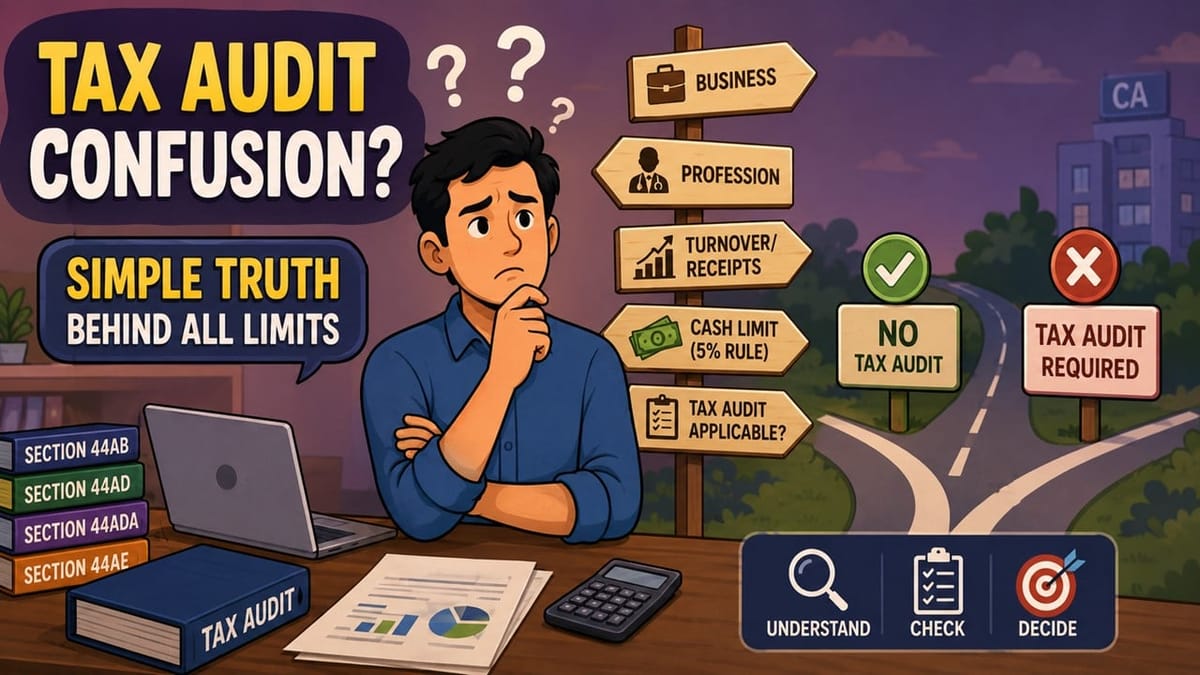

Tax Audit Confusion? Here’s the Simple Truth Behind All Limits
One of the most common questions among business owners, professionals, tax practitioners, and CA students is whether a Tax Audit is required in a particular case.
Many people think the rule is simple: if business turnover exceeds Rs 1 crore, Tax Audit becomes compulsory. Others know about the higher limit of Rs 10 crore and assume that no audit is needed unless turnover crosses that amount. Some taxpayers also believe that by choosing presumptive taxation under Sections 44AD or 44ADA, they can always avoid a Tax Audit.

However, the actual law is more complicated.
The requirement of Tax Audit under Section 44AB depends on several factors. These include the type of activity being carried on (business or profession), the turnover or gross receipts, the amount of cash transactions, whether the taxpayer is eligible for presumptive taxation, and the income declared by the taxpayer.
Because of these conditions, two businesses with the same turnover may have different Tax Audit requirements. Similarly, a professional earning Rs 60 lakh may be governed by different rules than a business owner with a turnover of several crores.

The confusion has increased in recent years because the government has introduced higher limits under different provisions. For example, the Tax Audit turnover limit for certain businesses can go up to Rs 10 crore if cash transactions remain within specified limits. At the same time, the presumptive taxation limit under Section 44AD has been increased to Rs 3 crore, and under Section 44ADA to Rs 75 lakh in eligible cases.
Many taxpayers mistakenly think that these limits are the same or can be used interchangeably. In reality, each limit applies to a different provision and serves a different purpose. Let’s understand tax audits in detail:
Tax Audit as a Compliance of Section 44AB is not only a Legal Requirement. The main object of the Act is to ensure that the taxpayers keep proper books of account, compute their taxable income correctly and comply with the Income-tax Act. During the audit, the books of account are checked by a Chartered Accountant, and CA reports important financial and tax-related information to the Income Tax Department in the prescribed format. This process helps to improve tax compliance, reduce reporting errors and increase transparency in financial records. However, Tax Audit is not mandatory for all the taxpayers. There are certain turnover limits and conditions under the Income-tax Act, which determine whether an audit is necessary.
Therefore, before looking at the various turnover thresholds, it is important to understand that Tax Audit applicability depends mainly on the category of taxpayer and the specific provisions that apply to them.
For easy understanding, Tax Audit cases can be grouped into five main categories:
| Category | Relevant Section |
| Business (Normal Provisions) | Section 44AB |
| Profession (Normal Provisions) | Section 44AB |
| Presumptive Business | Section 44AD |
| Presumptive Profession | Section 44ADA |
| Goods Carriage Business | Section 44AE |
The first step in deciding whether a Tax Audit is required is to identify which category the taxpayer falls under. Once the correct category is identified, the applicable turnover limits and other conditions can be checked to determine whether a Tax Audit is necessary.
A person carrying on a business is required to get their accounts audited under Section 44AB if their total sales, turnover, or gross receipts exceed the prescribed limit during the financial year.
Normally, the tax audit threshold for businesses is Rs1 crore. Therefore, if the turnover exceeds Rs1 crore, a tax audit becomes applicable.
However, to encourage digital transactions, the government has increased this limit to Rs10 crore for businesses that have minimal cash transactions.
The enhanced limit of Rs 10 crore can be claimed only if:
Both of the above conditions must be satisfied.
Section 44AD is a very useful provision for small businesses. Its main purpose is to reduce the compliance burden on eligible taxpayers. Under this scheme, taxpayers are not required to maintain detailed books of account or get their accounts audited in certain situations.
However, Section 44AD is often misunderstood. Many people think that once they choose this scheme, the Tax Audit provisions will never apply to them. This is not true. Whether a Tax Audit is required or not depends on various conditions and must be examined carefully.
The scheme is available only to Resident Individuals, Resident Hindu Undivided Families (HUFs), and Resident Partnership Firms. Limited Liability Partnerships (LLPs) cannot opt for Section 44AD. In addition, businesses earning income through commission, brokerage, agency work, or certain specified activities are not eligible for this scheme.
Before understanding the Tax Audit implications, it is important to know the turnover limits under Section 44AD.
Normally, a business can opt for Section 44AD if its turnover or gross receipts do not exceed Rs 2 crore during the financial year. To encourage digital transactions, the Government has increased this limit to Rs 3 crore. The higher limit is available only if cash receipts do not exceed 5% of the total turnover or gross receipts during the year.
It is important not to confuse the Rs3 crore limit under Section 44AD with the Rs10 crore limit under Section 44AB. The Rs 3 crore limit decides whether a business is eligible to opt for the presumptive taxation scheme. On the other hand, the Rs 10 crore limit is used to determine the applicability of Tax Audit in certain business cases. Both limits serve different purposes and should be understood separately.
If either of these conditions is not met, the benefit of the higher threshold is not available, and the normal tax audit limit of Rs 1 crore will apply.
When a taxpayer opts for Section 44AD, income is presumed at the following rates:
Digital Receipts: 6% of turnover
Cash Receipts: 8% of turnover
A taxpayer can always declare a higher income if the actual profit is more than these prescribed percentages.
However, a taxpayer may sometimes wish to declare income lower than the presumptive rates of 6% or 8%. In such cases, the provisions of Section 44AD(4) and Section 44AD(5) need to be carefully considered.
Where a taxpayer declares income less than the prescribed presumptive income and his aggregate income exceeds the basic exemption limit, he may be required to maintain proper books of account and have his accounts audited under the Income-tax Act. Thus, taxpayers should not presume that opting for Section 44AD will always spare them from tax audit requirements. If the income is declared lower, then the provisions relating to Section 44AD and lock-in need to be examined to ascertain whether books of account and tax audit provisions are applicable.
To make tax compliance easier for small professionals, the Income-tax Act provides a special scheme called Section 44ADA.
This scheme can be used only by:
LLPs (Limited Liability Partnerships) cannot use this scheme.
It is available for certain professions such as:
Under normal tax rules, a professional must get a Tax Audit done if their gross receipts exceed Rs 50 lakh.
However, Section 44ADA offers a simpler option. Eligible professionals can declare their income on a presumptive basis instead of maintaining detailed books and going through a tax audit.
Normally, a professional can opt for Section 44ADA if their gross receipts are up to Rs 50 lakh.
A higher limit of Rs75 lakh is available if cash receipts are not more than 5% of total receipts, meaning most payments are received through banking or digital modes.
This increase in the limit has allowed more professionals to benefit from the simplified presumptive taxation scheme.
Under section 44AE, there is a special scheme of presumptive taxation for small taxpayers carrying on the business of plying, hiring or leasing goods vehicles. Its purpose is to simplify tax compliance by eliminating the need to maintain detailed books of account and compute actual profits. The scheme is only available on the condition that the taxpayer does not possess more than ten goods vehicles at any time in the financial year. In the case of sections 44AD and 44ADA income is calculated as a percentage of turnover or receipts. Section 44AE calculates the income on the basis of number and type of vehicles owned.
Under this scheme, presumptive income is determined as follows:
The income calculated under these rules is treated as the taxable business income of the taxpayer under Section 44AE.
| Particulars | 44AB | 44AD | 44ADA | 44AE |
| Applicable To | Business | Small business | Professionals | Goods transport business |
| Basic Limit | Rs 1 Cr /Rs50 Lakh | Rs 2 Cr | Rs 50 Lakh | Not turnover based |
| Higher Limit | Rs 10 Cr | Rs 3 Cr | Rs 75 Lakh | Not applicable |
| Digital Transactions | Yes | Yes | Yes | No |
| Presumptive Income | Not applicable | 6% / 8% | 50% | Fixed per vehicle |
| LLP Allowed | Yes | No | No | Yes |
| Audit Condition | Based on turnover | If profit < 6%/8% | If profit < 50% | If below fixed limits |
A common mistake is confusing the Rs3 crore limit under Section 44AD with the Rs10 crore limit under Section 44AB for tax audit purposes.
Another mistake is thinking that all professionals can also use the Rs10 crore limit. This is not true, as it applies only in certain business cases and not to professionals.
Many taxpayers wrongly believe that once they choose Section 44AD or 44ADA, a tax audit can never apply. In reality, if income is shown lower than the required limit or other conditions are not met, a tax audit may still be required.
Some taxpayers also ignore the rule related to cash transactions (5% condition) while checking eligibility for higher limits.
These mistakes can lead to non-compliance and may result in penalties.
To determine whether a tax audit is applicable, you should follow a step-by-step approach.
First, identify whether the activity is a business or a profession. Then check if presumptive taxation provisions apply. After that, verify the turnover or gross receipts involved and examine the proportion of cash receipts and cash payments. You should also consider whether any higher threshold limits are available in the given case. Next, check if the income declared is lower than the prescribed presumptive rates. It is also important to see whether the total income exceeds the basic exemption limit. Finally, apply the relevant provisions of Section 44AB to conclude whether a tax audit is required.
This systematic approach helps ensure accurate determination of tax audit applicability in most practical situations.

In case of any Doubt regarding Membership you can mail us at [email protected]
Join Studycafe's WhatsApp Group or Telegram Channel for Latest Updates on Government Job, Sarkari Naukri, Private Jobs, Income Tax, GST, Companies Act, Judgements and CA, CS, ICWA, and MUCH MORE!"