A Registered Will Alone Cannot Prove Authenticity, Rules Gujarat High Court:
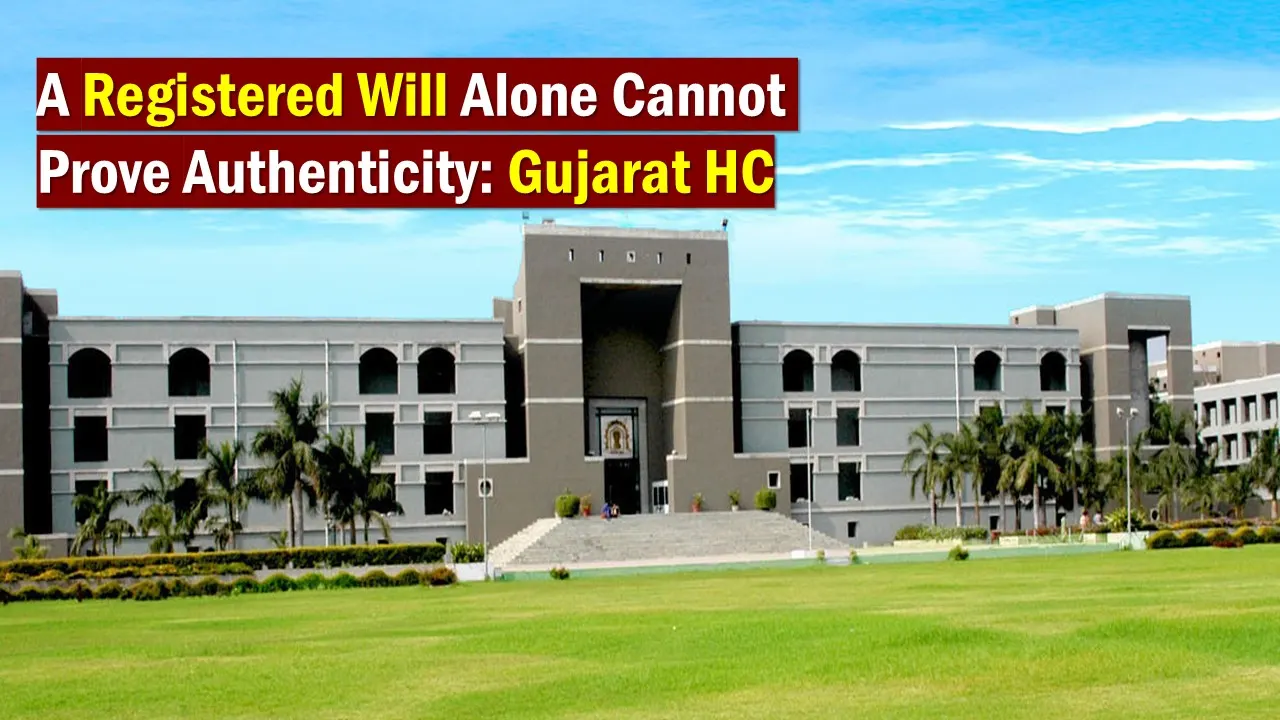
The Gujarat High Court held that merely registering a Will is not enough to prove its genuineness if there are suspicious circumstances surrounding its execution.
HC Sets Aside Probate in Suspicious Will Case
 Saloni Kumari
 May 7, 2026
A Registered Will Alone Cannot Prove Authenticity, Rules Gujarat High Court
The High Court of Gujarat set aside a probate order in a long-running family property dispute between two brothers over a house in Ahmedabad, holding that merely registering a Will is not enough to prove its genuineness if there are suspicious circumstances surrounding its execution.
A will is a legal document that decides who will inherit a property after the death of its owner. The dispute in the present case concerns a Will which was allegedly made by the late Shri Ramchandra just a week before his death in July 1981.
One brother, Bhaskar Pednekar, claimed that his father legally wrote a Will prior to his death, giving him the entire ownership of their family house in Bapunagar. Consequently, based on the will, he approached the court seeking probate (it is a legal process performed by the court where a deceased person's will is validated and ownership rights of the property are shifted to the beneficiary). When the court analysed the case, the will was initially accepted, and ownership rights of property in Bapunagar were transferred to Bhaskar Pednekar.
The other brother, Harishchandra Pednekar, being dissatisfied with the court's decision, argued that the Will was fraudulent and was clearly illegally made just to take control over his father's property. He explained that his father was suffering from Jaw and Tongue cancer and had also undergone treatment and surgery just before his death. Hence, he assured the court that at that point, his father was neither physically nor mentally fit to make such a major decision to make a Will.
When the court analysed the arguments served by Harishchandra Pednekar, it found several suspicious circumstances concerning the Will. The court noticed contradictions in the testimonies of witnesses about how and when the Will was signed. It was further noted that the Will mentioned only one property while ignoring all other assets and family members.
The High Court observed that simply proving signatures on a Will is not enough if serious doubts exist about its authenticity. The judge ruled that the person relying on the Will failed to remove these doubts convincingly. In conclusion, the High Court cancelled the earlier probate order and dismissed the probate proceedings.
About Author


Saloni Kumari
Content Writer
Saloni is a Content Writer with 2+ years of experience at studycafe.in. She writes legal, taxation, and finance related content including GST, Income Tax etc. Skilled in translating complex judicial pronouncements and regulatory developments into clear, and reader-friendly articles. Experienced in covering judgements of ITAT, High Court, GSTAT, and news related to Income Tax, GST, and corporate law. She can be reached at [email protected].
Saloni is a Content Writer with 2+ years of experience at studycafe.in. She writes legal, taxation, and finance related content including GST, Income Tax etc. Skilled in translating complex judicial pronouncements and regulatory developments into clear, and reader-friendly articles. Experienced in covering judgements of ITAT, High Court, GSTAT, and news related to Income Tax, GST, and corporate law. She can be reached at [email protected].
 StudyCafe
 Delhi, Delhi, India
 2954
2954My Recent Articles
- CBDT Clarifies BSNL, MTNL VRS-2019 Compensation Taxable Under Section 10(10C), Not 10(10B)
- Govt Extends Deadline for Raw Sugar Customs Duty Exemption upto December 31
- ITAT Deletes Section 69A Addition as Income Computation Supports Source of Cash Deposits
- Short Compliance Window Prompts ITAT to Allow Additional Evidence in Unsecured Loan Case
- ITAT Deletes Section 68 Unexplained Cash Credit Addition as NSEL Account Was Opened After FY 2011-12
Up Next
Loading suggestions…


Recent Posts

All Posts

Recent Posts
All Posts