Section 148 Notice Issued After 3 Years Requires Mandatory Approval From PCCIT or CCIT, Rules ITAT:
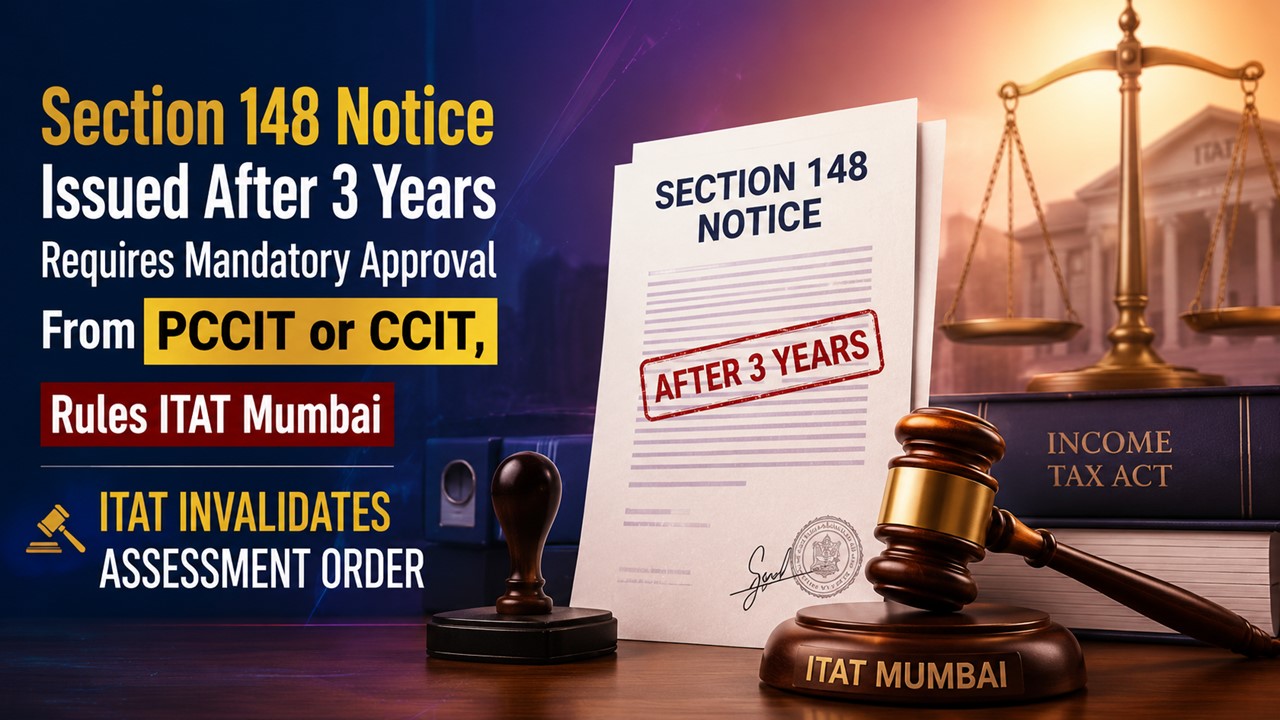
The ITAT holds that a Section 148 notice issued after three years from the end of the relevant AY requires prior approval from the PCCIT or CCIT under Section 151(ii).
Improper Sanction Under Section 151(ii) Makes Reassessment Void: ITAT
 Saloni Kumari
 May 30, 2026
Premium
Section 148 Notice Issued After 3 Years Requires Mandatory Approval From PCCIT or CCIT, Rules ITAT
The ITAT holds that a Section 148 notice issued after three years from the end of the relevant AY requires prior approval from the PCCIT or CCIT under Section 151(ii).
Also Read
ITAT Condones Over Two-Year Delay, Gives Taxpayer Fresh Opportunity to Contest Rs 1.30 Crore Property Sale AdditionITAT Sets Aside Ex Parte CIT(A) Order, Gives Assessee One More Opportunity to Prove Source of Rs 52.59 Lakh Cash DepositsSnowman Logistics Receives Rs 2.06 Crore Income Tax Demand for FY24, Plans to Challenge Penalty OrderBharat Bijlee Receives Rs 58.3 Lakh Income Tax Demand Over Excess Refund and Interest Re-Computation
About Author


Saloni Kumari
Content Writer
Saloni is a Content Writer with 2+ years of experience at studycafe.in. She writes legal, taxation, and finance related content including GST, Income Tax etc. Skilled in translating complex judicial pronouncements and regulatory developments into clear, and reader-friendly articles. Experienced in covering judgements of ITAT, High Court, GSTAT, and news related to Income Tax, GST, and corporate law. She can be reached at [email protected].
Saloni is a Content Writer with 2+ years of experience at studycafe.in. She writes legal, taxation, and finance related content including GST, Income Tax etc. Skilled in translating complex judicial pronouncements and regulatory developments into clear, and reader-friendly articles. Experienced in covering judgements of ITAT, High Court, GSTAT, and news related to Income Tax, GST, and corporate law. She can be reached at [email protected].
 StudyCafe
 Delhi, Delhi, India
 2853
2853My Recent Articles
- ED Arrests Two in Rs 734 Crore Fake GST ITC Fraud Case Involving 135 Bogus Firms
- ITAT Sets Aside Ex Parte CIT(A) Order, Gives Assessee One More Opportunity to Prove Source of Rs 52.59 Lakh Cash Deposits
- Skipper Limited Faces Rs 40.95 Crore GST Demand After Rectification of Rs 227.53 Crore SCN; Company Plans to Contest
- CBDT Circulars and Instructions Cannot Bind Courts on Income Tax Act Interpretation, Holds Supreme Court
- GST Reform: Pharma, Textiles, EVs and Other Sectors Seek Relief from Accumulated ITC
Up Next
Loading suggestions…


Recent Posts


All Posts



Recent Posts
All Posts