Allahabad High Court Grants Bail in Rs 45.84 Crore Fake ITC Case Holding that Bail is Rule and Jail is Exception:
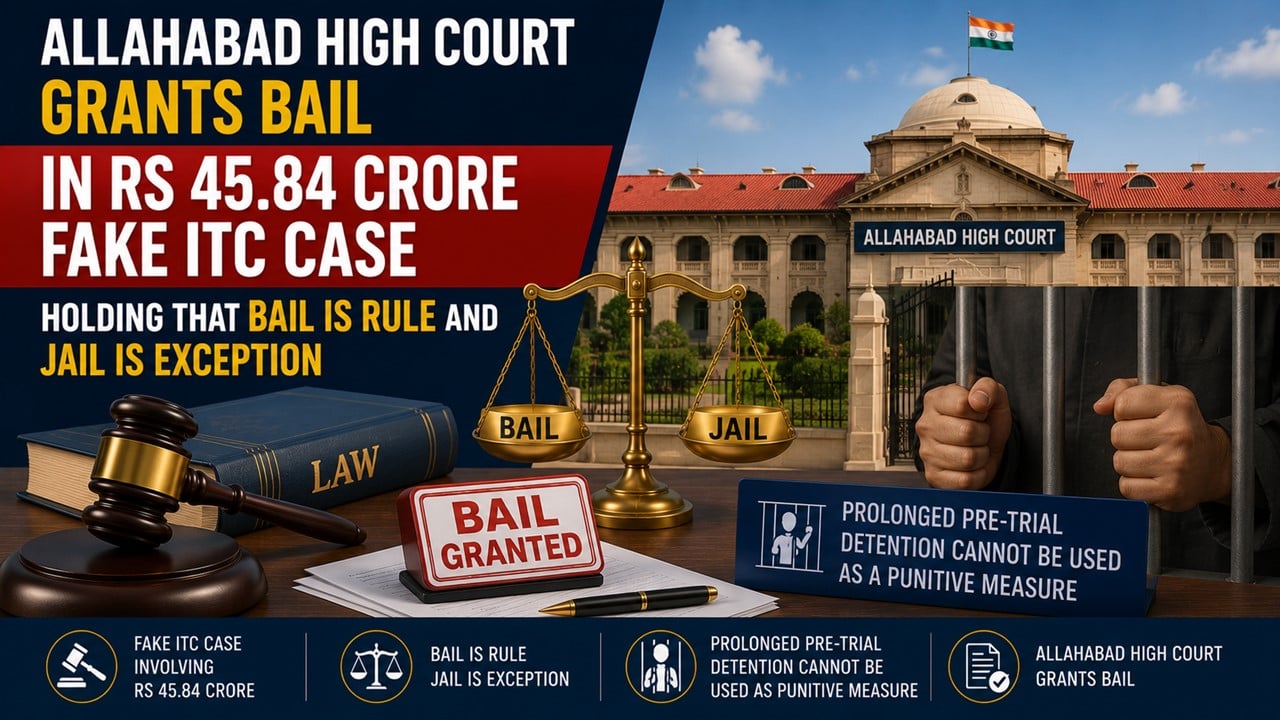
The Allahabad High Court has granted bail to an accused booked under Section 132 of the CGST Act in connection with an alleged fraudulent Input Tax Credit (ITC) racket.
Prolonged Pre-trial Detention Cannot be Used as a Punitive Measure
 Saima
Saima Jun 15, 2026
Allahabad High Court Grants Bail in Rs 45.84 Crore Fake ITC Case Holding that Bail is Rule and Jail is Exception
Allahabad High Court allowed the bail application and directed the release of the applicant on furnishing the requisite bonds and complying with the conditions imposed by the Court.
The prosecution alleged that the applicant was involved in creating and managing several fake entities through which he issued GST invoices without actual supply of goods and services, resulting in fraudulent availment and passing of Input Tax Credit amounting to Rs 45.84 crore. Investigation revealed common IP addresses, common principal places of business and interlinked bank transactions among several firms that were controlled by the applicant.
The Department contended that the applicant had committed offences under Sections 132(1)(b) and 132(1)(c), punishable under Section 132(1)(i) of the Central Goods and Services Tax Act, 2017. During the search, officials recovered documents and handwritten records that indicated sale and purchase of bills. On behalf of the applicant, it was argued that no proceedings under Sections 73 or 74 of the CGST Act had been initiated for determination of tax liability and that the applicant had no past criminal record. It was further submitted that he had remained in custody since 19 November 2025 and that the investigation had already concluded.
The Court noted that the prosecution case majorly rested upon documentary evidence, GST portal data, digital footprints, bank transactions and WhatsApp communications. The court relied on Supreme Court decisions in Sanjay Chandra Vs CBI, Ratnambar Kaushik Vs Union of India and Manish Sisodia Vs Enforcement Directorate to emphasize that every accused enjoys a presumption of innocence until proven guilty.
It further noted that the maximum punishment prescribed under Section 132 of the CGST Act is five years, the matter is triable by a Magistrate, the applicant had no previous criminal history and no material had been produced to show that he would tamper with evidence or influence witnesses. Consequently, the court put emphasis on the Bail is Rule and Jail is Exception principle and granted bail to the accused.

About Author


Saima
Content Writer
Saima is a Law graduate with a passion for research and content writing. She writes for Finance, Taxation and Legal Updates at Studycafe.in, simplifying complex legal decisions by the ITAT, High Court, AAR and GSTAT into uncomplicated and clear explanations.
Saima is a Law graduate with a passion for research and content writing. She writes for Finance, Taxation and Legal Updates at Studycafe.in, simplifying complex legal decisions by the ITAT, High Court, AAR and GSTAT into uncomplicated and clear explanations.
 StudyCafe
 Delhi, Delhi, India
 519
519My Recent Articles
- ITAT Holds SBI Not in Default for Non-Deduction of TDS on LFC During Interim Protection
- High Court Holds GST Notices and Orders Valid Despite No Visible Digital Signature
- ITAT Remits Rs.49.55 Lakh Agricultural Income Addition to CIT(A)
- ITAT Remits Profit Estimation and Salary Disallowance Matter for Fresh Adjudication
- ITAT Deletes Additions Against Jaya Bachchan Over Alleged Noida Property Cash Receipt
Up Next
Loading suggestions…


Recent Posts

All Posts

Recent Posts
All Posts