Belated Employee PF/ESI Contributions Not Deductible Even if Made Before ITR Filing Deadline: ITAT Upholds SC's Ruling:
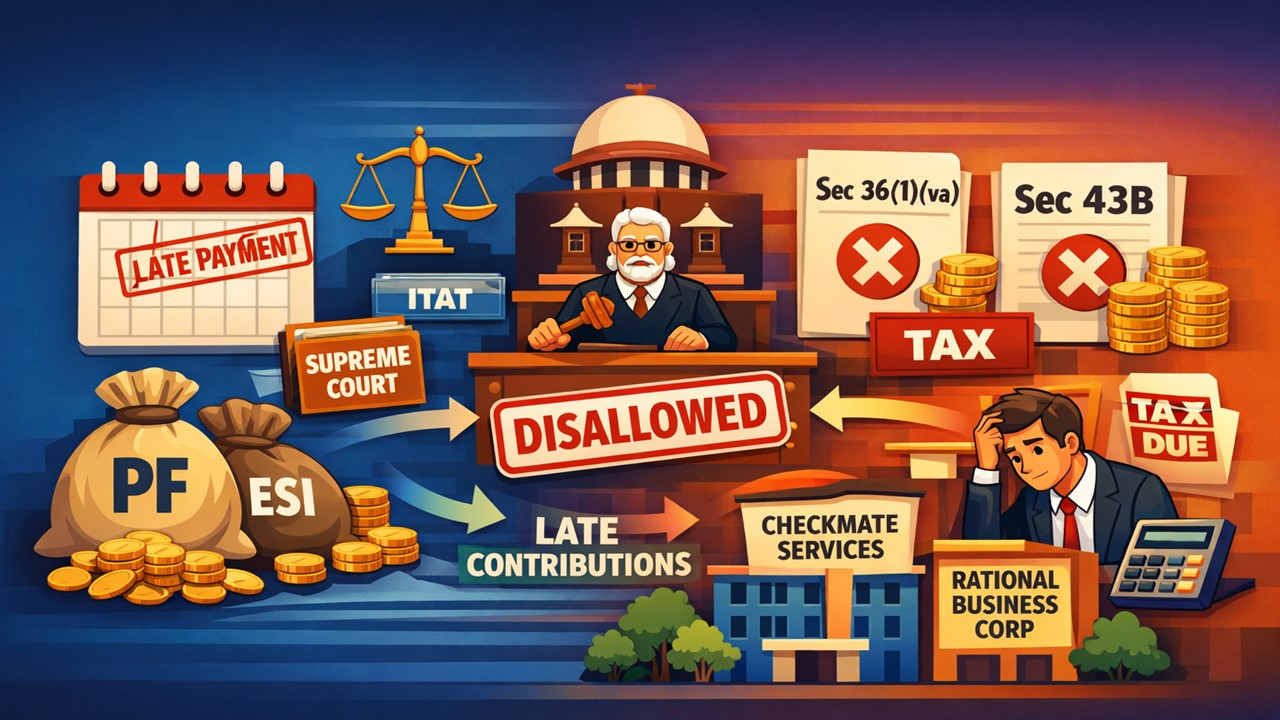
ITAT upheld that failure to deposit the employee contributions within the specified due date would result in disallowance of deduction.
ITAT Confirms Supreme Court’s Checkmate Services Ruling
 Nidhi
Nidhi Jan 27, 2026
Belated Employee PF/ESI Contributions Not Deductible Even if Made Before ITR Filing Deadline: ITAT Upholds SC's Ruling
The Income Tax Appellate Tribunal (ITAT), Delhi, has upheld the Supreme Court's Order, which stated that the late payments of employees' contributions to the PF and ESI are disallowed as deduction even if they are made before the Filing of the tax return.
The assessee company, Rational Business Corporation Private Limited, filed two appeals before the Income Tax Appellate Tribunal (ITAT) challenging the disallowance of the late payments of employees' contribution to the PF (Provident Fund) and ESI (Employee State Insurance) for assessment years 2018-19 and 2019-20. These payments were made after the due date for contributions but were deposited before the due date of filing the income tax return (ITR).
The company submitted that the issue of allowing the PF and ESI payments after the due date was resolved in 2022 by the Supreme Court in the case of Checkmate Services (supra), and its return was processed in 2019.
The Supreme Court, in its Checkmate Services case (supra), held that the belated employee contributions to PF/ESI are not deductible under Section 36(1)(va) of the Income Tax Act even if they are paid before the tax filing deadline. Here, the Apex Court had clarified that employee contributions to PF and ESI are governed only by Section 36(1)(va) of the Act and not by Section 43B of the Income Tax Act.
The company argued that before this ruling of the Supreme Court, the issue was debatable and outside the purview of Section 143(1)(a) of the Act. However, the Income Tax Department argued that the Checkmate Services Case would not apply prospectively from 2022.
The ITAT dismissed the appeals of the company, upholding the Supreme Court's ruling in the Checkmate Services Case, which stated that failure to deposit the employee contributions within the specified due date would result in disallowance of deduction.
The Tribunal held that the special provisions of 6(1)(va) of the Income Tax Act override the general provisions of Section 43B of the Income Tax Act.
The Tribunal also clarified that the Supreme Court's interpretation of the law has a retrospective effect unless the ruling specifically says that it should apply prospectively. Therefore, the Supreme Court's ruling in the Checkmate Services Case would apply retrospectively, which means that it applies to past cases as well, even if the judgment came after the assessment order.
About Author


Nidhi
Content Writer
Nidhi is a skilled content writer specializing in personal finance. She creates clear, engaging articles on mutual funds, investments, insurance, and wealth-building strategies. With a passion for simplifying complex financial topics, Nidhi helps readers make informed money decisions with confidence. She can be reached at [email protected]
Nidhi is a skilled content writer specializing in personal finance. She creates clear, engaging articles on mutual funds, investments, insurance, and wealth-building strategies. With a passion for simplifying complex financial topics, Nidhi helps readers make informed money decisions with confidence. She can be reached at [email protected]
 Studycafe
 New Delhi, Delhi, India
 1832
1832My Recent Articles
- Karnataka High Court Gives Another Chance in GST Matter Due to Lack of Hearing
- Delay Should Be Condoned if Explanation is Unrefuted: ITAT
- Non-Service of Income Tax Notice, Ill health of taxpayer, ITAT condones Appeal filing delay
- Books of Accounts Cannot be Rejected Without Any Specific Defect: ITAT Kolkata
- Karnataka High Court Sends ITC Matter Back to GST Authorities for Reconsideration
Up Next
Loading suggestions…


Recent Posts

All Posts


Tags
Recent Posts
All Posts