Bombay HC Rules Corporate Guarantees Without Consideration Not Taxable Under GST:
The HC holds that corporate guarantees issued to subsidiaries without consideration do not qualify as taxable “supply” under GST, and quashes the related summons and SCN.
HC Quashes GST Proceedings Against Company
 Saloni Kumari
 May 11, 2026
Bombay HC Rules Corporate Guarantees Without Consideration Not Taxable Under GST
The Bombay High Court held that corporate guarantees issued by D.P. Jain & Co. to subsidiaries without consideration did not qualify as a taxable “supply” under GST. Accordingly, it quashed the summons and SCN, while upholding Rule 28(2) of the CGST Rules.
The writ petition had been filed in the Bombay High Court by D.P. Jain & Co. Infrastructure Private Limited (Petitioner). The key dispute relates to corporate guarantees. In the present case, the company had provided guarantees to banks for credits taken by its subsidiaries for the purpose of highway and infrastructure projects. These guarantees were issued without charging any fee, commission, or consideration from the subsidiaries.
By referencing Circular No. 204/16/2023, dated October 27, 2023, and the changes introduced to Rule 28 of the Central Goods and Services Tax Rule, 2017, the tax authorities initiated proceedings against the company. According to the government, providing a corporate guarantee to a concerned company is treated as a taxable supply of service under GST, even if no consideration is received.
As result, the tax authorities issued a summons and a show cause notice (SCN) raising GST demand on the guarantees. However, the company argued that the tax authorities cannot treat a corporate guarantee as a taxable service without consideration. To support its claim, the company also cited an earlier judgement of the Supreme Court in a case titled Commissioner of CGST & Central Excise v. Edelweiss Financial Services Limited, wherein the court had held that a taxable service cannot exist in the absence of consideration.
The company further claimed that these types of guarantees are only internal support arrangements between group companies and not commercial services. When the High Court analysed the facts of the case, it endorsed the company's arguments.
It observed that the company was involved in the business of providing guarantees and that the guarantees were issued only to support subsidiaries in obtaining loans. Since no consideration was received, the essential requirement of “supply” under GST law was missing. Therefore, the Court set aside the impugned summons and show-cause notice issued against the company. However, the Court refused to strike down Rule 28(2) of the CGST Rules, holding that courts generally do not interfere with tax policy decisions unless they are clearly unconstitutional.
About Author


Saloni Kumari
Content Writer
Saloni is a Content Writer with 2+ years of experience at studycafe.in. She writes legal, taxation, and finance related content including GST, Income Tax etc. Skilled in translating complex judicial pronouncements and regulatory developments into clear, and reader-friendly articles. Experienced in covering judgements of ITAT, High Court, GSTAT, and news related to Income Tax, GST, and corporate law. She can be reached at [email protected].
Saloni is a Content Writer with 2+ years of experience at studycafe.in. She writes legal, taxation, and finance related content including GST, Income Tax etc. Skilled in translating complex judicial pronouncements and regulatory developments into clear, and reader-friendly articles. Experienced in covering judgements of ITAT, High Court, GSTAT, and news related to Income Tax, GST, and corporate law. She can be reached at [email protected].
 StudyCafe
 Delhi, Delhi, India
 2879
2879My Recent Articles
- RBI Eases Foreign Exchange Compliance for Small Exporters and Freelancers
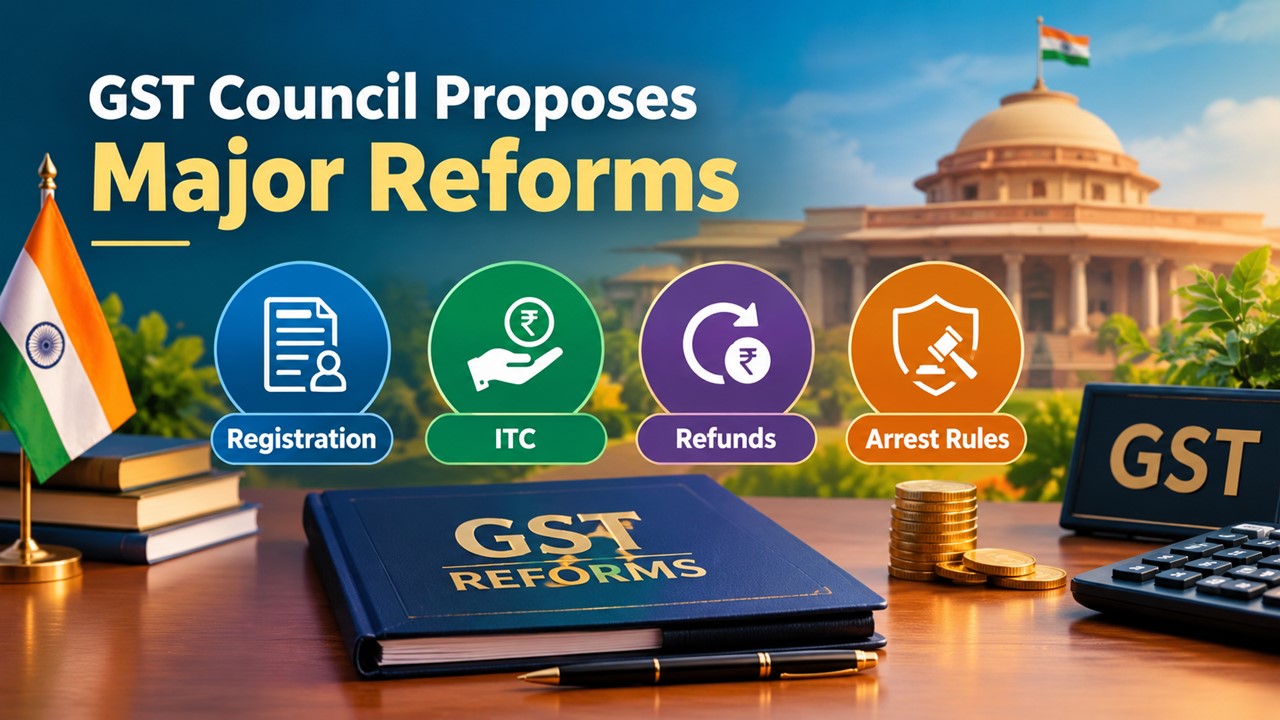
- GST Council Proposes Major Reforms in Registration, ITC, Refunds and Arrest Rules
- Govt Fixes 7.1% Interest Rate on Special Deposit Scheme for Non-Government PF Funds From Oct to Dec 2026
- CBI Apprehends Principal of Eklavya Model Residential School, Nuapada, for Demanding Rs 20,000 Bribe
- RBI Announces Exclusion of Paytm Payments Bank Limited from Second Schedule of RBI Act, 1934
Up Next
Loading suggestions…


Recent Posts

All Posts

Recent Posts
All Posts