CBDT Started MASS Dispatch of Scrutiny Notices for AY 2024-25; Know What You Should Do Immediately:
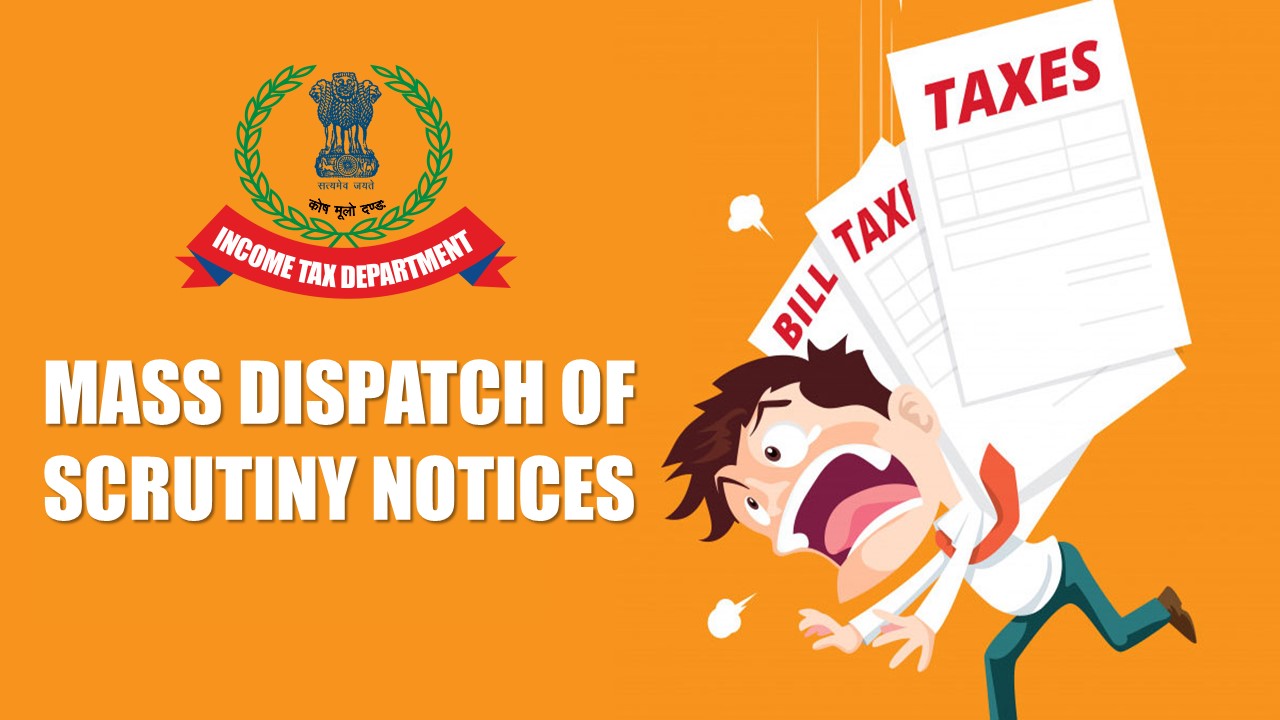
Mass scrutiny notices under Section 143(2) for AY 2024-25 are being issued due to AIS-ITR mismatches, unreported income, and filing errors. Here's what taxpayers need to know.
Mass Scrutiny Notices Triggered by ITR-AIS Mismatches for AY 2024-25
 Saloni Kumari
 Jun 28, 2025
CBDT Started MASS Dispatch of Scrutiny Notices for AY 2024-25; Know What You Should Do Immediately
The Central Board of Direct Taxes (CBDT) has started a MASS dispatch of Scrutiny Notices for the assessment year 2024-25 (income earned in the financial year 2023-24), based on recent real cases and guidelines. Here is the detailed and easy-to-understand breakdown:
1. What Is a Scrutiny Notice?
A scrutiny notice is a formal communication sent by the Income Tax Department under Section 143(2) of the Income Tax Act. Meaning, the income tax department wants to examine your income tax return (ITR) more closely and deeply in order to cross-check information. This is not because you have committed any crime or fraudulent activity; it is just to check if your return has any mismatches or errors.
2. Who Is Getting Picked This Time and Why?
This year, the income tax department is focusing more on not only businessmen or high-net-worth individuals but also salaried professionals and regular taxpayers. Numerous individuals who have received the income tax notices have one thing in common, i.e., there were discrepancies between their return (ITR) and the data mentioned in the Annual Information Statement (AIS) or Form 26AS. Common mistakes include:
- Individuals only displayed their salary income, and details such as mutual fund redemptions, dividends, or other incomes were missing in AIS.
- Numerous individuals ignored capital gains from mutual funds or shares.
- There were individuals who claimed deductions, such as deductions, but did not submit adequate proof for the same to their employers or disclose them properly in their tax returns.
- Several individuals also used the incorrect ITR form.
- In case I, an individual, redeemed Rs. 6 lakh from mutual funds, which was clearly registered in the Annual Information Statement (AIS). But his/her ITR displayed only his/her salary income; no capital gains were mentioned. This led to an investigation.
- In case II, there was another individual who had a total of Rs. 1.9 lakh in cryptocurrency (VDA) transactions, which were left out. The individual also claimed deductions such as 80D and 80G, but did not align them with other data as well.
- In case III, another individual filed an income tax return (ITR) form 1, even though he/she held foreign RSUs (stock units) in the US (foreign assets). Which is wrong: foreign assets must be disclosed in ITR-2/3 with full details mentioned.
- Check your email inbox for any message from [email protected].
- Visit the official Income Tax Portal of the IT department website: https://www.incometax.gov.in
- Download and carefully read the PDF notice.
- Look for the due date to respond; it is generally 15 to 30 days from the date on the notice.
- Download your Form 26AS, AIS (Annual Information Statement), and TIS (Taxpayer Information Summary) from the income tax portal.
- Compare each entry in these statements with what you declared in your ITR. Make a list of what you missed (if anything).
- Mutual Fund capital gains statement (from CAMS/Karvy)
- Salary slips and Form 16 (including perquisite details)
- Bank statements showing dividend income
- Receipts for deductions (insurance, donations, tuition fees, etc.)
- For filing a proper response, visit the official income tax portal; under ‘e-Proceedings,’ you will be able to see the option of submitting responses.
- There, upload your documents in PDF format and no zip files or RAR files.
- Clearly label your files, such as “MF Gains.pdf” and “Form 16.pdf.”

- Your ITR includes capital gains, foreign stocks or RSUs, or multiple sources of income (business, freelancing, investments).
- There is a large tax refund or big deductions claimed.
- You have made mistakes or omissions that now need to be explained in a structured and professional way.
- Do not respond casually to the scrutiny notices without proper consultation from a CA; otherwise, you may suffer penalties, reassessment, or a delay in refund.
- Your refund can be denied.
- Your deductions may be disallowed.
- The AO will calculate your tax liability based on assumptions.
- usually using the highest possible tax rates
- You could end up paying a lot more than you actually owe, just because of delay or non-response.
- When they file their response timely and complete.
- Submit proper documents.
- Maintain polite and logical communication.
- It is not a criminal charge; however, it is just a legal review process of your income tax return. Treat it that way.
- Always make sure to compare AIS, TIS, and Form 26AS with details filed in ITR before filing.
- Never ignore dividends, MF redemptions, or stock gains.
- If you have multiple income heads or capital gains, file ITR-2 or ITR-3 as required, not ITR-1.
- Notify RSUs, ESOPs, or foreign bank accounts in Schedule FA if applicable.
About Author


Saloni Kumari
Content Writer
Saloni is a Content Writer with 2+ years of experience at studycafe.in. She writes legal, taxation, and finance related content including GST, Income Tax etc. Skilled in translating complex judicial pronouncements and regulatory developments into clear, and reader-friendly articles. Experienced in covering judgements of ITAT, High Court, GSTAT, and news related to Income Tax, GST, and corporate law. She can be reached at [email protected].
Saloni is a Content Writer with 2+ years of experience at studycafe.in. She writes legal, taxation, and finance related content including GST, Income Tax etc. Skilled in translating complex judicial pronouncements and regulatory developments into clear, and reader-friendly articles. Experienced in covering judgements of ITAT, High Court, GSTAT, and news related to Income Tax, GST, and corporate law. She can be reached at [email protected].
 StudyCafe
 Delhi, Delhi, India
 2922
2922My Recent Articles
- GSTN Introduces New E-Invoicing Facility for Self-Invoices Under Reverse Charge Mechanism
- Flexi Cap vs Multi Cap Funds: What's the Real Difference?
- IBA Recommends Public Sector Banks to Reduce Ambit of Physical Branch Audits to 50% of Total Business
- ITAT Directs AO to Reconsider Rs 16.44 Lakh Capital Gains and Rs 25.87 Lakh Stamp Duty Value Addition
- ITAT Remands Rs 3.33 Crore Demonetisation Cash Deposit Case to AO, Directs Rs 10,000 Relief Fund Payment
Up Next
Loading suggestions…


Recent Posts


All Posts


Tags
Recent Posts
All Posts