E-Way Bill Just Got Smarter: Full Access Across Portals Now Live!:
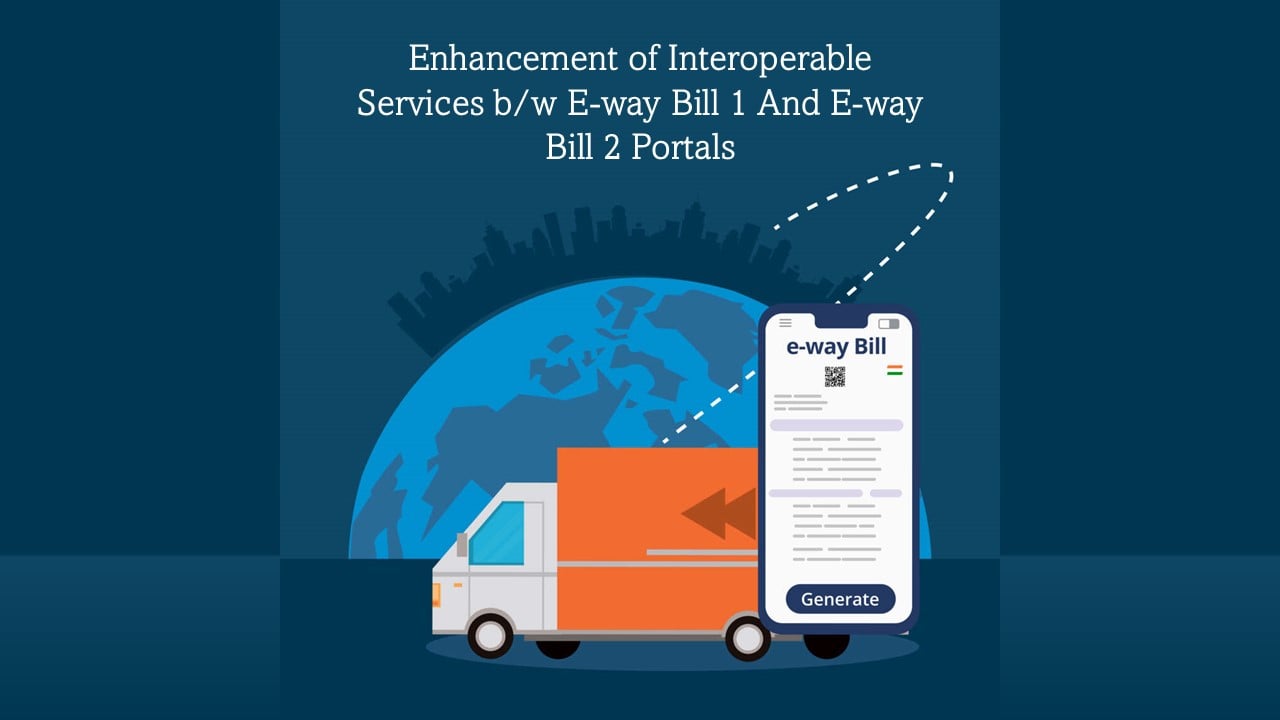
E-Way Bill portals are now fully interoperable, enabling seamless updates and actions from either portal anytime.
Enhanced E-Way Bill 1 and 2 Portal Integration, Full Feature Rollout
 Saloni Kumari
 Aug 20, 2025
Table of Contents

E-Way Bill Just Got Smarter: Full Access Across Portals Now Live!
The government has recently improved the functionality between the two E-Way Bill portals (E-Way Bill 1 and E-Way Bill 2) to ensure business continuity and flexibility during portal downtimes. Now, you can do first-time updates of Part B across portals, extend the validity of E-Way Bills from either portal, update transporter details from any portal, and perform all these operations without being forced to return to the original portal. These amendments have made it easier and more reliable to manage E-Way Bills in case of technical issues or emergencies.
Now (After August 2025 Enhancement):
So now, everything that could be done on one portal can be done from the other, giving users full flexibility
What Are E-Way Bill 1 and E-Way Bill 2 Portals?
The E-Way Bill portal is a digital platform used in India to generate electronic permits (called E-Way Bills), required for the movement of goods worth over a certain amount under GST. There are two E-Way Bill portals:- E-Way Bill 1: It is the main portal commonly used by the maximum number of people in India.
- E-Way Bill 2: It is an alternative or fallback portal, used by a select group of people in India.
Initial Interoperability Introduced (September 2024)
Previously, in September 2024, NIC introduced basic interoperability between these two portals. But originally, only limited operations were possible across portals: 1. Updating of Part B: This allowed individuals to update their vehicle details (Part B) of an existing E-Way Bill on the other portal, but only if Part B had already been updated once on the original portal. For instance, if you created an E-Way Bill on E-Way Bill 1 (portal 1), and its Part B was updated there only, then through the update, you were given permission to update it again from E-Way Bill 2. However, if you did not update Part B at all, you were not allowed to first update from the other portal. 2. Get EWB: This allowed individuals to view the E-Way Bill from the other portal.Enhancement Introduced in August 2025
Now, in August 2025, NIC has again made significant amendments or improvements in the interoperability of the portals by allowing more operations to be done across both portals, even for the first time. Here is the detailed breakdown of recent enhancements:- First-Time Part B Update for Part A Slips (Across Portals): Previously, individuals could only update Part B from other portals, provided they had already updated it once on the initial portal. Now, individuals are even allowed to update Part B for the first time from any of the portals. This is a major improvement and assistance when the initial portal is not available, and the vehicle needs to be updated to proceed with transportation.
- E-Way Bill Extension Across Portals: Previously, if the validity of an E-Way Bill needed to be extended, it had to be done on the same portal where it was initially created. Now, individuals extend the validity of an E-Way Bill from any of the portals. This allows businesses to avoid delays even if the original portal is down.
- Transporter Update Across Portals: Earlier, transporter details could only be changed on the portal where the E-Way Bill was originally generated. Now, you can update the transporter information from either portal, even if the E-Way Bill was created on the other one. This makes logistics smoother and gives more flexibility in case of portal issues.

Comparison Tables: Before vs. After
Here is how things have changed with this enhancement: Earlier (Before August 2025):|
Operation |
EWB 1 | EWB 2 | EWB 1 Criss-Cross at EWB 2 | EWB 2 Criss-Cross at EWB 1 |
| Part B Update (Part A Slip) | Yes | No | No |
No |
|
Part B Update (EWB) |
Yes | Yes | Yes | No |
| Extension | Yes | No | No |
No |
|
Transporter Update |
Yes | No | No |
No |
|
Operation |
EWB 1 | EWB 2 | EWB 1 Criss-Cross at EWB 2 | EWB 2 Criss-Cross at EWB 1 |
| Part B Update (Part A Slip) | Yes | Yes | Yes |
Yes |
|
Part B Update (EWB) |
Yes | Yes | Yes | Yes |
| Extension | Yes | Yes | Yes |
Yes |
|
Transporter Update |
Yes | Yes | Yes |
Yes |
About Author


Saloni Kumari
Content Writer
Saloni is a Content Writer with 2+ years of experience at studycafe.in. She writes legal, taxation, and finance related content including GST, Income Tax etc. Skilled in translating complex judicial pronouncements and regulatory developments into clear, and reader-friendly articles. Experienced in covering judgements of ITAT, High Court, GSTAT, and news related to Income Tax, GST, and corporate law. She can be reached at [email protected].
Saloni is a Content Writer with 2+ years of experience at studycafe.in. She writes legal, taxation, and finance related content including GST, Income Tax etc. Skilled in translating complex judicial pronouncements and regulatory developments into clear, and reader-friendly articles. Experienced in covering judgements of ITAT, High Court, GSTAT, and news related to Income Tax, GST, and corporate law. She can be reached at [email protected].
 StudyCafe
 Delhi, Delhi, India
 2923
2923My Recent Articles
- MCA and ICSI to Hold User Awareness Session on Form AOC-4 Filing Amid Glitches on MCA-21 Version-3 Portal
- GSTN Introduces New E-Invoicing Facility for Self-Invoices Under Reverse Charge Mechanism
- Flexi Cap vs Multi Cap Funds: What's the Real Difference?
- IBA Recommends Public Sector Banks to Reduce Ambit of Physical Branch Audits to 50% of Total Business
- ITAT Directs AO to Reconsider Rs 16.44 Lakh Capital Gains and Rs 25.87 Lakh Stamp Duty Value Addition
Up Next
Loading suggestions…


Recent Posts

All Posts
Tags
No tags yet.
Recent Posts
All Posts
Tags
No tags yet.