EPFO releases clarification for transition from Income Tax Form 15G/15H to unified Form 121:
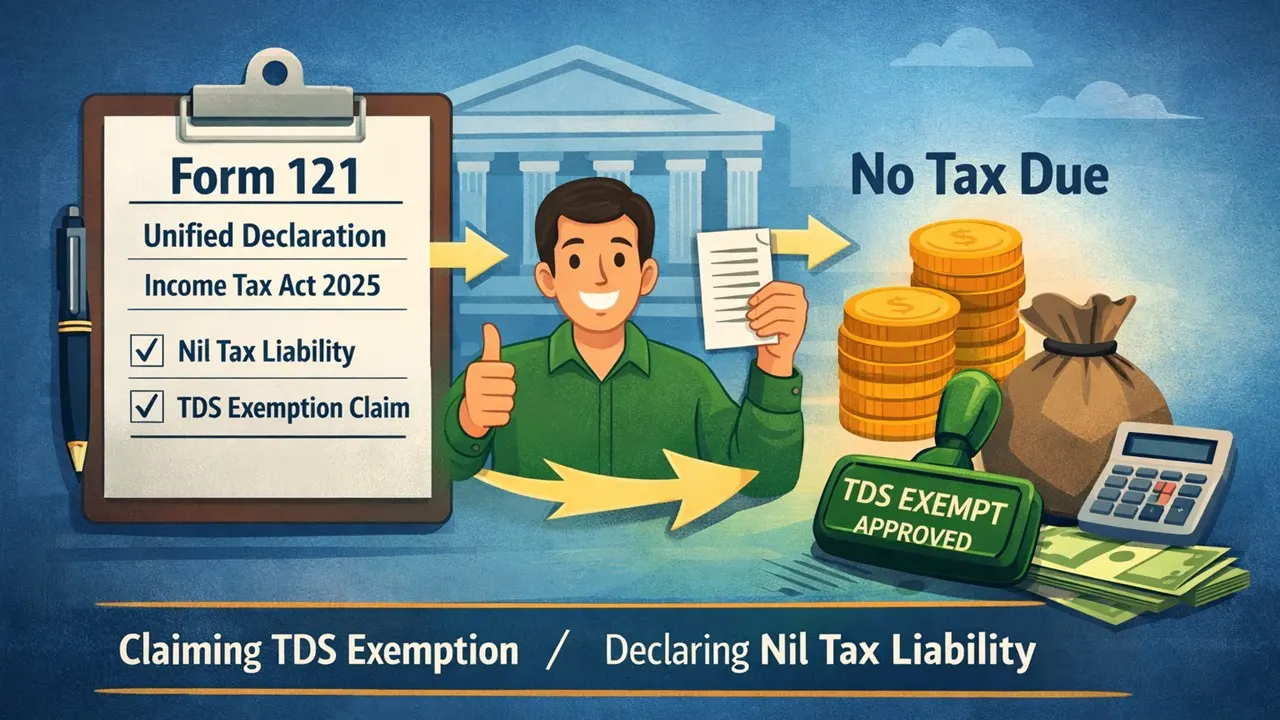
A unified declaration (Form 121) under the Income Tax Act 2025 enabling eligible taxpayers to claim TDS exemption by declaring nil tax liability.
Form 15G/15H Amalgamated to Consolidated Form 121
 Saloni Kumari
 Apr 15, 2026
EPFO releases clarification for transition from Income Tax Form 15G/15H to unified Form 121
The Employees Provident Fund Organisation (EPFO) under the Ministry of Labour & Employment, Government of India, has issued a Communication No. WSU/TDS Issues/E-772040/2026-27/11, regarding the transition from Form 15G/15H to the unified Form 121 for TDS-exempted Incomes under the New Income Tax Act 2025.
The new Income Tax Act 2025, effective from April 01, 2026, has introduced key changes related to income disclosure without tax being deducted at source (TDS). Among them, one of the major changes is regarding the amalgamation of Form 15G and Form 15H into a unified written declaration in Form 121. The declarant (who is required to be a resident) must ensure that his/her expected final liability for the tax year is NIL (zero) and make sure he/she is properly filing the details in Part A of the Form No. 121; and in the end, don't forget to sign it. Do not fill Part B of Form No. 121, as that part is required to be filled by the Payer.
Every taxpayer needs to be aware that it is not obligatory to fill out Form 121. The form has only been developed for the taxpayers who do not want their tax to be deducted at source. Another key requirement is related to the generation of a Unique Identification Number (UIN) by the payer for every Form 121 received. This generated UIN must include a sequence number, the tax year, and the TAN of the payer.
Payers are also required to upload a consolidated monthly statement of all forms 121 by the 7th of the following month using the income tax e-filing portal and report these details in quarterly TDS returns using Form 140. Until digital filing systems are fully implemented, physical forms may be used to ease the transition. However, taxpayers are advised to avoid mistakes such as missing UINs or incorrect reporting, as these can lead to penalties.
The communication reads, "Non-compliance with the provisions of the new IT Act, including missing UINs or incorrect reporting, may attract penalties under the relevant provisions of the said Act. All Regional Offices are therefore requested to ensure these guidelines are implemented without fail to avoid any regulatory discrepancies as stipulated in the new IT Act."
In this context, a detailed note of 5 pages on Form No. 121 has been uploaded on the official website of the Income Tax Department, along with frequently asked questions (FAQs) and the proforma of Form No. 121. Interested taxpayers can visit and read the same.
About Author


Saloni Kumari
Content Writer
Saloni is a Content Writer with 2+ years of experience at studycafe.in. She writes legal, taxation, and finance related content including GST, Income Tax etc. Skilled in translating complex judicial pronouncements and regulatory developments into clear, and reader-friendly articles. Experienced in covering judgements of ITAT, High Court, GSTAT, and news related to Income Tax, GST, and corporate law. She can be reached at [email protected].
Saloni is a Content Writer with 2+ years of experience at studycafe.in. She writes legal, taxation, and finance related content including GST, Income Tax etc. Skilled in translating complex judicial pronouncements and regulatory developments into clear, and reader-friendly articles. Experienced in covering judgements of ITAT, High Court, GSTAT, and news related to Income Tax, GST, and corporate law. She can be reached at [email protected].
 StudyCafe
 Delhi, Delhi, India
 2948
2948My Recent Articles
- Maharashtra Govt Eases Registration of Jointly Owned Land Sales, ‘KA’ Copy Can Replace Co-Owners’ NOC
- No Separate Section 69C Unexplained Expenditure Addition Allowed After Accepting Section 44AD Income Without Supporting Evidence: ITAT
- RBI Imposes Restrictions on Puducherry Co-operative Urban Bank for Six Months, Caps Cash Withdrawals at Rs 5,000
- ICAI Opens Application Window for Empanelment of Members to Act as Observer at CA January 2027 Exams
- ICAI CA Inter Sept 2026 Result OUT at caresults.icai.org, Check Steps to Download
Up Next
Loading suggestions…


Recent Posts


All Posts



Tags
Recent Posts
All Posts