GST 2.0: Council May Consider Wider ITC, Faster Refunds, Simpler Returns and End to Arrest Powers in Major Business Relief Push:
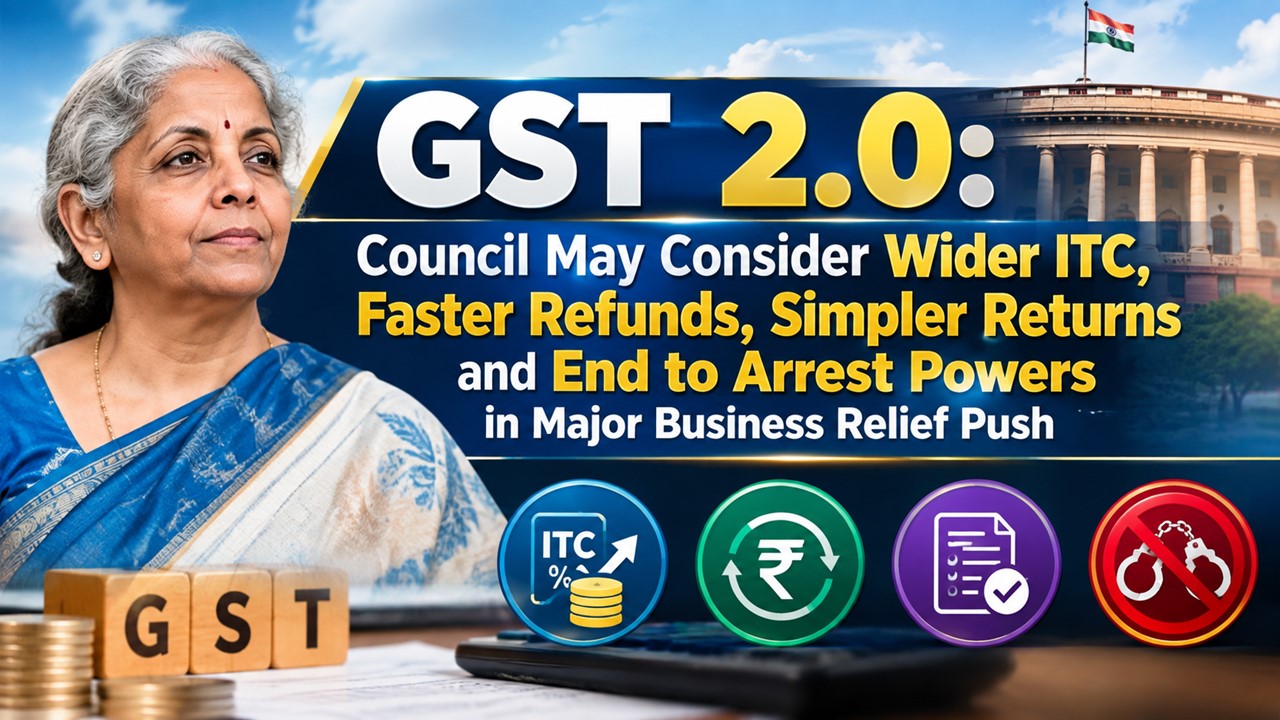
India’s GST 2.0 reform push could widen ITC, speed up refunds, simplify returns and curb arrest powers, giving businesses major compliance relief.
GST Council Set for Big Reform Push
 Vanshika verma
 Oct 5, 2026
India is considering a major overhaul of the Goods and Services Tax (GST) system to make compliance easier for businesses and reduce unnecessary legal action.
The GST Council is expected to discuss several proposals at its meeting on Wednesday, including easier input tax credit (ITC) rules, simpler e-way bill requirements, faster refunds and higher limits for prosecution. The proposals also include removing arrest powers under the GST law, marking a shift towards decriminalisation and a more business-friendly tax system.

A major proposal is to unlock thousands of crores of rupees stuck as input tax credit. The Council may consider allowing businesses to claim refunds on GST paid on plant and machinery and input services in monthly instalments over five years. It may also consider allowing ITC on several items that are currently blocked, such as health and life insurance for employees, outdoor catering, telecom towers, pipelines outside factories, certain free samples and destroyed goods, as well as vehicles with up to 13 seats and their insurance and maintenance costs.
Experts said that allowing more ITC could reduce business costs and free up money for investment. Refunds of accumulated credit, especially in sectors facing an inverted duty structure, could also release large amounts of working capital. Industries such as food, pharmaceuticals, textiles and electric vehicles have significant amounts of GST credit stuck because their inputs are taxed at higher rates than their final products.
Another important proposal aims to protect genuine businesses when a supplier fails to pay GST. Under the current system, a buyer can lose ITC even when the purchase was genuine. The proposed system would allow a genuine buyer to keep the credit, while the tax authorities would recover the unpaid tax from the supplier who defaulted. Officials believe that invoice-level data now available in the GST system can help identify fraud and mismatches more accurately.

The GST Council may also simplify the refund process by using information already available with Customs, the Reserve Bank of India and other government systems. This could reduce the need for businesses to repeatedly upload documents and wait for officers to manually verify them.
The IT and IT-enabled services sectors could also get relief. Supplies made by Indian companies to their overseas branch offices may be treated as exports, making them eligible for ITC. Goods sold to foreign buyers but delivered to a Special Economic Zone (SEZ) in India may also qualify as exports if payment is received in foreign currency. GST rules for export payments may also be aligned with RBI regulations.
The reforms are also aimed at reducing small-value disputes. The Council may propose that no show-cause notice be issued when the amount involved is below Rs 10,000, with the change also applying to some pending cases. Officials noted that a large number of notices arise from minor differences between tax returns, but they result in very little tax recovery.
Small businesses could also get simpler return-filing rules. Businesses with turnover of up to Rs 5 crore that sell only to unregistered customers may be allowed to file GST returns once a year while paying tax every quarter. Registration could also become faster, with businesses eligible for the automated route getting registration within three working days.
Changes such as a business's trade name, directors or partners, and additional business addresses may also be moved to automatic approval.
Overall, the proposed changes are to make GST less reliant on paperwork and manual checks and more on data, technology and risk based enforcement. The reforms are being seen as the next big step in India’s GST 2.0 plan and could bring about a big improvement in the ease of doing business.
About Author


Vanshika verma
Content Writer
 Studycafe
 Delhi, Delhi, India
 2022
2022My Recent Articles
- Five Tamil Nadu Police Personnel Face Disciplinary Action Within a Week Over Allegations of Demanding and Accepting Bribes
- ZF Commercial Vehicle Control Systems India Wins GST Appeal as Rs 1.79 Crore ITC Demand and Penalty Set Aside
- ITAT Condones Over Two-Year Delay, Gives Taxpayer Fresh Opportunity to Contest Rs 1.30 Crore Property Sale Addition
- Snowman Logistics Receives Rs 2.06 Crore Income Tax Demand for FY24, Plans to Challenge Penalty Order
- Bharat Bijlee Receives Rs 58.3 Lakh Income Tax Demand Over Excess Refund and Interest Re-Computation
Loading suggestions…


Recent Posts
All Posts

Recent Posts
All Posts