GSTN Update on difficulty in filing Appeal due to ‘NIL incorrect Demand’ Orders:
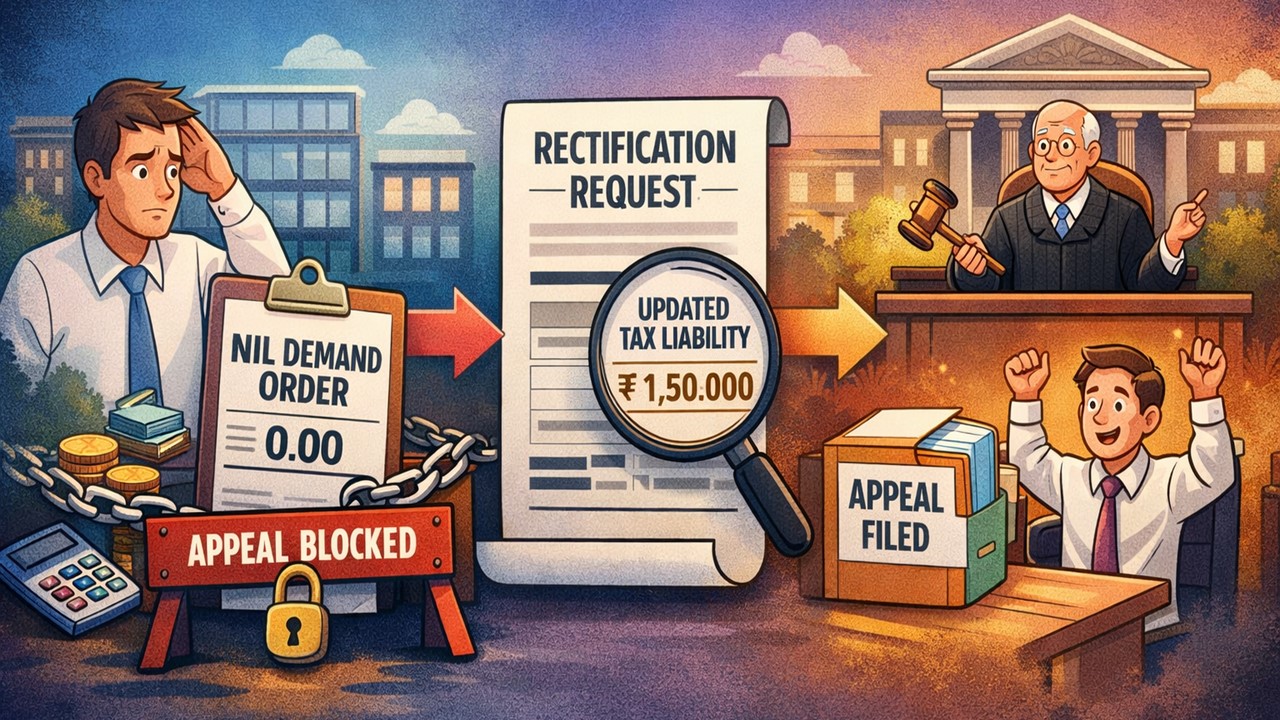
GSTN clarifies that taxpayers facing blocked appeals due to NIL demand orders must seek rectification of the order to reflect actual liability before filing an appeal.
‘NIL Demand’ Order Glitch on GST Portal
 Saloni Kumari
 Apr 4, 2026
GSTN Update on difficulty in filing Appeal due to ‘NIL incorrect Demand’ Orders
The Goods and Services Tax Network (GSTN) has issued a key announcement dated April 03, 2026, concerning the difficulty faced by taxpayers while furnishing appeals on the GST portal.
It has been noticed that certain taxpayers are facing issues while furnishing their appeals on the GST portal to challenge demand orders reflecting "NIL" (zero) demands, even though the taxpayer still disagrees with the tax liability.
This problem is generally seen when taxpayers have already made payment for tax, interest, or penalty (it does not matter fully or partially) at the point of issuance of the Show Cause Notice (SCN) without accepting the liability. Later, an order is issued by the tax officer, treating that payment as a full settlement, but not clearly mentioning the actual liability. In conclusion, the demand is recorded as "NIL" by the system.
On the GST portal, such orders create a Demand ID in the Demand and Collection Register (DCR) with no outstanding amount. When taxpayers try to file an appeal (APL-01), the system blocks it and may display an error reading, "Disputed amount cannot be more than the demand amount itself." Since the demand is recorded as NIL, the portal does not allow the appeal to proceed.
The announcement has clarified that a tax payment made during the stage of SCN issuance, without clear acceptance of liability, does not mean you agree with the demand. In such a situation, the taxpayers are allowed to challenge the liability by filing an appeal under Section 107 of the Central Goods and Services Tax Act, 2017. However, in cases where an adjudication order has incorrectly mentioned ZERO demand, taxpayers are not permitted to exercise the said right.
In cases where liability exists, however, the same has not been mentioned by the tax authorities in the issued demand order, and the payment of the liability has been made before the issuance of the demand order, the taxpayers are advised to request a rectification from the adjudicating authority through the GST portal. Once the corrected order reflects the actual demand, they can file the appeal within the statutory time limit.
About Author


Saloni Kumari
Content Writer
Saloni is a Content Writer with 2+ years of experience at studycafe.in. She writes legal, taxation, and finance related content including GST, Income Tax etc. Skilled in translating complex judicial pronouncements and regulatory developments into clear, and reader-friendly articles. Experienced in covering judgements of ITAT, High Court, GSTAT, and news related to Income Tax, GST, and corporate law. She can be reached at [email protected].
Saloni is a Content Writer with 2+ years of experience at studycafe.in. She writes legal, taxation, and finance related content including GST, Income Tax etc. Skilled in translating complex judicial pronouncements and regulatory developments into clear, and reader-friendly articles. Experienced in covering judgements of ITAT, High Court, GSTAT, and news related to Income Tax, GST, and corporate law. She can be reached at [email protected].
 StudyCafe
 Delhi, Delhi, India
 2924
2924My Recent Articles
- Major Relief in Arbitration Case: MCIA Denies Rs 908 Crore Statement Claim Made by Allied Silica Against Tata Chemicals
- MCA and ICSI to Hold User Awareness Session on Form AOC-4 Filing Amid Glitches on MCA-21 Version-3 Portal
- GSTN Introduces New E-Invoicing Facility for Self-Invoices Under Reverse Charge Mechanism
- Flexi Cap vs Multi Cap Funds: What's the Real Difference?
- IBA Recommends Public Sector Banks to Reduce Ambit of Physical Branch Audits to 50% of Total Business
Up Next
Loading suggestions…


Recent Posts
All Posts
Tags
Recent Posts
All Posts