HC Quashes GST Order for Non-Consideration of Taxpayer Reply:
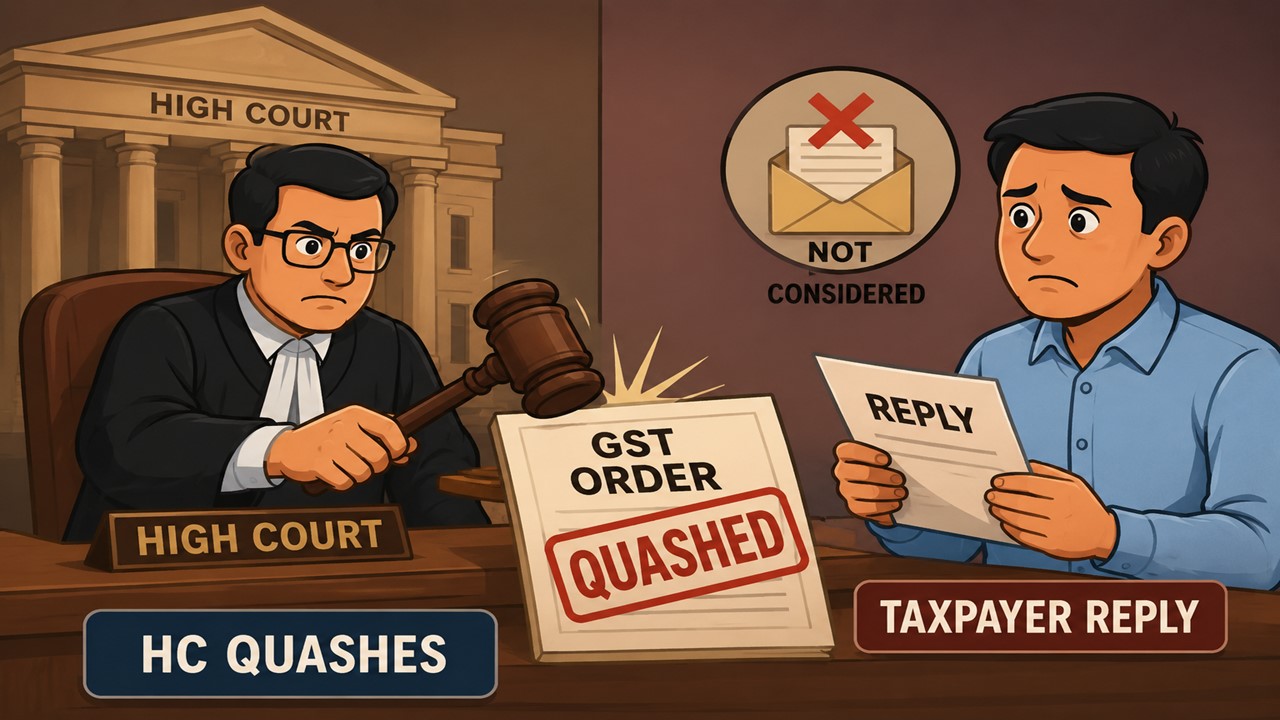
High Court quashes GST adjudication order passed without considering taxpayer’s detailed reply properly.
Court found complete non-application of mind in impugned GST order.
 Meetu Kumari
 May 16, 2026
The High Court in Janardan Panda v. Commissioner, Commercial Tax & GST, Odisha and Others held that GST adjudication orders passed without considering the taxpayer’s reply or recording reasons suffer from non-application of mind and are liable to be quashed. A Division Bench comprising Chief Justice Harish Tandon and Justice Murahari Sri Raman set aside the demand order and rectification order passed against the petitioner for the tax period 2021-22. The Court observed:
“The authority while adjudicating the proceeding is required to assign reasons for discarding the explanation offered by the assessee.”

The petitioner challenged the Order-in-Original dated 26 December 2025 passed under Section 73 of the GST Act, along with the rectification order dated 6 January 2026, by which tax, interest and penalty aggregating to Rs. 4.19 lakh were demanded. The petitioner contended that despite filing a detailed reply to the Show Cause Notice, the adjudicating authority failed to deal with the explanations and passed the order mechanically.
Before the High Court, it was argued that the impugned order did not reflect any independent application of mind and was completely silent on the documents and submissions placed on record by the petitioner. It was further submitted that such cryptic adjudication violated the principles of natural justice.

The Court examined the impugned order and found that there was no discussion whatsoever regarding the petitioner’s reply. It observed that even in cases where the assessee does not appear personally, the adjudicating authority is still under a legal obligation to consider the written response and record reasons while rejecting the same. The Court pointed out that
“The impugned order smacks arbitrariness as there is no independent application of mind discernible therefrom.”
Holding that the adjudication was unsustainable in law, the High Court quashed both the demand order and the rectification order. The matter was remanded back to the Deputy Commissioner of State Tax, Kalahandi Circle, with a direction to adjudicate the proceedings afresh after granting adequate opportunity of hearing to the petitioner and considering all materials placed on record.
About Author


Meetu Kumari
Content Manager
 Studycafe
 Jodhpur, Rajasthan, India
 2264
2264My Recent Articles
- ITAT Condones 302-Day Delay, Restores Salary Assessment for Fresh VerificationPremium
- ITAT Condones Delay After Tax Consultant's Death, Restores Appeals for Fresh HearingPremium
- ITAT Remands Salary Addition, Says Taxability Depends on Salary Becoming Due, Not Mere ReceiptPremium
- ITAT Deletes TP Royalty Adjustment, Orders Fresh Review of Commission BenchmarkingPremium
- ITAT Quashes Reassessment Over Unsigned Section 148 Notice Issued to AssesseePremium
Loading suggestions…


Recent Posts

All Posts

Recent Posts
All Posts