High Court Allows GST Budgetary Support on Scrap Arising from Manufacturing Process:
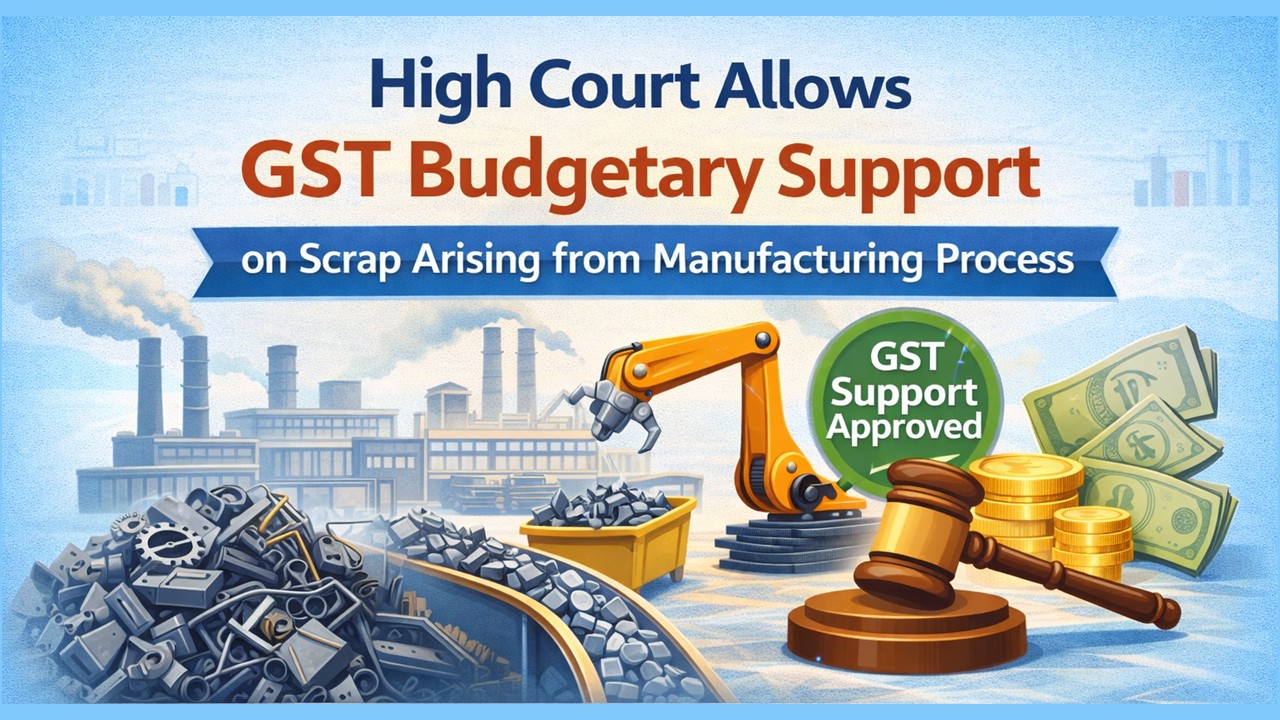
HC allows GST reimbursement on scrap holding it part of manufacturing and eligible goods
Scrap arising from production treated as specified goods for reimbursement
 Meetu Kumari
 Apr 10, 2026
High Court Allows GST Budgetary Support on Scrap Arising from Manufacturing Process
The petitioner, M/s Vijay Steel Industries, had established a manufacturing unit in Jammu for producing TMT bars and other steel products, initially availing excise exemptions under pre-GST notifications. After the introduction of GST, the earlier exemption regime was replaced with a Budgetary Support Scheme, under which eligible units were entitled to reimbursement of a portion of CGST and IGST paid.
The petitioner was granted registration as an eligible unit and continued to claim reimbursement under both Central and State schemes. During the manufacturing process, certain non-standard portions of TMT bars emerged, which were cut and sold as M.S. scrap. The petitioner treated such scrap as part of manufactured goods and claimed reimbursement accordingly. However, the State authorities rejected reimbursement on the sale of M.S. scrap, holding that the petitioner was registered only for manufacturing TMT bars and not scrap, and that scrap did not fall within “specified goods” under the applicable notification. Aggrieved, the petitioner approached the High Court challenging the rejection.
Main Issue: Whether M.S. scrap generated as a by-product of the manufacturing process qualifies as “specified goods” eligible for reimbursement under the GST Budgetary Support Scheme.
HC's Decision: The High Court held that the rejection of reimbursement by the State authorities was unsustainable. It observed that the petitioner was admittedly engaged in manufacturing TMT bars, and the scrap in question arose directly from the same manufacturing process. The Court noted that such scrap retained the essential character of the manufactured product and was not an independent or unrelated activity. Importantly, the Court emphasised that the exclusion list under the notification was specific and did not include scrap.
Since the scrap was a natural and unavoidable outcome of the manufacturing process and had undergone the same production cycle, it could not be denied the status of “specified goods” merely because it was not separately listed. The Court further found merit in the petitioner’s argument that even the Central authorities had granted reimbursement on such scrap, reinforcing the inconsistency in the State’s approach. Thus, the impugned order rejecting reimbursement was quashed, and the matter was remanded back to the authorities to reconsider the claim in light of the Court’s observations within a stipulated time.
To Read Full Judgment, Download PDF Given Below
About Author


Meetu Kumari
Content Manager
Meetu Kumari is an Experienced Advocate and Content Writer with 4+ years of demonstrated history of working in the law practice industry. Skilled in Developing Content, Researching, and Drafting. Strong professional with a Bachelor of Science (B.Sc.) focused on Law from Gujarat National Law University.
Meetu Kumari is an Experienced Advocate and Content Writer with 4+ years of demonstrated history of working in the law practice industry. Skilled in Developing Content, Researching, and Drafting. Strong professional with a Bachelor of Science (B.Sc.) focused on Law from Gujarat National Law University.
 Studycafe
 Jodhpur, Rajasthan, India
 2264
2264My Recent Articles
- ITAT Condones 302-Day Delay, Restores Salary Assessment for Fresh VerificationPremium
- ITAT Condones Delay After Tax Consultant's Death, Restores Appeals for Fresh HearingPremium
- ITAT Remands Salary Addition, Says Taxability Depends on Salary Becoming Due, Not Mere ReceiptPremium
- ITAT Deletes TP Royalty Adjustment, Orders Fresh Review of Commission BenchmarkingPremium
- ITAT Quashes Reassessment Over Unsigned Section 148 Notice Issued to AssesseePremium
Up Next
Loading suggestions…


Recent Posts

All Posts


Recent Posts
All Posts