ITAT Allows Section 11 Exemption to Trusts Publishing Educational Books:
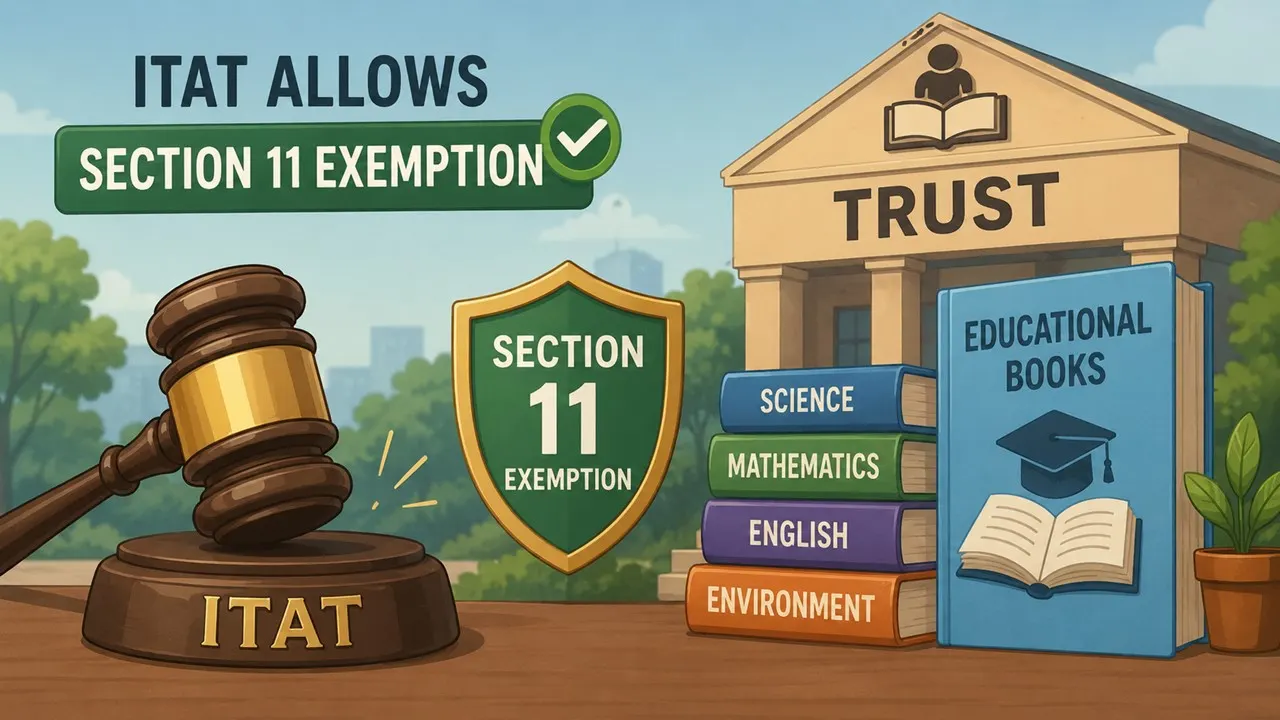
Printing and sale of educational books held charitable educational activity by ITAT Bangalore.
Tribunal Restores Exemption Under Sections 11 and 12 to Publishing Trust
 Meetu Kumari
 May 27, 2026
ITAT Allows Section 11 Exemption for Trusts Publishing Educational Books
The Bangalore Bench of the Income Tax Appellate Tribunal (ITAT) has held that a trust engaged in printing and publishing educational books is entitled to exemption under Sections 11 and 12 of the Income Tax Act, 1961, and its activities cannot be treated as “advancement of any other object of general public utility”.

The assessee trust had filed its return for AY 2018-19 declaring nil income after claiming exemption under Section 11. The trust, registered under Section 12AA since 1987, was engaged in printing and publication of books containing educational, cultural, historical and personality development content.
During scrutiny assessment, the Assessing Officer observed that the trust earned receipts of over ₹8.40 crore from printing and publication activities and generated a surplus of Rs.1.49 crore. According to the department, the activity was commercial in nature and fell under “general public utility”, thereby attracting the proviso to Section 2(15). Since receipts allegedly exceeded the prescribed threshold, exemption under Sections 11 and 12 was denied.
The CIT(A) also upheld the denial, holding that the trust was mainly carrying on printing and publication business for consideration and that amendments introduced from AY 2009-10 restricted exemption where activities resembled trade or commerce.

Before the Tribunal, the assessee argued that its activities were educational in nature and identical claims had been accepted by the department in earlier as well as subsequent assessment years. The trust also relied on earlier ITAT rulings in its favour and judgments including Radhasoami Satsang v. Commissioner of Income-tax and Delhi Bureau of Text Books v. Director of Income-tax (Exemption).
The Tribunal observed that the Assessing Officer himself had accepted the assessee’s claim for exemption in scrutiny assessments for AY 2016-17 and AY 2022-23 after examining the same activities. It held that the Revenue could not take contradictory stands on identical facts.
The ITAT further noted that:
publication and distribution of educational books contributes to the training and development of knowledge, mind and character of students and society. Merely earning surplus from publication activity would not change the fundamental character of the institution.
Relying heavily on the Delhi High Court ruling in Delhi Bureau of Text Books, the Tribunal held that there need not necessarily be a physical school for an activity to qualify as “education”. What is relevant is whether the activity is intrinsically connected with education.
The Tribunal concluded that the assessee was engaged in educational activities and not in commercial activities falling under “general public utility”. Therefore, the proviso to Section 2(15) was held inapplicable.
The ITAT reversed the orders of the lower authorities and directed the Assessing Officer to grant exemption under Sections 11 and 12, including accumulation benefit under Section 11(2) of the Act.
To Read Full Order, Download PDF Given Below.
About Author


Meetu Kumari
Content Manager
 Studycafe
 Jodhpur, Rajasthan, India
 2264
2264My Recent Articles
- ITAT Condones 302-Day Delay, Restores Salary Assessment for Fresh VerificationPremium
- ITAT Condones Delay After Tax Consultant's Death, Restores Appeals for Fresh HearingPremium
- ITAT Remands Salary Addition, Says Taxability Depends on Salary Becoming Due, Not Mere ReceiptPremium
- ITAT Deletes TP Royalty Adjustment, Orders Fresh Review of Commission BenchmarkingPremium
- ITAT Quashes Reassessment Over Unsigned Section 148 Notice Issued to AssesseePremium
Loading suggestions…


Recent Posts

All Posts
Recent Posts
All Posts