High Court Allows ITC Claim, Protects Bona Fide Buyer from Seller’s GST Default:
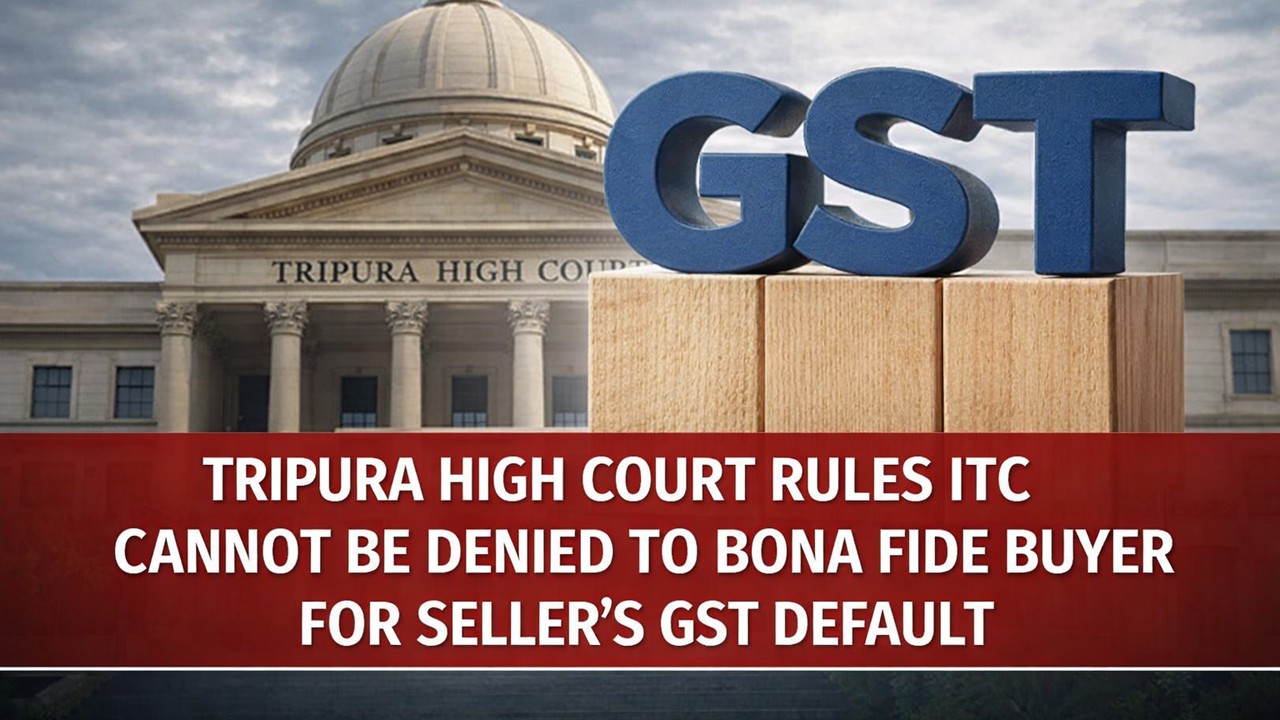
Tripura High Court holds that ITC cannot be denied to a bona fide purchaser due to supplier’s GST non-payment; reads down Section 16(2)(c) CGST Act
GST ITC denied due to seller default judgment
 CA Deepak Gupta
 Feb 27, 2026
In a significant ruling strengthening protections for bona fide taxpayers under the Goods and Services Tax (GST) regime, the High Court of Tripura has held that Input Tax Credit (ITC) cannot be denied to a genuine purchaser merely because the selling dealer failed to deposit the tax collected from the buyer.
A Division Bench comprising Chief Justice M.S. Ramachandra Rao and Justice Biswajit Palit delivered the judgment in M/S Malaya Rub-Tech Industries v. Union of India & Others (WP(C) No. 849 of 2022), allowing the writ petition filed by the Kerala-based rubber manufacturing firm.
Background of the Case

M/S Malaya Rub-Tech Industries, registered under the CGST and SGST Acts, had purchased input materials from a supplier in Tripura between March and November 2018. The company claimed ITC on the GST paid during these transactions.
However, in January 2021, the GST authorities issued a show cause notice alleging wrongful availment of ITC for the tax period between August 2017 and July 2019. The department sought recovery of ₹22.09 lakh, asserting that the supplier had not deposited the tax with the government.
In February 2022, the Assistant Commissioner passed an order confirming the demand. Challenging this, the company approached the High Court.

Court’s Observations
The High Court noted that the department had invoked Section 73 of the CGST Act, which applies to cases not involving fraud, wilful misstatement, or suppression of facts. Importantly, the show cause notice and the final order did not record any finding that the transaction between the purchaser and supplier was fraudulent, collusive, or lacking bona fides.
The Bench relied heavily on its recent decision in M/s Sahil Enterprises v. Union of India & Others (decided on January 6, 2026), where Section 16(2)(c) of the CGST Act was “read down” to prevent denial of ITC in genuine transactions.
The Court observed that a purchasing dealer cannot be expected to ensure that a selling dealer deposits the collected GST with the government. Imposing such a burden would create an “impossible obligation” and could render the provision vulnerable under Article 14 of the Constitution of India.
Final Verdict
Allowing the writ petition, the High Court set aside the order dated February 17, 2022, and directed the authorities to immediately grant ITC amounting to ₹22,09,964 to the petitioner.
No costs were awarded.
Significance of the Ruling
The judgment reinforces a growing judicial view that bona fide purchasers should not suffer for the tax compliance failures of their suppliers. By applying the principle of “reading down” to Section 16(2)(c), the Court clarified that ITC can only be denied where transactions are fraudulent, collusive, or not genuine.
The ruling is expected to provide relief to several businesses facing similar disputes under the GST framework and may influence pending litigation across jurisdictions.
About Author


CA Deepak Gupta
Co Founder
 StudyCafe
 Delhi, Delhi, India
 3423
3423My Recent Articles
- UltraTech Cement slapped with Rs. 808.78 Cr Income Tax Demand
- GST: High Court upheld constitutional validity of Section 16(2)(c), asks government to address ITC issues of genuine purchasers
- Old vs New Tax Regime for Tax Year 2026-27
- High court criticizes Income Tax Department for not releasing ITR Utilities despite 11 years of directions
- Fino Payments Bank CEO Rishi Gupta Gets Bail in GST Case, Bank Clarifies No Direct Link
Loading suggestions…


Recent Posts
All Posts
Recent Posts
All Posts