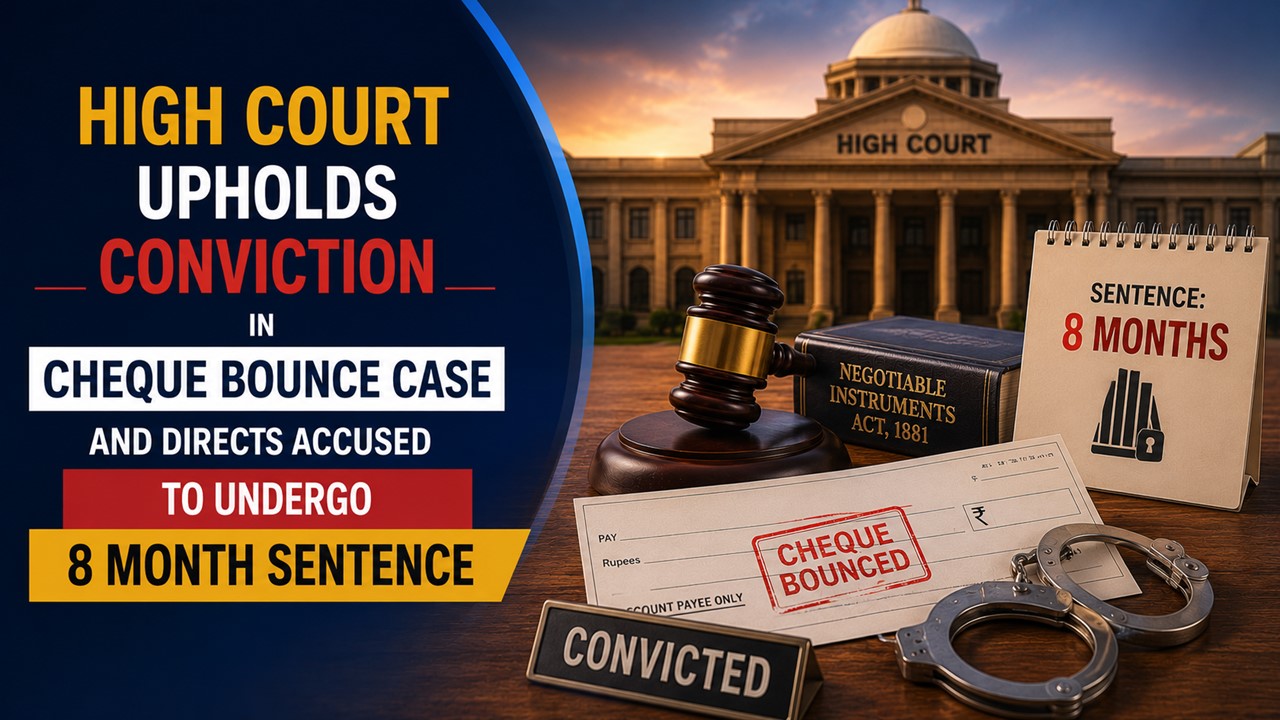
High Court Upholds Conviction in Cheque Bounce Case And Directs Accused to Undergo 8 Month Sentence:
Cheque Issued Towards Loan Liability Carries Presumption of Legally Enforceable Debt
Cheque Issued Towards Loan Liability Carries Presumption of Legally Enforceable Debt
 Saima
Saima Jun 24, 2026
High Court Upholds Conviction in Cheque Bounce Case And Directs Accused to Undergo 8 Month Sentence
The Himachal Pradesh High Court held that once the issuance and signature on the cheque are admitted, the statutory presumptions under Sections 118 and 139 of the NI Act start operating in favour of the holder, and the burden shifts to the accused to rebut the same through evidence.
The respondent bank had sanctioned a loan of Rs 10.50 lakh to the father of the petitioner. The petitioner, Kartar Singh, was a co-applicant in the loan account. After a default in repayment, the petitioner issued a cheque dated 25 January 2019 for Rs 10.50 lakh in favour of the bank to discharge the liability. But the cheque was dishonoured due to "Insufficient Funds". The bank thereafter issued a statutory demand notice. Despite receipt of the notice, the petitioner failed to make payment within the prescribed period, making the bank initiate proceedings under Section 138 of the Negotiable Instruments Act.
The Trial Court convicted the petitioner and sentenced him to eight months’ simple imprisonment along with compensation of Rs 20 lakh. The conviction was later upheld by the Sessions Judge in appeal. The High Court observed that the petitioner never questioned either the issuance of the cheque or his signature on it. He had also admitted receipt of the statutory notice. Consequently, the presumptions available under Sections 118 and 139 of the Negotiable Instruments Act were rightly invoked by the courts.
The Court noted that the accused failed to provide any evidence to establish a defence or to question the legally enforceable debt. Mere suggestions during cross-examination that the cheque was blank or that the loan belongs only to the petitioner's deceased father were insufficient to counter the statutory presumption.
The Himachal Pradesh High Court held that all essential ingredients of the offence under Section 138 of the Negotiable Instruments Act are fully proved. As the cheque was issued towards the discharge of a lawful liability, dishonoured for insufficient funds, and the accused failed to make payment even after receiving the statutory notice, the conviction was justified.
The High Court dismissed the criminal revision petition and upheld the conviction and sentence. The petitioner was directed to surrender before the Trial Court within 30 days to serve the sentence and the deposited amount was ordered to be released in favour of the bank.

About Author


Saima
Content Writer
Saima is a Law graduate with a passion for research and content writing. She writes for Finance, Taxation and Legal Updates at Studycafe.in, simplifying complex legal decisions by the ITAT, High Court, AAR and GSTAT into uncomplicated and clear explanations.
Saima is a Law graduate with a passion for research and content writing. She writes for Finance, Taxation and Legal Updates at Studycafe.in, simplifying complex legal decisions by the ITAT, High Court, AAR and GSTAT into uncomplicated and clear explanations.
 StudyCafe
 Delhi, Delhi, India
 534
534My Recent Articles
- Supreme Court Holds GRD Powder and GRD Mix Not Taxable as Non-Alcoholic Beverages
- ITAT Remands Appeal Over Incorrect Email Service
- ITAT Remands Decommissioning and Retention Bonus Disallowances for Fresh Adjudication
- ITAT Remands Trust Registration and Section 80G Approval Applications for Fresh Adjudication
- ITAT Deletes Unexplained Money Addition After Finding No Evidence of Accommodation Entries
Up Next
Loading suggestions…


Recent Posts
All Posts
Recent Posts
All Posts