Import Procedure Under GST | Import under GST
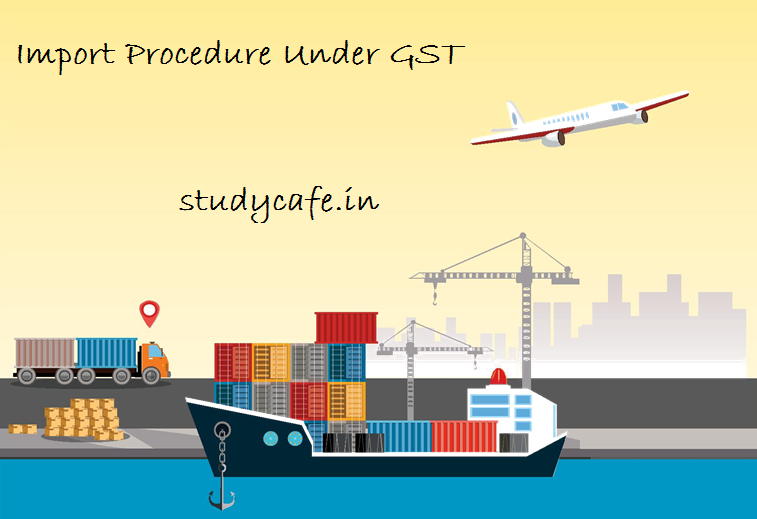
Import Procedure Under GST | Import under GST Definition Import of Goods - The import of goods has been defined in the IGST Act, 2017 as bri
 CA Deepak Gupta
 Jul 12, 2017
Table of Contents

Import Procedure Under GST | Import under GST
Definition
- Import of Goods - The import of goods has been defined in the IGST Act, 2017 as bringing goods into India from a place outside India. All imports shall be deemed as inter-state supplies and accordingly Integrated tax shall be levied in addition to the applicable Custom duties.
- Import of services - The import of services has specifically been defined under IGST Act, 2017 and refers to supply of any service where the supplier is located outside India, the recipient is located in India, and the place of supply of service is in India.
- Input Tax Credit -The definition of input tax in relation to a registered person also includes the integrated tax charged on import of goods. Thus, input tax credit of the integrated tax paid at the time of import shall be available to the importer and the same can be utilized by him as Input Tax credit for payment of taxes on his outward supplies.
- Export of Goods will be treated as zero rated supply as before.
Import of Goods
- All imports shall be deemed as inter-state supplies and accordinglyIntegrated tax shall be levied in addition to the applicable Custom duties.
- With the introduction of GST, Import of goods would have no impact on levy of Basic Customs duty, Education Cess, Anti-dumping duty, Safeguard duty and the like.
- However, Integrated Goods and Services Tax(IGST) will replace the Additional duties of Customs, which are in common parlance referred to as Countervailing Duty (CVD) and Special Additional duty of Customs (SAD), barring a few exceptions.
- The integrated tax on goods shall be in addition to the applicable Basic Customs Duty (BCD) which is levied as per the Customs Tariff Act.
- In addition, GST compensation cess, may also be leviable on certain luxury and de-merit goods under the Goods and Services Tax (Compensation to States) Cess Act, 2017.
The taxes will be calculated as under:
- Assessable Value= Rs. 100/-
- Basic Customs Duty (BCD) = Rs. 10/-
- Value for the purpose of levying integrated tax= Rs. 100/- + Rs.10/-= Rs. 110/-
- Integrated Tax = 18% of Rs.110/- =Rs. 19.80/-
- Total taxes = Rs. 29.80 ( Rs. 10/- + Rs. 19.80/-)
On the top of it, If the goods are also leviable to cess under the Goods and Services Tax (Compensation to States) Cess Act, 2017, the same will be collected on the value taken for levying integrated tax. Thus, in the above example, in case, cess is leviable, the same would be levied on Rs. 110/-.

Import of Services
- Import of services refers to supply of any service where the supplier is located outside India, the recipient is located in India, and the place of supply of service is in India.
- As per the provisions contained in Section 7(1)(b) of the CGST Act, 2017,
- Import of services withconsideration shall be considered as a supply,whether it is used or not in the course or furtherance of business.
- Imports of services without consideration shall not be considered as supply.
- However, there is no business test required to be fulfilled for import of service to be considered as supply.
- Furthermore, as per the provisions contained in Schedule I of theCGST Act, 2017,the import of services by a taxable person from a related person or from a distinct person as defined in Section 25 of the CGST Act, 2017, in the course or furtherance of business shall be treated as supply even if it is made without any consideration.
Imports & Input Tax Credit
- Importer being a registered person under GST can utilize theintegrated tax charged to him on import of goods as input tax credit.
- This input tax credit can be utilized for payment of taxes (SGST/CGST/IGST) on his outward supplies of goods.
- Input tax credit ofintegrated tax (IGST) and GST Compensation Cess will beavailable to the importer and then will be transferred to therecipients in the supply chain.
- However,the credit of basic customs duty (BCD) will not be available.
- But if importer wants to avail input tax credit of IGST & GSTCompensation Cess, he needs tomandatorily declare GST Registration number (GSTIN) in the Bill of Entry.
- Provisional IDs issued by GSTN can be used during the transition period. But importer are advised to complete their registration process for GSTIN.
- As Input tax credit will beavailable based on GSTIN declared in the Bill of Entry. Input tax credit shall be availed by a registered person only if all the applicable particulars as prescribed in the Invoice Rules are contained in the said document, and the relevant information, as contained in the said document, is furnished in FORM GSTR-2 by such person.
- Customs EDI system would be interconnected with GSTN for validation of ITC. Further, Bill of Entry data in non-EDI locations would be digitized and used for validation of input tax credit provided by GSTN.
Duties at the time of import
- In the GST regime, IGST and GST Compensation cess will be levied on imports by virtue of sub-sections (7) &(9) of Section 3 of the Customs Tariff Act, 1975.
- Barring a few commodities such as pan masala, certain petroleum products which attract levy of CVD, majority of imports would attract levy of IGST.
- Further, a few products such as aerated waters, tobacco products, motor vehicles etc, would also attract levy of GST Compensation Cess, over and above IGST.
- IGST and GST Compensation cess, wherever applicable, would be levied on cargo that would arrive on or after 1st July, 2017.
- Note : It may also be noted that IGST would also be levied on cargo which has arrived prior to 1st July but a bill of entry is filed on or after 1st July 2017.
- Similarly ex-bond bill of entry filed on or after 1st July 2017 would attract IGST and GST Compensation cess, as applicable.
- In the case where cargo arrival is after 1st July and an advance bill of entry was filed before 1st July along with the payment of duty, the bill of entry may be recalled and reassessed by the proper officer for levy of IGST and GST compensation Cess, as applicable.
How the duty will be calculated
IGST rate- IGST rates have been notified through notification 01/2017-Integrated Tax (Rate), dated 28-06-2017.
- There are seven rates prescribed for IGST- Nil, 0.25%, 3% 5%, 12%, 18% and 28%. The actual rate applicable to an item would depend on its classification and would be specified in Schedules notified under section 5 of the IGST Act, 2017.
- IGST rate on any product can be ascertained by selecting the correct Sl. No. as per description of goods and tariff headings in the relevant schedules of the notification.
- Importers are advised to familiarize themselves with IGST and GST compensation cess rates, schedule and exemptions which are available on CBEC website.
- The Customs duty calculator would be made available on CBEC and ICEGATE website.
- The rates applicable to goods of Chapter 98 are as under:
- 9801- Project Imports- 18%
- 9802- Laboratory Chemicals- 18%
- 9803- Passenger baggage Nil Rate
- 9804- Specified Drugs and medicines for personal use- 5%
- 9804- Other drugs and medicines for personal use- 12%
- 9804- All other dutiable goods for personal use- 28%
- GST compensation Cess isleviable only on 55 item descriptions(of supply). Different rates have been notified for the same.
- Mostly Compensation cess rates are ad valorem. But for some exceptional items specific rates and for a few others mixed rates have been prescribed.For eg. Coal attract specific rates; Cigarettes attractmixed rates (ad valorem + specific).
- List of goods which are coveredunder GST compensation cess is available on CBEC website along with their HSN codes and applicable cess rates.
- The IGST Rates of Goods, Chapter wise IGST rate, GST Compensation Cess rates, IGST Exemption/Concession are available on CBEC website for trade and departmental officers as well.
Valuation and method of calculation
- Value for IGST Calculation : IGST is leviable on the value of imported goods and for calculating integrated tax on any imported article, the value of such imported goods would be the aggregate of -
(i) the value of imported article determined under sub-section (1) of section 14 of the Customs Act, plus any duty of Customs chargeable on that article under section 12 of the Customs Act, 1962 and any sum chargeable on that article under any law for the time being in force as an addition to, or as duty of Customs but does not include to the tax referred in the sub-section 7 (IGST) and sub-section 9 (Compensation Cess).
- Value for GST Compensation Cess Calculation: The value of the imported article for the purpose of levying GST Compensation cess shall be, assessable value plus Basic Customs Duty levied under the Act, and any sum chargeable on the goods under any law for the time being in force, as an addition to, and in the same manner as, a duty of customs. These would include education cess or higher education cess as well as anti-dumping and safeguard duties. The inclusion of anti-dumping duties and safeguard duty in the value for levy of IGST and Compensation Cess is an important change. These were not hitherto included in the value for the levy of additional duty of customs (CVD) or Special Additional Duty (SAD). The IGST paid shall not be added to the value for the purpose of calculating Compensation Cess.
- Although BCD, Education Cesses and IGST would be applicable in majority of cases, however, for some products CVD, SAD or GST Compensation cess may also be applicable. For different scenarios the duty calculation process has been illustrated in Annexure - I of this document.
Changes in import procedures
Importer Exporter Code (IEC)- In GST regime, GSTIN would be used for credit flow of IGST paid on import of goods. Therefore, GSTIN would be the key identifier.
- DGFT in its Trade Notice No. 09 dated 12.06.2017 has stated hat PAN would be the Import Export code (IEC). However, while PAN is identifier at the entity level, GSTIN would be used as identifier at the transaction level for every import and export.
- Further, in scenarios where GSTIN is not applicable, UIN or PAN would be accepted as IEC. It is advised that all importers need to quote GSTIN in their Bills of Entry in addition to IEC. In due course of time IEC would be replaced by PAN / GSTIN.
- To capture additional details in the Bill of entry such as GSTIN, IGST rate and amount, GST Compensation Cess and amount, the electronic as well as manual formats of Bill of entry including Courier Bill of entry are being amended.
- For the benefit of the trade, modified Forms have been hosted on the departmental website, www.cbec.gov.in.
- Further, suitable notifications shall be issued to amend the relevant regulations and introduce modified Forms.
- Under the GST regime, Customs duties will be exempted on imports made under export promotion schemes namely EPCG, DEEC (Advance License) and DFIA. IGST and Compensation Cess will have to be paid on such imports.
- The EXIM scrips under the export incentive schemes of chapter 3 of FTP (for example MEIS and SEIS) can be utilized only for payment of Customs duties or additional duties of Customs, on items not covered by GST, at the time of import. The scrips cannot be utilized for payment Of Integrated Tax and Compensation Cess. Similarly, scrips cannot be used for payment of CGST, SGST or IGST for domestic procurement.
- EOUs/EHTPs/STPs will be allowed to import goods without payment of basic customs duty (BCD) as well additional duties leviable under Section 3 (1) and 3(5) of the Customs Tariff Act.
- GST would be leviable on the import of input goods or services or both used in the manufacture by EOUs which can be taken as input tax credit (ITC).
- This ITC can be utilized for payment of GST taxes payable on the goods cleared in the DTA or refund of unutilized ITC can be claimed under Section 54(3) of CGST Act.
- In the GST regime, clearance of goods in DTA will attract GST besides payment of amount equal to BCD exemption availed on inputs used in such finished goods.
- DTA clearances of goods, which are not under GST,would attract Central Excise duties as before.
- Authorized operations in connection with SEZs shall be exempted from payment of IGST. Hence, there is no change in operation of the SEZ scheme.
- Currently for items imported under project import scheme (i.e. CTH 9801), unique heading under the Central Excise Tariff, for the purposes of levy of CVD does not exist. Therefore, under the Central Excise Tariff, each item is getting classified in a heading as per its description and duty is paid on merit.
- In the GST regime, for the purpose of levying IGST all the imports under the project import scheme will be classified under heading 9801 and duty shall be levied @ 18%.
- Full exemption from IGST has been provided on passenger baggage.
- However, basic customs duty shall be leviable at the rate of 35% and education cess as applicable on the value which is in excess of the duty free allowances provided under the Baggage Rules, 2016.
- The need for SAD refunds arose mainly on account of the fact that traders or dealers of imported goods were unable to take credit of this duty (which was a Central tax) while discharging their VAT or Sales tax liability (which was State levy) on subsequent sale of the goods.
- Unless corrected through a mechanism such as refund (of one of the taxes) this would have resulted in double payment of tax.
- With the introduction of GST on 01.07.2017, credit of eligible duties in respect of inputs held in stock and inputs contained in semi-finished or finished goods held in stock, is permissible to registered persons not liable to be registered under the existing law (for instance, VAT dealers) under transitional provisions (Section 140(3) of the CGST Act).Further, eligible duties as defined in sub-section (10) include SAD.
- In other words, dealers/ traders can take ITC of SAD paid on goods imported prior to 1st July 2017. Sub-section (5) of section 140 also allows a registered person to take credit of eligible duties in respect of inputs received on or after 1 July 2017 but the duty on which has been paid under the existing law.
- These provisions taken together ensure that SAD paid by dealers/ traders can be set-off against their GST liability as and when imported goods are supplied by them in the domestic market.
- However, certain items which are out of the GST net would be eligible for SAD refunds as earlier.
Suppose Assessable Value (A.V.) including landing charges =Rs. 100/-
(1) BCD- 10%

(2) IGST-12%
(3) Education cess 2%
(4) Higher education cess -1%
Solution : In view of the above parameters, the calculation of duty would be as below:(a) BCD = Rs. 10 [10% of A.V.]
(b) Education cess- Rs. 0.2 [2% of (a)]
(c) Higher education cess- Rs. 0.1 [1% of (a)]
(d) IGST- Rs. 13.236 [A.V.+(a) +(b) +(c)]x12%
Example 2. - Where product does not attract CVD but attract IGST as well as compensation cessSuppose Assessable Value (A.V.) including landing charges =Rs. 100/-
(1) BCD- 10%
(2) IGST-12%
(3) Education cess 2%
(4) Higher education cess -1%
(5) Compensation cess- 10%
Solution : In view of the above parameters, the calculation of duty would be as below:(a) BCD = Rs. 10 [10% of A.V.]
(b) Education cess- Rs. 0.2 [2% of (a)]
(c) Higher education cess- Rs. 0.1 [1% of (a)]
(d) IGST- Rs.13.236 [A.V.+(a)+(b)+(c)]x12%
(e) Compensation cess- Rs. 11.03 [A.V.+(a)+(b)+(c)]x 10%
Example 3. - Where product attract both CVD & IGST:Suppose Assessable Value (A.V.) including landing charges =Rs. 100/-
(1) BCD- 10%
(2) CVD- 12%
(3) IGST-28 %
(4) Education cess 2%
(5) Higher education cess -1%
Solution : In view of the above parameters, the calculation of duty would be as below:(a) BCD = Rs. 10 [10% of A.V.]
(b) CVD = Rs 13.2 [ 12% of (A.V.+ BCD)
(c) Education cess- Rs. 0.464 [2% of (BCD+CVD)]
(d) Higher education cess- Rs. 0.232 [1% of (BCD+CVD)]
(e) IGST- Rs. 34.69 [A.V.+(a)+(b)+(c)+(d)]x 28%
Example 4. - Where product attract CVD, IGST& Compensation cess:Suppose Assessable Value (A.V.) including landing charges =Rs. 100/-
(1) BCD- 10%
(2) CVD- 12%
(3) IGST-28 %
(4) Education cess 2%
(5) Higher education cess -1%
(6) Compensation cess-10%
Solution :In view of the above parameters, the calculation of duty would be as below:(a) BCD = Rs. 10 [10% of A.V.]
(b) CVD = Rs 13.2 [ 12% of (A.V.+ BCD)
(c) Education cess- Rs. 0.464 [2% of (BCD+CVD)]
(d) Higher education cess- Rs. 0.232 [1% of (BCD+CVD)]
(e) IGST- Rs. 34.69 [A.V.+(a)+(b)+(c)+(d)]x 28%
(f) Compensation cess Rs. 12.389 [A.V.+(a)+(b)+(c)+(d)]x 10%
Note: In cases where imported goods are liable to Anti-Dumping Duty or Safeguard Duty, calculation of Anti-Dumping Duty or Safeguard duty would be as per the respective notification issued for levy of such duty. It is also clarified that value for calculation of IGST as well as Compensation Cess shall also include Anti-Dumping Duty amount and Safeguard duty amount.About Author


CA Deepak Gupta
Co Founder
 StudyCafe
 Delhi, Delhi, India
 3423
3423My Recent Articles
- UltraTech Cement slapped with Rs. 808.78 Cr Income Tax Demand
- GST: High Court upheld constitutional validity of Section 16(2)(c), asks government to address ITC issues of genuine purchasers
- Old vs New Tax Regime for Tax Year 2026-27
- High court criticizes Income Tax Department for not releasing ITR Utilities despite 11 years of directions
- Fino Payments Bank CEO Rishi Gupta Gets Bail in GST Case, Bank Clarifies No Direct Link
Loading suggestions…


Recent Posts
All Posts


Tags
No tags yet.
Recent Posts
All Posts
Tags
No tags yet.