Income Tax Dept Introduces Additional Field To Disclose Secondary Address in All ITR Forms for AY 2026-27:
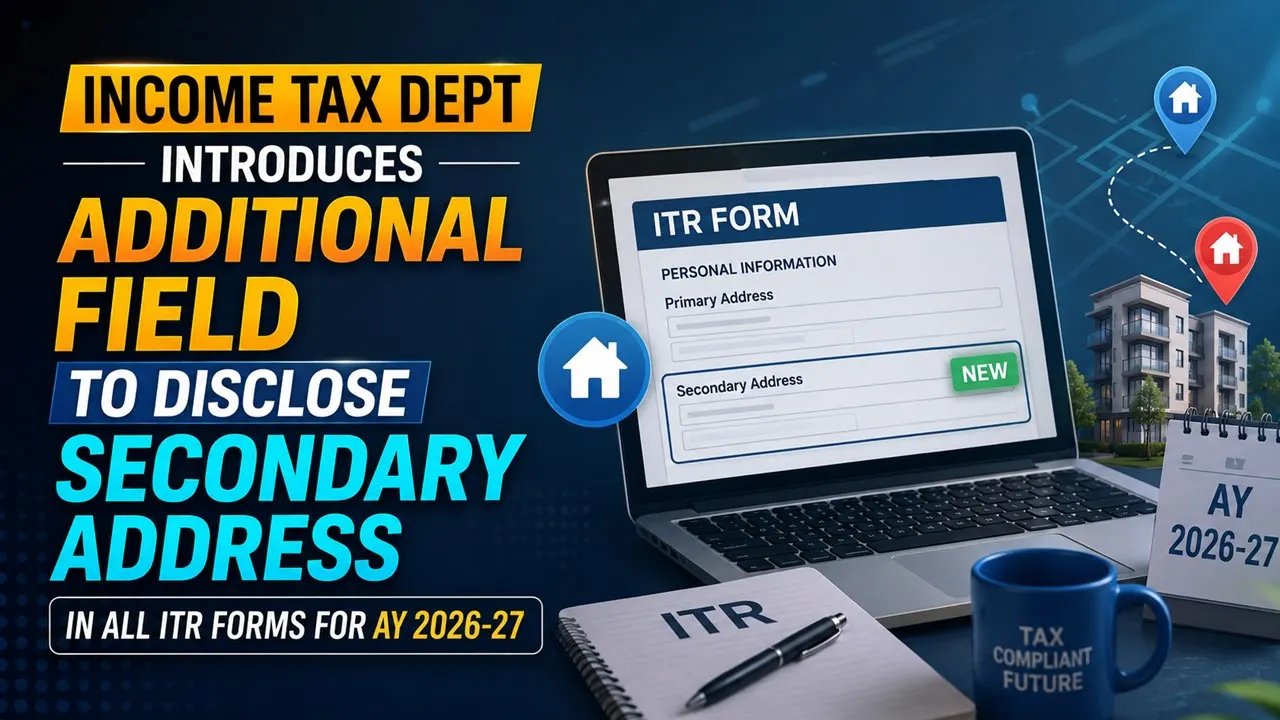
The Income Tax Department has introduced an additional field to provide a secondary address across all income tax return (ITR) forms for the Assessment Year (AY) 2026-27.
Providing Secondary Address Made Mandatory in ITR Forms
 Saloni Kumari
 Jul 22, 2026
The Income Tax Department has introduced an additional field across all income tax return (ITR) forms for the Assessment Year (AY) 2026-27. Under this field, taxpayers are required to provide a secondary address (if applicable). Meaning, the taxpayers who are required to file an ITR for the AY 2026-27 will now be required to disclose an additional communication address along with their primary address. This change is applicable to all salaried individuals, professionals, businesses, firms, LLPs, companies and trusts.
This additional field for disclosing secondary address is available under the personal or general information section of all ITR forms, including ITR-1, ITR-2, ITR-3, ITR-4, ITR-5, ITR-6 and ITR-7. The additional field added is not titled "secondary address"; however, the ITR forms include a separate section asking taxpayers to enter an additional address, where applicable.

What If Someone Does Not Have A Secondary Address?
In the ITR forms, taxpayers are first asked to enter their primary address. After filling the same, the portal is asking taxpayers to specify whether their secondary address is the same as the primary one. In such a situation, if the taxpayer selects 'Yes', then the portal will automatically fill the 'secondary address' field by entering the same address mentioned in the 'primary address' field. However, if the taxpayer selects 'No', then the portal will keep the secondary address field blank, and you will need to fill that field by entering an address different from the primary one.

Why Is This Change Important?
Including an additional field for disclosing a secondary address in ITR forms is important in many ways. Think of the following situations:
Suppose you have changed your residential house (the address you provided to the tax department for the purpose of communication), and you forgot to disclose the changes in address to the tax department. In that case, if any notice or communication is sent to your earlier address, you will not be aware of it. Providing an additional address will help tax authorities reach you easily and will avoid wastage of time.
Suppose you are living in a rented house; however, you own a house in a city, town, or village. Hence, providing the addresses of both locations makes it easier for the income tax department to contact you.
Suppose you live in a rented house, but you also own a house with a home loan in one city and claim house rent allowance (HRA) under the old tax regime.
Since the income tax department has made it mandatory for the taxpayers to provide the secondary address, taxpayers should make sure they are providing accurate and complete information, as this would be beneficial for them only. Sometimes, when notices/communications do not reach taxpayers, and they are unaware of them, taxpayers do not furnish any reply. This is considered serious negligence in the eyes of tax authorities. This can even lead to prolonged litigation, penalties, etc.
What If I Do Make a Mistake Filing a Secondary Address?
If you filed your income tax return (ITR) within the statutory deadline, i.e., on or before July 31, 2026, but you filled in incorrect address details, in that case, you can still rectify this mistake by filing a revised return by March 31, 2027, under Section 139(5) of the Income-Tax Act.
About Author


Saloni Kumari
Content Writer
 StudyCafe
 Delhi, Delhi, India
 2931
2931My Recent Articles
- Rs 843.97 Crore Bogus Political Party Donation Racket Unearthed in Gujarat, Income Tax Dept Files Complaint With CID (Crime)
- Retired Central GST Commissioner Kidnapped by Unknown Persons, Assailants Nabbed Within Hours
- Madhya Pradesh HC Quashes Section 74 GST Show Cause Notice Passed Against G R Infraprojects
- GSTAT Introduces SOP for Branch Officer-to-Branch Officer (BO-to-BO) Case Transfer Ensuring Seamless Reassignment of Cases
- GSTAT: E-Way Bills Cannot Be Invalidated Merely Because They Were Not Generated by Original Supplier
Loading suggestions…


Recent Posts



All Posts



Recent Posts
All Posts