Filing Your ITR for AY 2026-27? Avoid These Common Mistakes to Prevent Tax Notices, Penalties and Delayed Refunds:
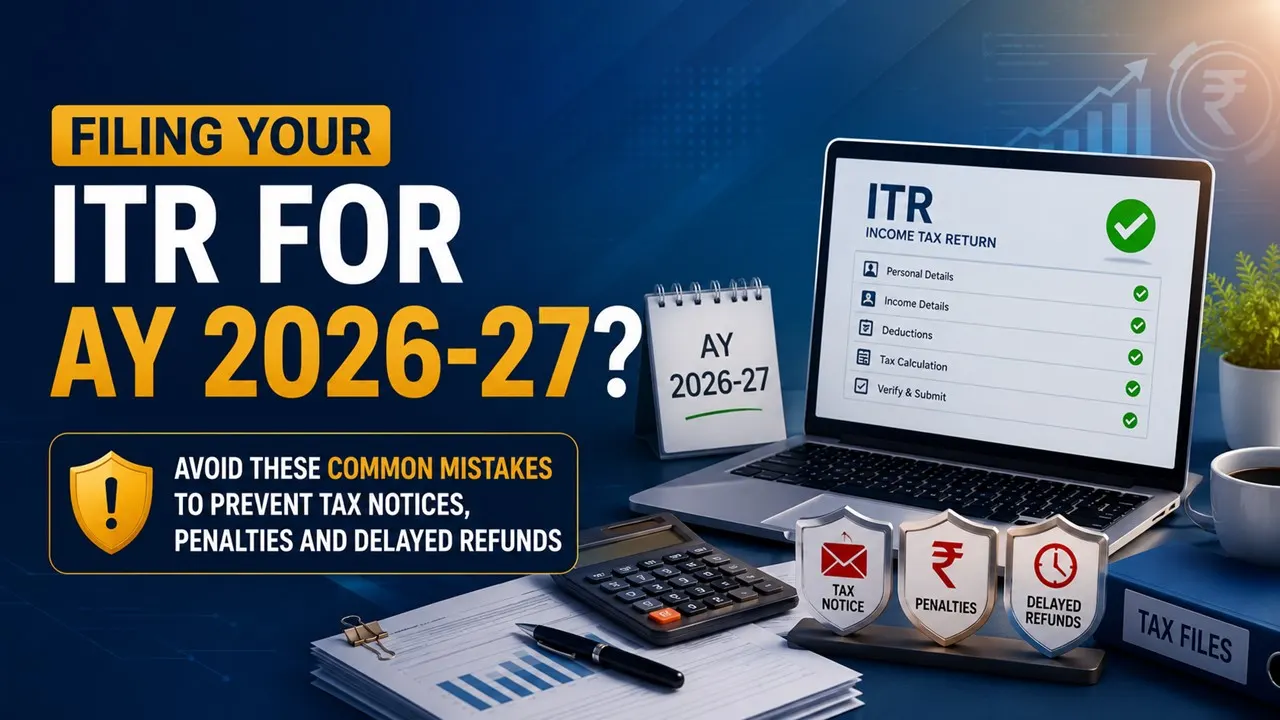
Avoid these common ITR filing mistakes for AY 2026-27 to prevent tax notices, penalties, delayed refunds, and invalid return issues.
Key ITR Filing Errors That Trigger Tax Notices and Penalty Fees
 Saloni Kumari
 Jul 20, 2026
Table of Contents

It is very important to file an income tax return (ITR) correctly, as even a minor mistake can lead to tax notices, penalties, delayed refunds, or even make your return invalid or delayed. As the ITR filing season for the Assessment Year (AY) 2026-27 is ongoing, it is important for taxpayers to carefully review all details before submitting the return. Here's a list of the top common mistakes taxpayers should avoid while filing their ITR:
Not Filing ITR On or Before Statutory Deadline
One of the biggest mistakes is missing the ITR filing deadline. Filing your return after the due date can attract a late filing fee under Section 234F of the Income Tax Act. The fee can go up to Rs 5,000, while taxpayers with total income up to Rs 5 lakh may have to pay a maximum of Rs 1,000.

Selection of Incorrect ITR Form or Tax Regime
Selection of an incorrect ITR form can delay the processing of your return or make it defective. Similarly, taxpayers should deeply analyse both tax regimes, i.e., the old and new tax regimes, before selection, as an incorrect tax regime can increase your aggregate tax liability significantly and may result in paying more tax than necessary. Taxpayers should calculate their tax liability under both regimes before making a final choice.
Ineligible Availment of Tax Deductions
Incorrectly claiming tax deductions is also a common problem. Deductions under Sections 80C, 80D and 80G should be claimed only if the eligible investments or payments were actually made during the financial year. Availment of deductions that a taxpayer is not eligible for can lead to additional tax, interest and penalties.

Discrepancies in Details of AIS and Form 26AS
Taxpayers should make sure the details disclosed in their income tax return (ITR) match the details available in AIS, Form 26AS and Form 16. Even a minor discrepancy can attract notice from the Income Tax Department and delay the processing of refunds.
Filing a Revised Return Lately
Taxpayers should be aware that they can make changes to their initial income tax return (ITR) even after filing. In case you find any mistakes after filing your original ITR, you can submit a revised return and correct your mistakes.
If you timely furnished your initial ITR, meaning within the statutory deadline, then you will not be required to pay any additional fee to file a revised return if it is filed within its legal time limit of 12 months from the end of the relevant assessment year or before the assessment is completed, whichever is earlier. However, after this time limit, a fee is applied for filing a revised return under Section 234I of the Income Tax Act.
Incorrect Disclosure of Bank Account Details
Another simple but important step is entering the correct bank account details. An incorrect account number, the wrong IFSC code or failure to pre-validate the bank account on the income tax e-filing portal can delay your refund. Taxpayers should also ensure that the bank account is linked to their PAN.
Forgetting to Verify ITR After Filing
Finally, many taxpayers forget to verify their ITR after filing it. An income tax return is considered complete only after it is verified through Aadhaar OTP, net banking, a demat account or any other approved method within the prescribed time. If the return is not verified, it is treated as invalid, which means it is considered as though no return was filed. This can delay refunds and may also result in the consequences applicable to non-filing of the return.
Under-reporting or Misreporting of Income
Another very common mistake made by the taxpayers is not disclosing their complete income. Numerous taxpayers disclose only their salary income and forget to include earnings from bank interest, fixed deposits, dividends, rental income, capital gains or freelance work. According to the provisions of Section 270A of the Income Tax Act, under-reporting income can lead to a penalty equal to 50% of the tax payable on the undisclosed amount. If income concealment or false claims are deliberately made, in that case, the penalty may increase upto 200% of the tax on the misreported income.
Totally Depending on Form 16 for Filing
Many salaried employees also depend only on Form 16 while filing their returns. However, Form 16 contains only salary details and the tax deducted by the employer. It does not include income from other sources. Taxpayers are advised to check their other documents, such as Annual Information Statement (AIS), Form 26AS, bank statements and investment records, as well, along with Form 16, to ensure that all income has been reported correctly.
About Author


Saloni Kumari
Content Writer
 StudyCafe
 Delhi, Delhi, India
 2931
2931My Recent Articles
- Rs 843.97 Crore Bogus Political Party Donation Racket Unearthed in Gujarat, Income Tax Dept Files Complaint With CID (Crime)
- Retired Central GST Commissioner Kidnapped by Unknown Persons, Assailants Nabbed Within Hours
- Madhya Pradesh HC Quashes Section 74 GST Show Cause Notice Passed Against G R Infraprojects
- GSTAT Introduces SOP for Branch Officer-to-Branch Officer (BO-to-BO) Case Transfer Ensuring Seamless Reassignment of Cases
- GSTAT: E-Way Bills Cannot Be Invalidated Merely Because They Were Not Generated by Original Supplier
Loading suggestions…


Recent Posts



All Posts


Recent Posts
All Posts