Investor Relief! HC Rules Stock-Exchange Timing Not Enough for GAAR Invocation:
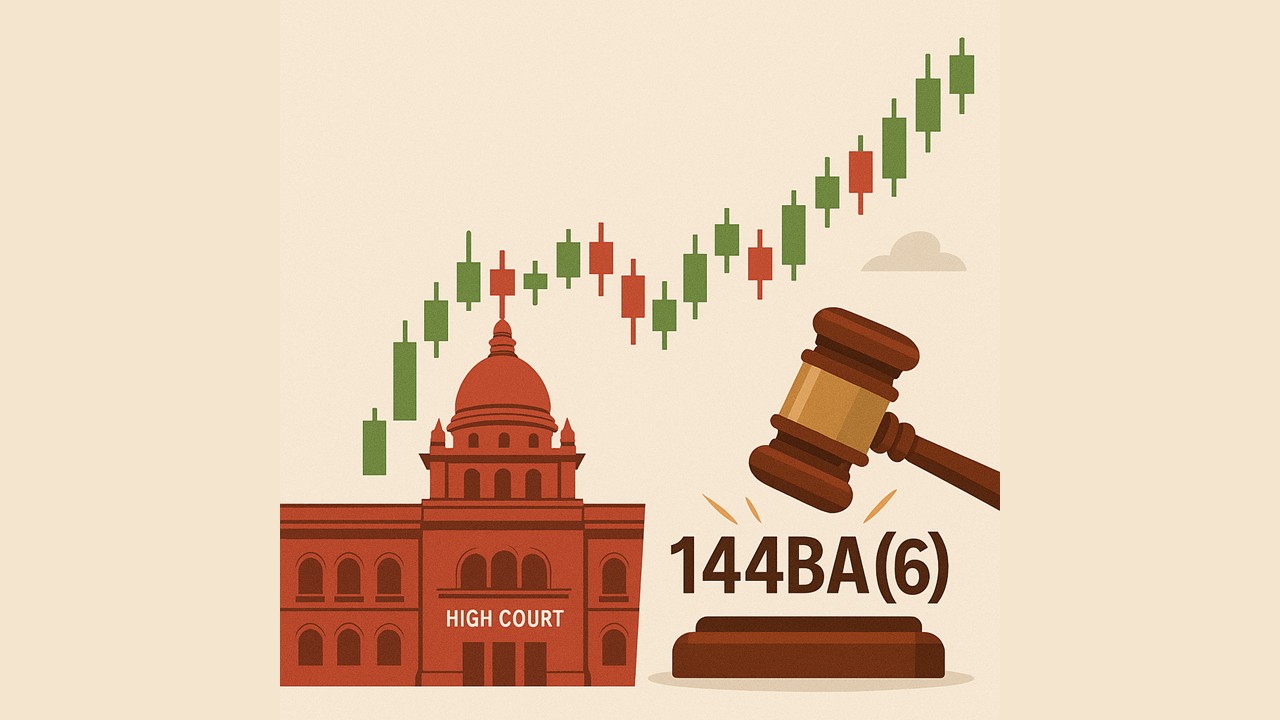
High Court sets aside GAAR order under Section 144BA(6), holding that timing of stock-exchange share trades alone cannot establish an impermissible avoidance arrangement under Section 96.
Court finds no “arrangement” or misuse under Section 96; impugned GAAR order quashed.
 Meetu Kumari
 Sep 8, 2025
Investor Relief! HC Rules Stock-Exchange Timing Not Enough for GAAR Invocation
The assessee is a long-time investor in shares and securities. As on 31.03.2020, the portfolio included shares valued at Rs. 31,88,81,428 and mutual funds of Rs. 47.59 crores. During FY 2019–20, long-term capital gains of Rs. 44,14,05,007 arose on the sale of investments. Subsequent deployments included purchases of shares of M/s. HCL Technologies Pvt. Ltd. and mutual fund units worth Rs. 32.92 crores. Part of the HCL position was sold within the same year for Rs. 17.35 crores, leaving a net investment of about Rs. 17.66 crores; cumulatively, those HCL trades resulted in a short-term loss of about Rs. 17.65 crores.
GAAR was invoked on the premise that the short-term loss was booked to offset long-term gains. The matter went to the Approving Panel, which passed an order under Section 144BA(6) dated 23.01.2023, treating the stock-exchange transactions as an impermissible avoidance arrangement. The assessee had objected, inter alia, pointing out a detailed e-reply to the Rule 10UB(1) notice and emphasising that all trades were exchange-routed through a demat account without a counterparty nexus.
Issue Before Court: Whether timing-based reliance on stock-exchange purchases and sales, absent material showing an “arrangement” or lack of commercial substance, can justify invoking GAAR by treating the transactions as an “impermissible avoidance arrangement” under Section 96.
HC Held: The Court held that GAAR requires an “arrangement” meeting the statutory ingredients in Section 96(1). On the admitted record: there was no material of trades with known persons, no nexus between purchase and sale of the specific shares, all trades occurred through the stock exchange via the investor’s demat, the conduct reflected continuous investing rather than a one-off tax device, and the Department relied essentially on timing. The Bench’s query also elicited no cogent material beyond timing.
Taking note of the expert committee’s view that stock-exchange transactions by themselves do not attract GAAR and that timing of such trades is not to be questioned, the Court concluded that Section 96 was not satisfied. The impugned order dated 23.01.2023 passed under Section 144BA(6) for AY 2020-21 was set aside.
To Read Full Judgment, Download PDF Given Below
About Author


Meetu Kumari
Content Manager
Meetu Kumari is an Experienced Advocate and Content Writer with 4+ years of demonstrated history of working in the law practice industry. Skilled in Developing Content, Researching, and Drafting. Strong professional with a Bachelor of Science (B.Sc.) focused on Law from Gujarat National Law University.
Meetu Kumari is an Experienced Advocate and Content Writer with 4+ years of demonstrated history of working in the law practice industry. Skilled in Developing Content, Researching, and Drafting. Strong professional with a Bachelor of Science (B.Sc.) focused on Law from Gujarat National Law University.
 Studycafe
 Jodhpur, Rajasthan, India
 2264
2264My Recent Articles
- ITAT Condones 302-Day Delay, Restores Salary Assessment for Fresh VerificationPremium
- ITAT Condones Delay After Tax Consultant's Death, Restores Appeals for Fresh HearingPremium
- ITAT Remands Salary Addition, Says Taxability Depends on Salary Becoming Due, Not Mere ReceiptPremium
- ITAT Deletes TP Royalty Adjustment, Orders Fresh Review of Commission BenchmarkingPremium
- ITAT Quashes Reassessment Over Unsigned Section 148 Notice Issued to AssesseePremium
Up Next
Loading suggestions…


Recent Posts
All Posts

Recent Posts
All Posts