ITAT Deletes Section 56 Addition: Allotment Letter Treated Valid as Enforceable Property Agreement:
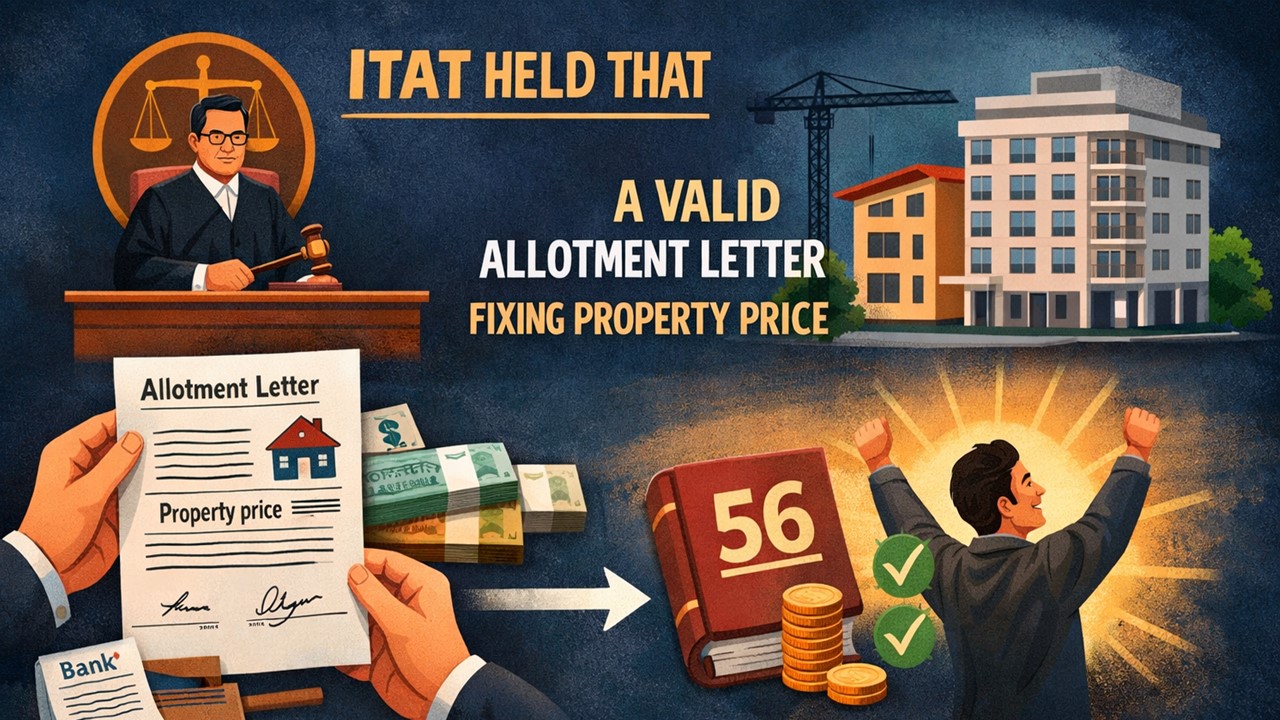
ITAT held that a valid allotment letter fixing property price and supported by bank payments is sufficient to grant relief from addition under Section 56.
Unexplained Income Addition on Property Purchase Rejected
 Saloni Kumari
 Dec 24, 2025
ITAT Deletes Section 56 Addition: Valid Allotment Letter Treated as Enforceable Property Agreement
ITAT held that a valid allotment letter fixing the property price and payment terms qualifies as an agreement. Since part payment was made through banking channels, an addition under Section 56(2)(vii)(b) was unjustified and hence deleted.
Raghavendra Ramakrishna Naik filed the present appeal in the ITAT Mumbai, challenging an order dated January 28, 2025, passed by the Income Tax Officer (ITO).
The assessee in the Assessment Year 2016-17 had purchased an immovable property in Mumbai amounting to Rs. 81,80,500; however, they had not filed an Income Tax Return (ITR) for the year in consideration. The information was pointed out as per the Risk Management Strategy formulated by CBDT through the ITBA portal under the category “NMS cases.”
When examined, it was noticed that there was a difference in the purchase value of the flat mentioned in the registered sale agreement dated March 17, 2016, and that mentioned in the allotment letter dated September 29, 2010, passed by the builder, for which the assessee had made a part payment through an account payee cheque for booking of the said flat. Considering this difference, the AO treated the full difference amount of Rs. 18,95,000 as unexplained money under 56(2)(vii)(b) and made an addition of the same to the assessee's income.
The aggrieved assessee filed an appeal before the ITAT Mumbai. The tribunal deeply examined all the relevant documents related to the sale of the property in question, including the allotment letter, bank statements, and proof of payments made by the assessee. The tribunal also analysed the ruling of lower authorities and provisions of section 56(2)(x)/56(2)(vii)(b). The tribunal deeply analysed the letter of allotment, mentioning the terms and conditions related to payment of the property in question, agreed upon by both the builder and the buyer.
The law provides relief in cases where the agreement fixing the price of property is entered into earlier; however, the registration takes place later, and part of the payment is made through banking channels. This prevents hardship due to an increase in stamp duty value over time. In the present case, the assessee fulfils the aforementioned conditions. The tribunal also noted that the AO and tax department had objected that the allotment letter was not an “agreement.”
However, the Tribunal discovered that the allotment letter furnished by the assessee clearly fixed the value of the property, the payment schedule, and identified the flat exclusively for the assessee. It was enforceable and satisfied the requirements of a valid contract.
Thus, in the final ruling, the tribunal cited provisions of Section 56 and ruled that the addition made by the AO was not fair, hence set aside the same, and allowed the assessee's appeal.
About Author


Saloni Kumari
Content Writer
Saloni is a Content Writer with 2+ years of experience at studycafe.in. She writes legal, taxation, and finance related content including GST, Income Tax etc. Skilled in translating complex judicial pronouncements and regulatory developments into clear, and reader-friendly articles. Experienced in covering judgements of ITAT, High Court, GSTAT, and news related to Income Tax, GST, and corporate law. She can be reached at [email protected].
Saloni is a Content Writer with 2+ years of experience at studycafe.in. She writes legal, taxation, and finance related content including GST, Income Tax etc. Skilled in translating complex judicial pronouncements and regulatory developments into clear, and reader-friendly articles. Experienced in covering judgements of ITAT, High Court, GSTAT, and news related to Income Tax, GST, and corporate law. She can be reached at [email protected].
 StudyCafe
 Delhi, Delhi, India
 2924
2924My Recent Articles
- Major Relief in Arbitration Case: MCIA Denies Rs 908 Crore Statement Claim Made by Allied Silica Against Tata Chemicals
- MCA and ICSI to Hold User Awareness Session on Form AOC-4 Filing Amid Glitches on MCA-21 Version-3 Portal
- GSTN Introduces New E-Invoicing Facility for Self-Invoices Under Reverse Charge Mechanism
- Flexi Cap vs Multi Cap Funds: What's the Real Difference?
- IBA Recommends Public Sector Banks to Reduce Ambit of Physical Branch Audits to 50% of Total Business
Up Next
Loading suggestions…


Recent Posts
All Posts


Tags
Recent Posts
All Posts