ITAT Holds Opening Cash Cannot Be Added Without Supporting Evidence:
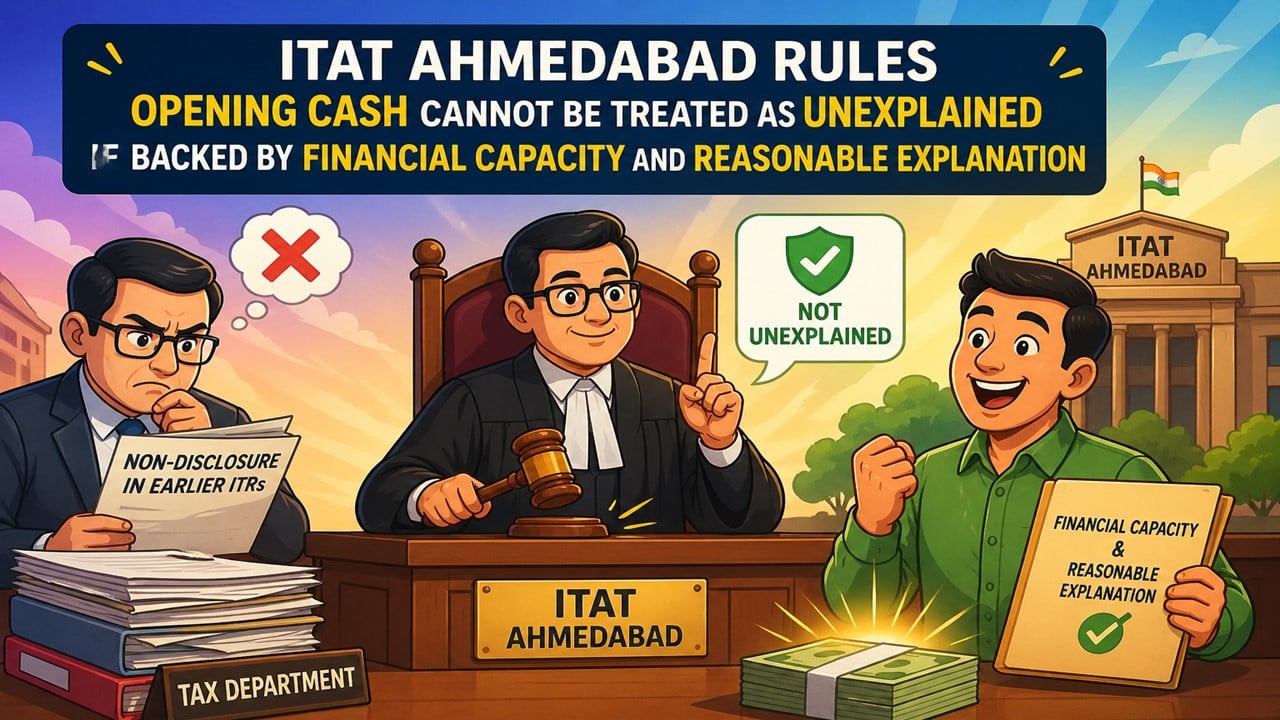
The ITAT Ahmedabad rules that opening cash cannot be treated as unexplained merely due to non-disclosure in earlier ITRs if backed by financial capacity and reasonable explanation.
Opening Cash Valid If Supported by Financial Capacity: ITAT
 Meetu Kumari
 Apr 28, 2026
ITAT Holds Opening Cash Cannot Be Added Without Supporting Evidence
The assessee, an individual, filed his return for AY 2017-18, declaring income of Rs 84.86 lakh. During scrutiny, the assessing officer noticed that the assessee had shown an opening cash in hand of Rs.1,098,810 as of 01.04.2016, whereas in the return for AY 2016-17, the cash balance was disclosed as "Nil". On being questioned, the assessee explained that earlier returns did not require balance sheet disclosure and that the cash represented accumulated withdrawals from bank accounts out of income already offered to tax.
The heart of the dispute is a large opening cash balance that the taxpayer claimed was simply part of his business financials. He pointed out a specific trigger: because he started trading in Futures & Options (F&O) during the 2016-17 assessment year, he hit the threshold where a formal tax audit became mandatory. That audit forced a full disclosure of his books, which included the cash he had on hand.
Main Issue: Whether an opening cash balance can be taxed under Section 69A solely for prior non-disclosure, despite an explanation of past taxed income and financial capacity?
Tribunal Decided: The Tribunal’s ruling is a major victory for taxpayers against the "presumption of guilt" often used in cash-related additions. By deleting the Rs. 1,098,810 addition, the Tribunal reinforced that the burden of proof under Section 69A isn't an impossible mountain to climb if the taxpayer’s story is financially logical. The ITAT rejected the tax department's "gotcha" tactics, focusing instead on the actual financial capacity of the assessee. Here is the breakdown of why the tribunal ruled in favour of the taxpayer. The assessee argued that the cash didn't appear out of thin air; it was simply saved over time from withdrawals made out of previously disclosed (and taxed) income.
The Tribunal found this highly plausible because the assessee had a history of high-reported incomes. While the lower court (CIT(A)) had blocked the cash book as "new evidence", the Tribunal focused on the bigger picture. It ruled that the core question wasn't about the timing of the paperwork but whether the explanation was reasonable. Given the taxpayer's financial capacity, the Tribunal concluded they had successfully "discharged the burden" of proving the source of the money.
To Read Full Order, Download PDF Given Below

About Author


Meetu Kumari
Content Manager
Meetu Kumari is an Experienced Advocate and Content Writer with 4+ years of demonstrated history of working in the law practice industry. Skilled in Developing Content, Researching, and Drafting. Strong professional with a Bachelor of Science (B.Sc.) focused on Law from Gujarat National Law University.
Meetu Kumari is an Experienced Advocate and Content Writer with 4+ years of demonstrated history of working in the law practice industry. Skilled in Developing Content, Researching, and Drafting. Strong professional with a Bachelor of Science (B.Sc.) focused on Law from Gujarat National Law University.
 Studycafe
 Jodhpur, Rajasthan, India
 2264
2264My Recent Articles
- ITAT Condones 302-Day Delay, Restores Salary Assessment for Fresh VerificationPremium
- ITAT Condones Delay After Tax Consultant's Death, Restores Appeals for Fresh HearingPremium
- ITAT Remands Salary Addition, Says Taxability Depends on Salary Becoming Due, Not Mere ReceiptPremium
- ITAT Deletes TP Royalty Adjustment, Orders Fresh Review of Commission BenchmarkingPremium
- ITAT Quashes Reassessment Over Unsigned Section 148 Notice Issued to AssesseePremium
Up Next
Loading suggestions…


Recent Posts

All Posts

Recent Posts
All Posts