ITAT Holds Section 11 Exemption Cannot Be Denied to Educational Trust Merely for Excess Fee Collection:
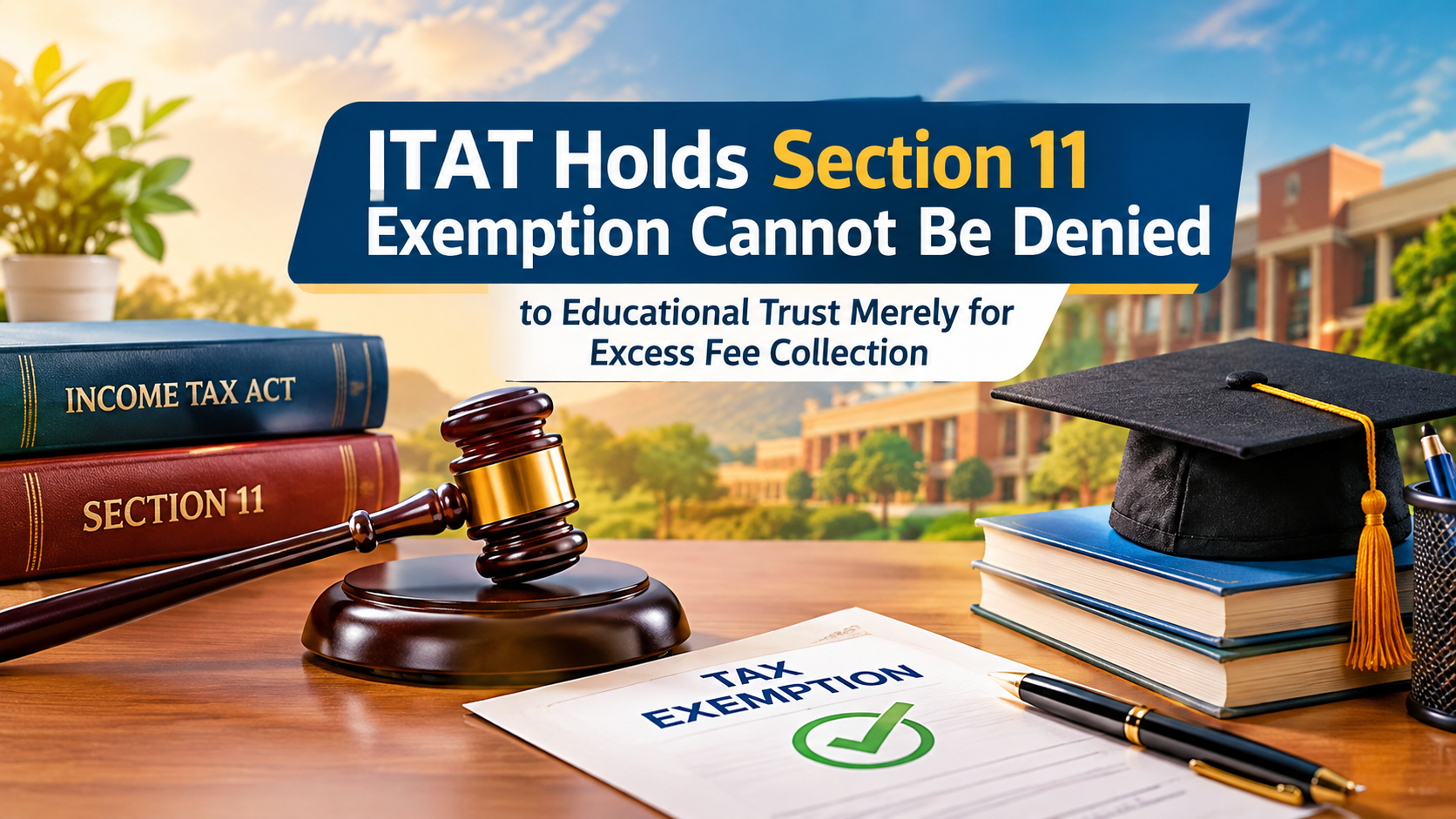
The ITAT restored Exemption under Section 11 as fee dispute was pending before Odisha High Court
ITAT Allowed Exemption
 Saima
Saima Oct 9, 2026
The assessee was a registered charitable educational trust engaged in imparting B.Tech., Diploma and equivalent technical education in Odisha. The trust had been granted registration under Section 12AA of the Income Tax Act with effect from April 9, 2007. For AY 2010-11, it filed its return declaring nil income. During assessment, the AO noticed that the trust had disclosed gross income of Rs. 7.41 crore, including academic receipts of approximately Rs. 7.30 crore from tuition fees and other educational charges. The AO alleged that the trust had collected fees over and above the amounts prescribed by the Government.
According to the AO, the excess collections were utilised for infrastructure expansion and educational activities and, therefore, the activities could not be regarded as purely charitable. Consequently, the AO denied exemption under Section 11, treated the assessee as an AOP instead of a trust, and added the surplus of Rs. 26,06,930 to its income.

The appeal was filed by Indus Educational & Charitable Trust against the order of the CIT(A) which had confirmed the assessment order passed by the AO for Assessment Year 2010-11. Before the Tribunal, the assessee submitted that imparting education falls within the definition of “charitable purpose” under Section 2(15) and that its registration under Section 12AA remained valid. It argued that no violation of Sections 11 to 13 had been established by the AO.
The assessee further pointed out that the prescribed fee structure itself was under challenge before the Odisha High Court. The Tribunal noted that the AO had not alleged that the trust was conducting activities outside its stated objects or undertaking commercial activities with a profit motive. The sole basis for denying Section 11 exemption was the alleged collection of fees over the prescribed limit. The Tribunal also took note of the fact that the Odisha High Court had permitted the assessee to retain the additional fees pending disposal of the writ petitions.

The Tribunal observed that the question concerning collection of excess fees was still pending before the Odisha High Court and, therefore, it was inappropriate to make a final adverse finding against the assessee on that issue. The Tribunal held that the benefit of Section 11 could not be denied merely on the allegation of collection of fees over the prescribed limit, particularly in view of the interim orders passed by the Odisha High Court.
About Author


Saima
Content Writer
 StudyCafe
 Delhi, Delhi, India
 521
521My Recent Articles
- ITAT Remands Ex-Parte Assessment for Fresh Adjudication
- ITAT Holds SBI Not in Default for Non-Deduction of TDS on LFC During Interim Protection
- High Court Holds GST Notices and Orders Valid Despite No Visible Digital Signature
- ITAT Remits Rs.49.55 Lakh Agricultural Income Addition to CIT(A)
- ITAT Remits Profit Estimation and Salary Disallowance Matter for Fresh Adjudication
Loading suggestions…


Recent Posts
All Posts
Recent Posts
All Posts