ITAT Quashes Penalties for Failure to Specify Exact Charge in Notices Under Sections 271(1)(c) & 270A:
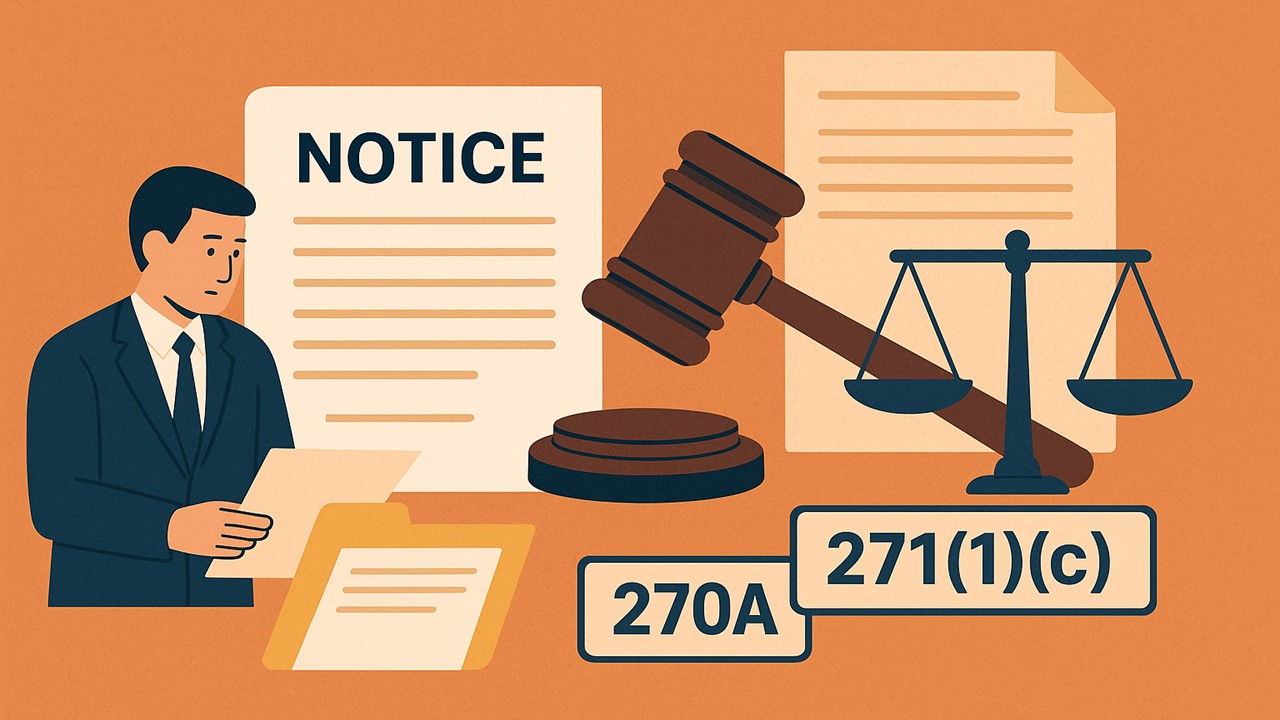
Tribunal rules that vague and non-specific penalty notices invalidate the levy; AO must clearly state specific charge.
ITAT: Specify Exact Charge in Notices
 Meetu Kumari
 Nov 17, 2025
ITAT Quashes Penalties for Failure to Specify Exact Charge in Notices Under Sections 271(1)(c) & 270A
The Revenue filed four appeals against orders of the CIT(A) deleting penalties imposed on Ajay Vision Education Pvt. Ltd. for AYs 2016-17, 2017-18, 2018-19, and 2019-20. For AY 2016-17, penalty was levied u/s 271(1)(c) following reassessment in which the unrecorded cash income of Rs. 98,59,655 was added. For the other three years, penalties were levied u/s 270A. Before the CIT(A), the assessee argued that the penalty notices did not specify the exact limb of the provision invoked, whether concealment vs furnishing inaccurate particulars under Section 271(1)(c), or under-reporting vs mis-reporting under Section 270A.
Appeal before CIT(A): The CIT(A) accepted this contention, pointing out fundamental defects in the notices and inconsistencies between the assessment order and the penalty notice. The Revenue appealed to the ITAT.
Issue Before Tribunal: Whether penalties imposed under Sections 271(1)(c) and 270A are sustainable when the penalty notices fail to specify the exact charge or limb of the provision invoked.
ITAT's Ruling: The Tribunal upheld the CIT(A)’s deletion of all penalties. For AY 2016-17, it held that the notice u/s 274 r/w 271(1)(c) only mentioned “concealment” even though the assessment order’s reasoning suggested issues relating to “furnishing inaccurate particulars,” rendering the notice vague and legally defective. Relying on judicial precedents, including Delhi High Court rulings in Neeraj Jindal, Sahara India Life Insurance, and the Supreme Court affirmation in SSA’s Emerald Meadows, it held that a clear and specific charge is mandatory.
For AYs 2017-18 to 2019-20, the Tribunal found that the notices u/s 270A failed to specify whether the alleged default was “under-reporting” or “mis-reporting,” nor did they identify the relevant clauses of Section 270A(2) or 270A(9). As a penalty is a separate and quasi-criminal proceeding, such ambiguity invalidates the levy. The ITAT therefore dismissed all Revenue appeals and affirmed deletion of penalties for all four years.
To Read Full Judgment, Download PDF Given Below
About Author


Meetu Kumari
Content Manager
Meetu Kumari is an Experienced Advocate and Content Writer with 4+ years of demonstrated history of working in the law practice industry. Skilled in Developing Content, Researching, and Drafting. Strong professional with a Bachelor of Science (B.Sc.) focused on Law from Gujarat National Law University.
Meetu Kumari is an Experienced Advocate and Content Writer with 4+ years of demonstrated history of working in the law practice industry. Skilled in Developing Content, Researching, and Drafting. Strong professional with a Bachelor of Science (B.Sc.) focused on Law from Gujarat National Law University.
 Studycafe
 Jodhpur, Rajasthan, India
 2264
2264My Recent Articles
- ITAT Condones 302-Day Delay, Restores Salary Assessment for Fresh VerificationPremium
- ITAT Condones Delay After Tax Consultant's Death, Restores Appeals for Fresh HearingPremium
- ITAT Remands Salary Addition, Says Taxability Depends on Salary Becoming Due, Not Mere ReceiptPremium
- ITAT Deletes TP Royalty Adjustment, Orders Fresh Review of Commission BenchmarkingPremium
- ITAT Quashes Reassessment Over Unsigned Section 148 Notice Issued to AssesseePremium
Up Next
Loading suggestions…


Recent Posts



All Posts

Recent Posts
All Posts