ITAT Remands Section 11 Exemption Case After Revenue Fails to Prove Taxpayer's Engagement in Commercial Activity:
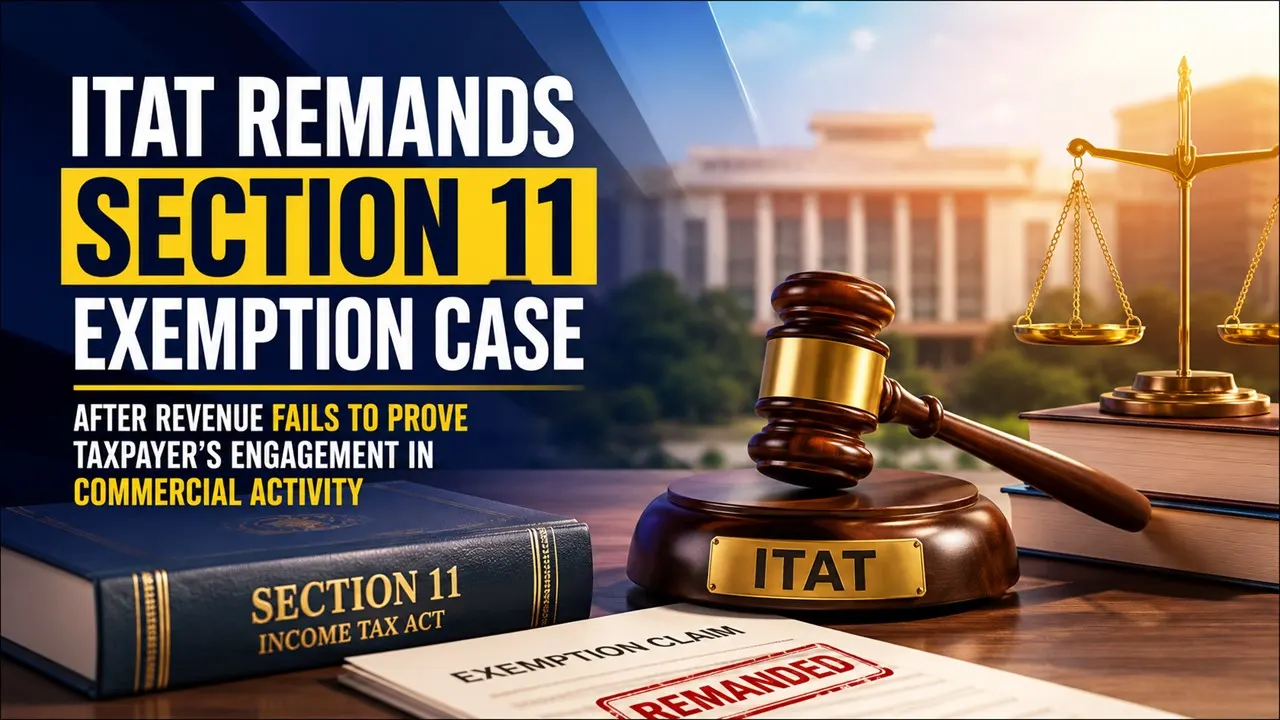
The ITAT Delhi remands Section 11 exemption case after the tax authorities fails to prove that educational institute engaged in trade or commercial activities.
Revenue Must Prove Trade or Business Before Denying Section 11 Exemption, Says ITAT
 Saloni Kumari
 Jun 30, 2026
ITAT Remands Section 11 Exemption Case After Revenue Fails to Prove Taxpayer's Engagement in Commercial Activity
The ITAT Delhi Bench remanded the case of a Section 11 exemption claim by an educational institute registered under Section 12A of the Income Tax Act, considering the Revenue's failure to submit proper evidence proving that the assessee was engaged in trade, commerce or business.
The Federation of Hotel & Restaurant Associations of India (Assessee) is a society registered under Section 12A of the Income Tax Act. The assessee's key objective is to consolidate the four regional associations in the country, including the Hotel & Restaurant Association of Eastern India (HRAEI), the Hotel and Restaurant Association of Northern India (HRANI), the South India Hotels and Restaurants Association (SIHRA), and the Hotel & Restaurant Association (Western India) – HRAWI. During the year under consideration, the assessee had claimed exemption under Section 11 of the Act. The assessee is an educational institute running an institute of hospitality management.
During the return processing, the Assessing Officer (AO) got to know from the assessee's income and expenditure account that it had received an annual subscription from members of Rs 2.55 crore, convention and seminar receipts amounting to Rs 27.92 lakh, a receipt on account of royalty of Rs 92.83 lakh and a fee on account of entrance fees of Rs 15.73 lakh. As per the AO's probe, the assessee's receipts were commercial in nature and not for public welfare; hence, they were not falling under the scope of charitable activities as per the amended provisions of section 2(15) of the Act.
It was also noted that the assessee's receipts from such activities during the year under consideration were 20% more than those from the preceding year. This explicitly indicates that the assessee was not involved in charitable activities; consequently, it is not eligible for tax exemptions under section 11, according to the provisions of section 2(15) of the Act. As a result, the AO disallowed the assessee's exemption claim under Section 11 of the Act, excluding application of income and, thereby, a surplus of Rs 3.31 crore and assessed it as income of the assessee.
Before the Income Tax Appellate Tribunal (ITAT), Delhi, the assessee claimed that it was never engaged in any commercial activity and hence is entitled to relief under Section 11 of the Act. It was further claimed that the tax authorities had earlier accepted the assessee's activities as charitable during the assessment years 2018-19 and 2012-13; the tax authorities should accept the same position in the present AY as well.
When the tribunal analysed the case, it noted that both the CIT(A) and the AO had not conducted any independent inquiry to find out whether the assessee was doing charitable activity or not. Additionally, the AO could not serve any evidence proving that the assessee was engaged in trade, commerce or business.
Accordingly, the tribunal set aside the CIT(A)'s order sustaining the disallowance of the claim under Section 11 of the Act and remanded the case to the Assessing Officer (AO) for fresh adjudication. The AO is instructed to adhere to the guidelines laid down by the Hon’ble Supreme Court of India in the case titled ACIT (Exemptions) vs Ahmedabad Urban Development Authority and thereafter issue a reasoned and speaking order after granting the assessee a fair opportunity of hearing.

About Author


Saloni Kumari
Content Writer
Saloni is a Content Writer with 2+ years of experience at studycafe.in. She writes legal, taxation, and finance related content including GST, Income Tax etc. Skilled in translating complex judicial pronouncements and regulatory developments into clear, and reader-friendly articles. Experienced in covering judgements of ITAT, High Court, GSTAT, and news related to Income Tax, GST, and corporate law. She can be reached at [email protected].
Saloni is a Content Writer with 2+ years of experience at studycafe.in. She writes legal, taxation, and finance related content including GST, Income Tax etc. Skilled in translating complex judicial pronouncements and regulatory developments into clear, and reader-friendly articles. Experienced in covering judgements of ITAT, High Court, GSTAT, and news related to Income Tax, GST, and corporate law. She can be reached at [email protected].
 StudyCafe
 Delhi, Delhi, India
 2948
2948My Recent Articles
- Maharashtra Govt Eases Registration of Jointly Owned Land Sales, ‘KA’ Copy Can Replace Co-Owners’ NOC
- No Separate Section 69C Unexplained Expenditure Addition Allowed After Accepting Section 44AD Income Without Supporting Evidence: ITAT
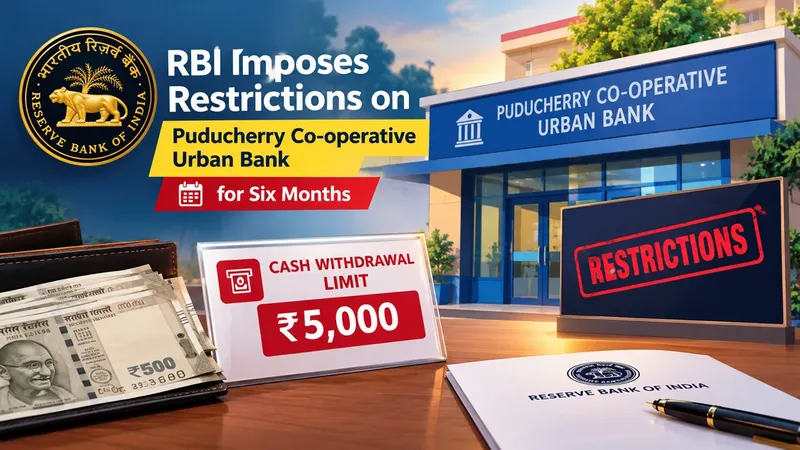
- RBI Imposes Restrictions on Puducherry Co-operative Urban Bank for Six Months, Caps Cash Withdrawals at Rs 5,000
- ICAI Opens Application Window for Empanelment of Members to Act as Observer at CA January 2027 Exams
- ICAI CA Inter Sept 2026 Result OUT at caresults.icai.org, Check Steps to Download
Up Next
Loading suggestions…


Recent Posts

All Posts
Recent Posts
All Posts