ITC Can't Be Denied for Seller's Default: HC Rules State Must Recover Tax from Seller, Not Bona Fide Purchaser:
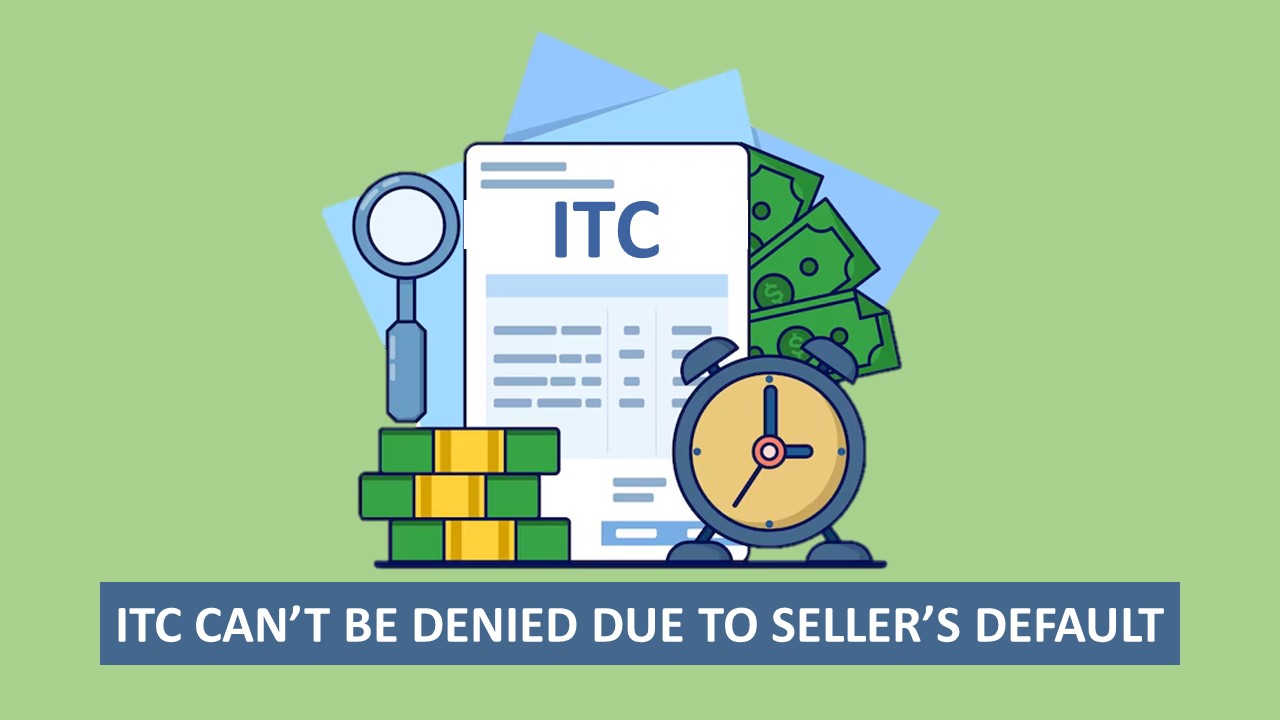
ITC can be availed by the compliant purchaser under the Kerala Value Added Tax Act, 2003, even if the seller has failed to remit the tax to the government.
Compliant Purchaser Not Responsible for Seller's Default: HC
 Nidhi
Nidhi Jul 30, 2025
ITC Can't Be Denied for Seller's Default: HC Rules State Must Recover Tax from Seller, Not Bona Fide Purchaser
The Kerala High Court has recently passed an important judgement in an ITC Case where the petitioner was rejected from claiming Input Tax Credit (ITC) for purchases from a registered dealer, who collected tax but did not deposit it to the government. Read below to know what the court held in this case.
The petitioner, S.P. Faizal, was denied the claim of ITC for purchases just because the selling dealer who collected the tax failed to deposit it to the government. Even though the petitioner had proper tax invoices and had complied with the law, he was denied the ITC Claim. Therefore, the petitioner filed a writ petition in the Kerala High Court.
The question was "Whether the credit of input tax can be availed by the purchasing dealer if the selling dealer had failed to remit the tax due at an earlier instance under the provisions of the Kerala Value Added Tax Act, 2003". Earlier Division Bench ruling in C.P. Rasheed v. State of Kerala had held that ITC could be denied in such cases.
The petitioner relied on the judgement passed in On Quest Merchandising (Supra) and in Arise India Ltd. v. Commissioner of Trade and Taxes, which concluded that purchasers should not be held responsible and penalised for the seller's default.
The petitioner argued that Section 2(xxiii) of KVAT defines input tax as "tax paid or payable", which indicates that credit should be available if the purchaser has paid the tax, no matter whether the seller has remitted the tax or not.
The petitioner also outlines Section 11, which mentions specific conditions for availing ITC, none of which include the selling dealer's tax payment status. It was stated by the petitioner that the denial would undermine the VAT system's objective of preventing the cascading effect.
The High Court observed that if the purchaser is denied ITC merely on the grounds that the seller failed to remit the collected tax, then this can lead to a cascading effect. The purchaser will have to pay tax twice: first to the seller and then through the denial of ITC. Additionally, it would also put an extra burden on the purchaser to monitor the tax compliance of the seller, which would affect the business operations of the purchaser. The bona fide purchaser who complied with all tax requirements would have to face legal issues, while the seller who did not deposit the tax would escape the scrutiny. This is an unfair burden and an unreasonable requirement. The court observed that this would encourage the state government to prioritise recovering tax from the compliant purchasers instead of the defaulting sellers, undermining the object of the Credit Scheme under the KVAT Act.
The Kerala High Court disagreed with the view of C.P. Rasheed and called it incorrect. The High Court ruled that ITC can be legitimately availed by the compliant purchaser under the Kerala Value Added Tax Act, 2003, even if the seller has failed to remit the tax to the government. The court also directed that unpaid tax should be recovered from the defaulting seller rather than the compliant purchaser.

About Author


Nidhi
Content Writer
Nidhi is a skilled content writer specializing in personal finance. She creates clear, engaging articles on mutual funds, investments, insurance, and wealth-building strategies. With a passion for simplifying complex financial topics, Nidhi helps readers make informed money decisions with confidence. She can be reached at [email protected]
Nidhi is a skilled content writer specializing in personal finance. She creates clear, engaging articles on mutual funds, investments, insurance, and wealth-building strategies. With a passion for simplifying complex financial topics, Nidhi helps readers make informed money decisions with confidence. She can be reached at [email protected]
 Studycafe
 New Delhi, Delhi, India
 1832
1832My Recent Articles
- Karnataka High Court Gives Another Chance in GST Matter Due to Lack of Hearing
- Delay Should Be Condoned if Explanation is Unrefuted: ITAT
- Non-Service of Income Tax Notice, Ill health of taxpayer, ITAT condones Appeal filing delay
- Books of Accounts Cannot be Rejected Without Any Specific Defect: ITAT Kolkata
- Karnataka High Court Sends ITC Matter Back to GST Authorities for Reconsideration
Up Next
Loading suggestions…


Recent Posts


All Posts
Recent Posts
All Posts