Ten Big Tax Changes Middle-Class Taxpayers May Hope for in Budget 2026:
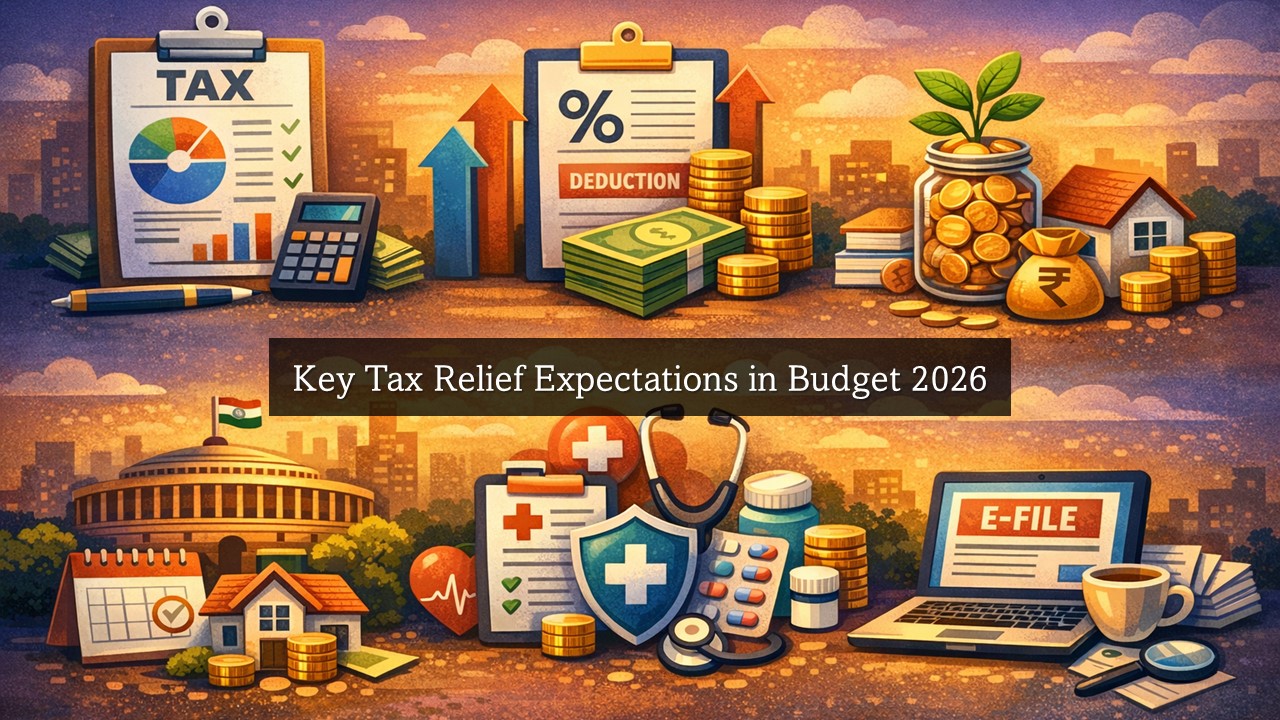
A quick look at the top tax changes and relief measures experts expect for middle-class and salaried taxpayers in Union Budget 2026.
Key Tax Relief Expectations for Salaried and Middle Class
 Saloni Kumari
 Jan 24, 2026
Ten Big Tax Changes Middle-Class Taxpayers May Hope for in Budget 2026
Taxpayers have great expectations from the Union Finance Minister Nirmala Sitharaman concerning the Budget 2026, after the superhit Budget 2025 release. The Budget 2026 release date, i.e., February 01, 2026, is approaching.
Some experts think the government will have already used most of its financial capacity in 2025 due to major reductions in income tax and GST rates last year. Therefore, they believe the government may not give any big tax relief in the near future. However, some experts believe that there are still areas that need improvements to several tax rules.
Here's a list of 10 changes likely to occur this year for common taxpayers, including middle-class and salaried employees:
Tax rebate on capital gains
- In the previous Budget 2025, income up to Rs. 12 lakh was declared as free from income tax by increasing the Section 87A rebate to Rs. 60,000. However, this rebate only applies to taxpayers who do not earn any capital gains from equity shares or mutual funds. Meaning, taxpayers may be required to pay tax, even if their total income is below Rs. 12 lakh, if their income includes gains from equity investments. Now, experts believe that this is unfair for the taxpayers earning equity capital gains; this tax-free income relief should also be made available for them.
- Numerous experts believe that India may bring back the earlier 182-day residency rule, where NRIs and PIOs were considered residents only if they stayed in India for 182 days or more in a year. They believe that the present residency rules are too convoluted and difficult to understand and comply with, especially for NRIs and PIOs who visit India. Because of this complication, several taxpayers are getting confused, facing tax problems, and having difficulties in understanding whether they are classified as residents or non-residents for tax purposes.
- Currently, salaried taxpayers and pensioners get a standard deduction of up to Rs. 75,000 under the New Tax Regime. Meaning, their total taxable income is calculated after deducting this amount. This reduces their overall taxable income. However, numerous experts believe that this deduction is really low and should be increased to at least Rs. 1 lakh or Rs. 1.5 lakh so that people can save more tax and have more take-home income.
- Presently, taxpayers under the Old Tax Regime are only allowed to claim income tax deductions on health insurance premiums. This benefit is not available under the New Tax Regime. Experts believe that this benefit should also be available for taxpayers under the New Tax Regime, so people under this regime can also save on tax when they buy health insurance.
- As per the current rules, taxpayers are required to pay an extra tax called a surcharge if their total income exceeds the limit of Rs. 50 lakh. Under the new tax regime, taxpayers do not claim deductions; hence, their income looks much higher and appears to exceed the Rs. 50 lakh limit. Now, the key problem here is that even a small increase in income leads to the imposition of a 10% surcharge on the entire income and not just on the increased portion of income. This causes a sudden and unfair jump in tax. Therefore, experts believe that this limit of surcharge should be increased so that taxpayers are not punished too heavily for a slightly higher income.
- Present-day buying of homes has become harder for several individuals as house prices are rising and current tax benefits are not enough to bear this expense. Therefore, experts think that the government may increase tax deductions on home loan interest to Rs. 5 lakh so that buyers get more financial relief. They also recommend giving this tax benefit even to people who choose the new tax regime, not just the old one.
- Currently, there are a total of six distinct TDS rates available in the tax system, i.e., 0.1%, 1%, 2%, 5%, 10%, and 20%. However, ICAI has proposed to limit these TDS rates to just two: 1% and 5%.

- Presently, the HRA tax exemption is limited to 50% of salary in metro cities and 40% in non-metro cities. But these limits do not align with real rental costs nowadays. Therefore, several experts believe that the government may amend HRA rules in the future, especially because rents in Tier-2 cities are now almost as high as those in metro cities.
About Author


Saloni Kumari
Content Writer
Saloni is a Content Writer with 2+ years of experience at studycafe.in. She writes legal, taxation, and finance related content including GST, Income Tax etc. Skilled in translating complex judicial pronouncements and regulatory developments into clear, and reader-friendly articles. Experienced in covering judgements of ITAT, High Court, GSTAT, and news related to Income Tax, GST, and corporate law. She can be reached at [email protected].
Saloni is a Content Writer with 2+ years of experience at studycafe.in. She writes legal, taxation, and finance related content including GST, Income Tax etc. Skilled in translating complex judicial pronouncements and regulatory developments into clear, and reader-friendly articles. Experienced in covering judgements of ITAT, High Court, GSTAT, and news related to Income Tax, GST, and corporate law. She can be reached at [email protected].
 StudyCafe
 Delhi, Delhi, India
 2922
2922My Recent Articles
- GSTN Introduces New E-Invoicing Facility for Self-Invoices Under Reverse Charge Mechanism
- Flexi Cap vs Multi Cap Funds: What's the Real Difference?
- IBA Recommends Public Sector Banks to Reduce Ambit of Physical Branch Audits to 50% of Total Business
- ITAT Directs AO to Reconsider Rs 16.44 Lakh Capital Gains and Rs 25.87 Lakh Stamp Duty Value Addition
- ITAT Remands Rs 3.33 Crore Demonetisation Cash Deposit Case to AO, Directs Rs 10,000 Relief Fund Payment
Up Next
Loading suggestions…


Recent Posts



All Posts


Tags
Recent Posts
All Posts