ITR Filing: How to decide which ITR Form I need to file:
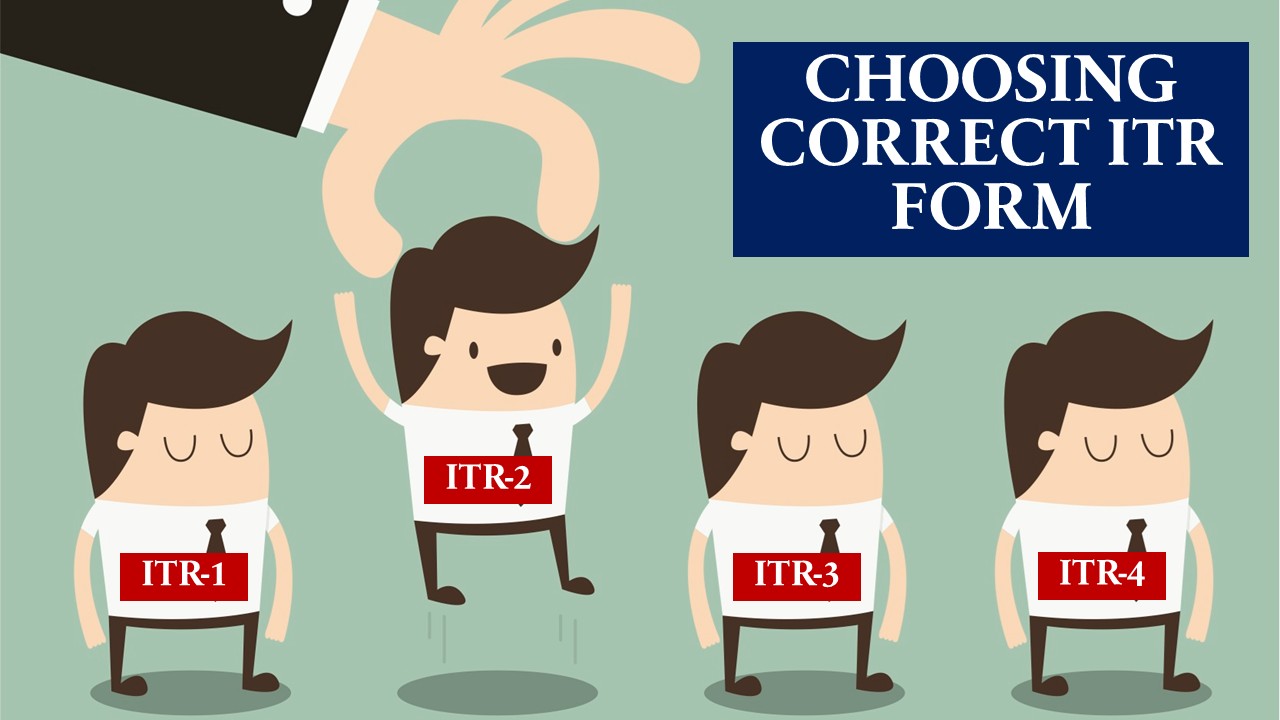
How to decide which ITR Form I need to file to avoid income Tax Notice Deciding correct ITR Form How to decide which ITR Form I need to file to avoid income Tax Notice
Deciding correct ITR Form
 CA Pratibha Goyal
 May 5, 2025
Table of Contents

In this article, we have discussed which income tax return (ITR) form one is required to choose at the time of filing the Return of Income Tax for the financial year 2024-25.
Choosing the correct ITR form is very important. An incorrect ITR Form can leave your ITR filing defective and invite an income tax notice.
Who can use ITR -1 Sahaj
Return Form ITR - 1 (SAHAJ) can be used by an individual having Income from Salaries, one house property, other sources (Interest etc.) and having total income upto Rs.50 lakh and whose total income includes: (1) Income from salary/pension; or (2) Income from one house property (excluding cases where loss is brought forward from previous years); or (3) Income from other sources (excluding winnings from lottery and income from race horses, income taxable under section 115BBDA or Income of the nature referred to in section 115BBE). (4) Income from Long Term Capital Gain under section 112A up to Rs. 1.25 Lakhs Further, in a case where the income of another person like spouse, minor child, etc., is to be clubbed with the income of the taxpayer, this return form can be used only when such income falls in any of the above categories.Return Form ITR - 1 (SAHAJ) cannot be used by an individual:
- Who is a Non-resident or Not Ordinarily Resident
- Who is a Director of a company
- Whose total income exceeds Rs. 50 lakhs
- Who has income from more than 1 house property
- Who has held unlisted equity shares at any time during the previous year
- Who claims deduction under section 80QQB or section 80RRB in respect of royalty from patents or books
- Who is a person in whose case tax has been deducted under section 194N.
- Who is a person in whose case payment or deduction of tax has been deferred under section 191(2) or section 192(1C)
- Who claims deduction under section 10AA or Part-C of Chapter VI-A
- Who has brought forward loss or losses to be carried forward under any head
- Person claiming deduction under section 57 from income taxable under the head 'Other Sources'(other than deduction allowed from family pension)
- Who wants to claim relief under section 90 or section 91
- Who wants to claim credit of tax deducted at source in the hands of any other person.
- Who has any assets (including Financial Interest in an entity) located outside India.
- Who has signing authority in any account outside India
- Who has any income to be apportioned in accordance with provisions of section 5A
- Who has any of the following income:
- Income from Business or Profession
- Capital Gains except Long Term Capital Gain under section 112A up to Rs. 1.25 Lakhs
- Income taxable under the head 'Other sources' which is taxable at special rate
- Dividend income exceeding Rs. 10 lakhs taxable under section 115BBDA
- Unexplained income (i.e., cash credit, unexplained investment, etc.) taxable at 60% under section 115BBE
- Agricultural Income exceeding Rs. 5,000
- Income from any source outside India
ITR Form 2
Form ITR - 2 can be used by an individual and Hindu Undivided Family who is not eligible to fileITR-1 Sahaj and not having income from “profit and gains of business or profession” and also not having income from “Profits and gains of business or profession” in the nature of interest, salary, bonus, commission or remuneration, by whatever name called, due to, or received by him from a partnership firm. Further, in case where the income of another person like spouse, minor child, etc., is to be clubbed with the income of the taxpayer, this Return Form can be used if income to be clubbed falls in any of the above categories. Who cannot use ITR - 2? Form ITR - 2 cannot be used by an individual and HUF whose total income for the year includes income from profit and gains from business or profession and also having income in the nature of interest, salary, bonus, commission or remuneration, by whatever name called, due to, or received by him from partnership firmITR Form 3
Form ITR - 3 can be used by an individual or a Hindu Undivided Family who is having income from profits and gains of business or profession.ITR - 3 is also required to be filed by a person whose income is chargeable to tax under the head “Profits and gains of business or profession” is in the nature of interest, salary, bonus, commission or remuneration, by whatever name called, due to, or received by him from a partnership firm. Who cannot use ITR - 3? Form ITR - 3 cannot be used by any person other than an individual or a HUF. Further, an individual or a HUF not having income from business or profession cannot use ITR - 3.Who can use ITR - 4 (SUGAM)?
Form ITR - 4 (SUGAM) can be used by an Individual/HUF/Firm (Other than LLP) whose total income for the year includes: (a) Business income computed as per the provisions of section 44AD or 44AE; or; (b) Income from Profession as computed as per the provisions of 44ADA; or (c) Income from salary/pension; or (d) Income from one house property (excluding cases where loss is brought forward from previous years); or (e) Income from other sources (excluding winnings from lottery and income from race horses, dividend income in excess of Rs. 10 lakhs or unexplained Income, etc. as referred to in section 115BBE) (f) Income from Long Term Capital Gain under section 112A up to Rs. 1.25 Lakhs Further, in a case where the income of another person like spouse, minor child, etc., is to be clubbed with the income of the taxpayer, this return form can be used where income to be clubbed falls in any of the above categories. Who cannot use ITR - 4 (SUGAM)?
Form ITR - 4 (SUGAM) cannot be used by an individual/HUF:- Who is a Non-resident or Not Ordinarily Resident
- Who is a Director of a company
- Whose total income exceeds Rs. 50 lakhs
- Who has income from more than one House Property
- Who has held unlisted equity shares at any time during the previous year
- Who claims deduction under section 80QQB or section 80RRB in respect of royalty from patent or books
- Who claims deduction under section 10AA or Part-C of Chapter VI-A
- Who has brought forward loss or losses to be carried forward under any head
- Who has income of the nature specified in section 17(2)(vi) on which tax is payable or deductible under section 191(2) or section 192(1C).
- Person claiming deduction under section 57 from income taxable under the head 'Other Sources' (other than deduction allowed from family pension)
- Who wants to claim relief under section 90 and section 91
- Who wants to claim credit of tax deducted at source in the hands of any other person.
- Who has any assets (including Financial Interest in an entity) located outside India.
- Who has signing authority in any account outside India
- Who has any income to be apportioned in accordance with provisions of section 5A
- Who has any of the following income:
- Income from Business or Profession other than computed under section 44AD/ 44ADA/ 44AE.
- Capital Gains or Loss except Income from Long Term Capital Gain under section 112A up to Rs. 1.25 Lakhs
- Income taxable under the head 'Other sources' which is taxable at special rate
- Dividend income exceeding Rs. 10 lakhs taxable under Section 115BBDA
- Unexplained income (i.e., cash credit, unexplained investment, etc.) taxable at 60% under section 115BBE
- Agricultural Income exceeding Rs. 5,000
- Income from any source outside India
- Income from speculative business and other special incomes.
- Income from agency business or commission or brokerage
ITR Form 5
Who can use ITR - 5? Form ITR - 5 can be used by a person being a firm, LLP, AOP, BOI, Artificial Juridical Person (AJP) referred to in section 2(31)(vii), local authority referred to in section 2(31)(vi), representative assessee referred to in section 160(1)(iii) or (iv), cooperative society, society registered under Societies Registration Act, 1860 or under any other law of any State, trust other than trusts eligible to file Form ITR - 7, estate of deceased person, estate of an insolvent, business trust referred to in section 139(4E) and investments fund referred to in section 139(4F). Who cannot use ITR - 5? Form ITR - 5 cannot be used by, a person who is required to file the return of income under section 139(4A) or 139(4B) or 139(4C) or139(4D) (i.e., trusts, political party, institutions, colleges).ITR Form 6
Who can use ITR - 6? Form ITR - 6 can be used by a company, other than a company claiming exemption under section 11 (charitable/religious trust can claim exemption under section 11). Who cannot use ITR - 6? Form ITR - 6 cannot be used by a company claiming exemption under section 11 (charitable/religious trust can claim exemption under section 11).ITR Form 7
Who can use ITR - 7? Form ITR - 7 can be used by persons including companies who are required to furnish return under section 139(4A) or section 139(4B) or section 139(4C) or section 139(4D) (i.e., trusts, political party, institutions, colleges). Who cannot use ITR - 7? Form ITR - 7 cannot be used by a person who is not required to furnish return under section 139(4A) or section 139(4B) or section 139(4C) or section 139(4D) (i.e., trusts, political party, institutions, colleges).About Author


CA Pratibha Goyal
Co Founder
CA Pratibha Goyal is Chartered Accountant qualified in 2016, is a Member of The Institute of Chartered Accountants of India having wide experience in the field of Auditing, Taxation, ROC, GST and Secretarial matters etc.
She has written over a thousand articles & has made several videos on topics related to Auditing & Taxation. As a Speaker she has delivered various sessions on various branches of NIRC of ICAI.
CA Pratibha Goyal is Chartered Accountant qualified in 2016, is a Member of The Institute of Chartered Accountants of India having wide experience in the field of Auditing, Taxation, ROC, GST and Secretarial matters etc.
She has written over a thousand articles & has made several videos on topics related to Auditing & Taxation. As a Speaker she has delivered various sessions on various branches of NIRC of ICAI.
 Studycafe
 New Delhi, Delhi, India
 1486
1486My Recent Articles
- Biggest Labour Reform in Indian History: 4 Labour Codes Effective from today
- Tax Audit and ITR Due date not extended in this case: Know More
- Government notifies Agreement and Protocol between India and Qatar [Read Notification]
- CA Breaking: Results of ICAI Examination to be announced soon, Know probable Date
- Breaking: GSTR-3B Due Date for September 2025 extended by CBIC amid Diwali Festivities
Up Next
Loading suggestions…


Recent Posts

All Posts


Tags
No tags yet.
Recent Posts
All Posts
Tags
No tags yet.