New ITR Form Announced for Financial Year 2024-25, Know Key Amendments You Must be Aware of:
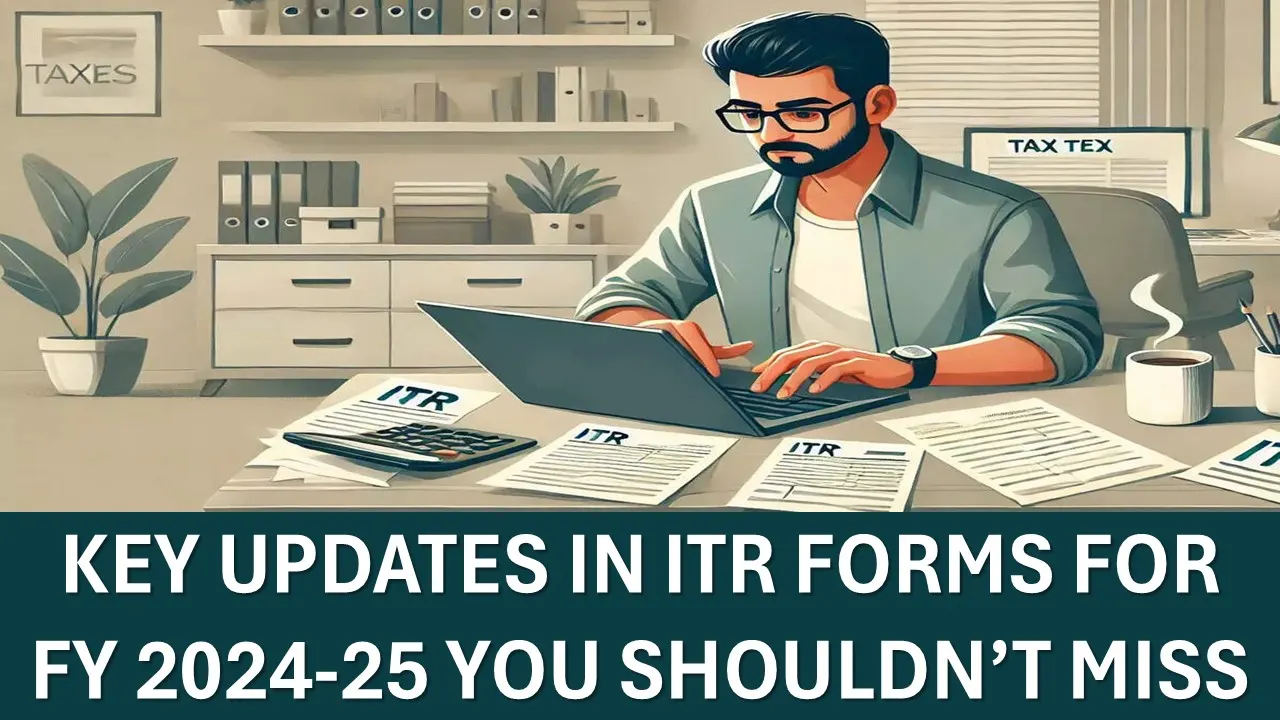
CBDT has updated Income Tax Return (ITR) forms for FY 2024-25, highlighting key changes in capital gains reporting, asset disclosures, and compliance requirements.
Key Updates in ITR Forms for FY 2024-25 You Shouldn’t Miss
 Saloni Kumari
 May 13, 2025
Table of Contents

New ITR Form Announced for Financial Year 2024-25, Know Key Amendments You Must be Aware of
The Central Board of Direct Taxes (CBDT) has notified all Income Tax Return (ITR) forms for Assessment Year 2025–26 (Income earned in the financial year 2024-25). Key amendments such as new LTCG limits, tougher capital gains reporting, updated asset disclosure thresholds, and added compliance for business owners, corporates, and trusts, however, the basic structure of the forms are as it is.
ITR-1 (Sahaj): Now covers small capital gains
The Income Tax Return (ITR) Form-1 is still for the resident individuals earning income upto Rs. 50 lakhs from sources such as salary, one house, and other sources. A new update now allows you to report long-term capital gains (LTCG) of up to Rs. 1.25 lakh under Section 112A. This applies to profits made from selling listed shares and mutual funds that you've held for over a year.ITR-2: Capital gains split and asset threshold raised
Because of indexation and tax rate amendments, the gains before and after July 23, 2024, are required to be indicated separately. Unlisted bonds or debentures must be reported based on how long you have held them. If you receive money from a buyback of shares after October 1, 2024, you need to report it under both “Income from Other Sources” and in the capital gains section, showing the sale value as “Nil.” Additionally, the threshold for disclosing assets and liabilities has been increased; now, you only need to report them if their total value exceeds Rs. 1 crore, compared to the earlier limit of Rs. 50 lakh.ITR-3: Tax regime choice and high-value spends
The Income Tax Return (ITR) Form-3 is for individuals and HUFs having business/professional income. This form now asks for the following: Your chosen tax regime among the old and new regimes with Form 10-IE/10-IEA, must be clearly mentioned. Also, additional details relating to the business income, including profits/losses and foreign assets. Description of high-value transactions: Cash deposits over Rs 1 crore, Foreign travel over Rs 2 lakh, Electricity bills over Rs 1 lakh, Credit card spending over Rs 10 lakh, etc.ITR-4 (Sugam): Small LTCG allowed
The Income Tax Return (ITR) Form-4 (Sugam) now allows people filing under the presumptive tax scheme to report long-term capital gains (LTCG) up to Rs. 1.25 lakh under Section 112A. This is helpful for small investors.ITR-5: Paper verification remains
The Income Tax Return (ITR) Form-5 is still used if you don’t e-verify your income tax return. You must sign the ITR-V form and send it by speed post to the CPC office in Bengaluru within 30 days. Alternatively, you can e-verify using Aadhaar OTP, net banking, or a verified bank or demat account.ITR-6: More details for companies
The Income Tax Return (ITR) Form-6, used by most companies (except those filing ITR-7), now requires more detailed information. Companies must show capital gains separately for amounts earned before and after July 23, 2024. Buyback losses can only be reported if the company also declares dividend income after October 1, 2024. There are also new sections for reporting income from cruise operations (Section 44BBC) and profits from diamond sales (with a minimum 4% margin), along with more detailed disclosures for TDS and business information.ITR-7: New reporting for trusts
The Income Tax Return (ITR) Form-7, meant for trusts, political parties, and other institutions, also has new requirements. These include reporting capital gains based on whether they occurred before or after July 23, 2024, showing buyback losses along with matching dividend income, claiming housing loan interest deductions under Section 24b, and entering more precise TDS codes for easier verification.About Author


Saloni Kumari
Content Writer
Saloni is a Content Writer with 2+ years of experience at studycafe.in. She writes legal, taxation, and finance related content including GST, Income Tax etc. Skilled in translating complex judicial pronouncements and regulatory developments into clear, and reader-friendly articles. Experienced in covering judgements of ITAT, High Court, GSTAT, and news related to Income Tax, GST, and corporate law. She can be reached at [email protected].
Saloni is a Content Writer with 2+ years of experience at studycafe.in. She writes legal, taxation, and finance related content including GST, Income Tax etc. Skilled in translating complex judicial pronouncements and regulatory developments into clear, and reader-friendly articles. Experienced in covering judgements of ITAT, High Court, GSTAT, and news related to Income Tax, GST, and corporate law. She can be reached at [email protected].
 StudyCafe
 Delhi, Delhi, India
 2931
2931My Recent Articles
- Rs 843.97 Crore Bogus Political Party Donation Racket Unearthed in Gujarat, Income Tax Dept Files Complaint With CID (Crime)
- Retired Central GST Commissioner Kidnapped by Unknown Persons, Assailants Nabbed Within Hours
- Madhya Pradesh HC Quashes Section 74 GST Show Cause Notice Passed Against G R Infraprojects
- GSTAT Introduces SOP for Branch Officer-to-Branch Officer (BO-to-BO) Case Transfer Ensuring Seamless Reassignment of Cases
- GSTAT: E-Way Bills Cannot Be Invalidated Merely Because They Were Not Generated by Original Supplier
Up Next
Loading suggestions…


Recent Posts


All Posts
Tags
No tags yet.
Recent Posts
All Posts
Tags
No tags yet.