Received Dividend, Loan, or Buyback Proceeds? Decode Deemed Dividend Under Section 2(22) with Practical Examples:
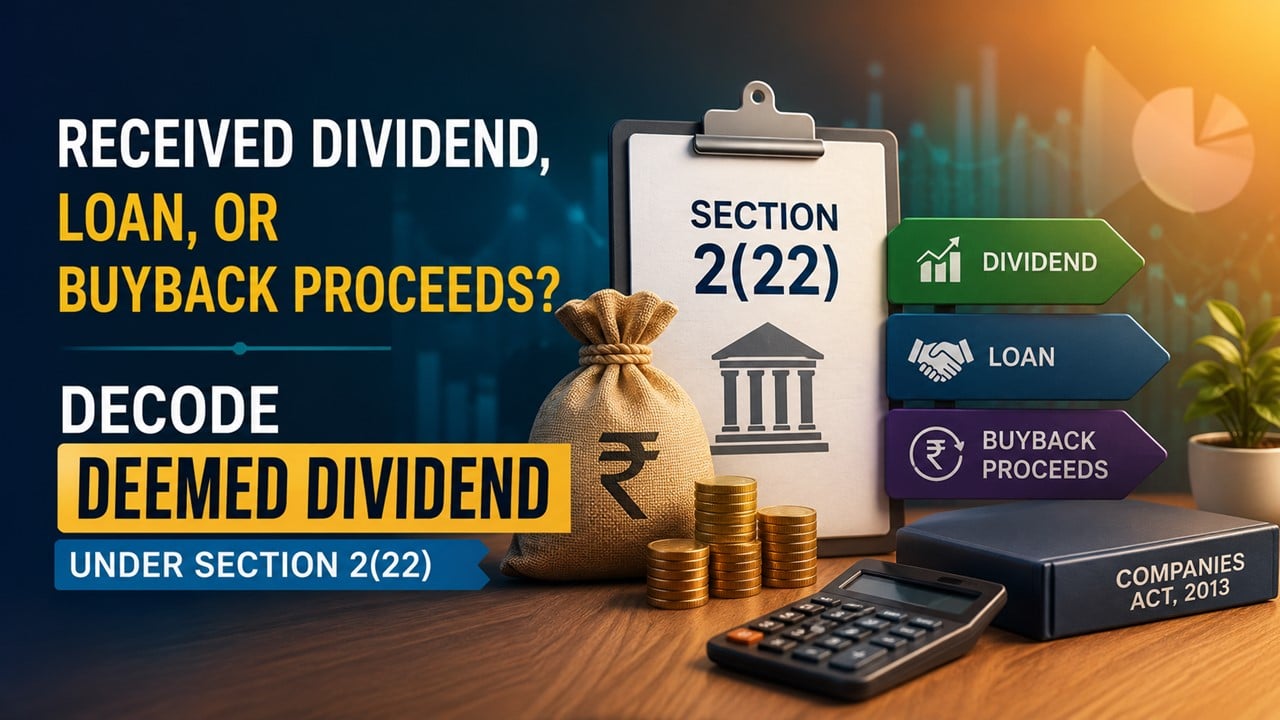
Learn the complete tax treatment of deemed dividend under Section 2(22) of the Income Tax Act, 1961, including loans, buybacks, asset distributions, liquidation, and practical examples.
Deemed Dividend Under Income Tax Act
 Khush Trivedi
 Jun 29, 2026
Received Dividend, Loan, or Buyback Proceeds? Decode Deemed Dividend Under Section 2(22) with Practical Examples
Have you received Dividend or something else from company during the year? & don’t know about the tax treatment of certain transactions done by company towards its share-holders for distributing the profits via different ways. Then this article is for you
Let’s decode it
What is Deemed Dividend?
Under the Income Tax Act, 1961, dividend is generally a distribution of profits by a company to its shareholders.
However, authorities recognised that certain transactions between a closely-held company and its shareholders can serve as a proxy for dividend which allows company to easily distribute the profits by avoiding taxes. Such transactions are treated as deemed dividend under Section 2(22)
Six Clauses of Section 2(22)
Let’s understand with examples.
Section 2(22)(a): Distribution of Accumulated Profits with Asset Release
E.g: 1 RST Pvt. Ltd. gives a loan of Rs. 12 lakhs to Mr. R who holds 15% voting power.
Accumulated profits of Company: Rs. 8 Lakhs
Rs. 8 lakhs will taxable as deemed dividend in Mr. R's hands
E.g: 2 ABC Pvt. Ltd. gives a loan of Rs. 20 lakhs to XYZ & Co. (Partnership Firm)
Mr. A holds 12% in ABC Pvt. Ltd. AND 30% share in XYZ & Co
Accumulated profits of ABC Pvt. Ltd. Rs. 15 lakhs
Rs. 15 lakhs will taxable as deemed dividend in hands of Mr. A (as the qualifying shareholder)
Section 2(22)(f): Buy-Back of Shares w.e.f 01/10/2024
Earlier the Tax treatment of Buy back is to be taxed as Capital gain under section 46A of income tax Act 1961
However, Section 2(22)(f) was inserted by Finance Act, 2024 w.e.f. 01.10.2024 to treat buy-back consideration as deemed dividend in the hands of shareholders if received by domestic companies.
However, the shareholder can claim the cost of acquisition of shares bought back by company as a STCL/LTCL under capital gain by taking Full Value of Consideration as NIL where the consideration is taxed under 2(22)(f).
Note: Under this section there is no threshold of accumulated profits like othe clauses
E.g: Mr. A holds 500 shares of XYZ Ltd. (listed), purchased at ₹100/share on 25/07/2023
XYZ Ltd. buys back shares at ₹300/share on 17/9/2025
In the Hands of Mr. A FY 25-26, AY 26-27
Deemed dividend us 2(22)(f) taxable under IFOS: Rs. 1,50,000(Rs.300*500)
Capital gain on sell of right:
| Clause | Transaction Type | Key Condition | Recipient |
| 2(22)(a) | Distribution of assets | Assets released to shareholders from accumulated profits whether capitalised or not | Shareholder |
| 2(22)(b) | Distribution by way of debentures, deposit certificates, bonus shares to preference shareholders | Must be from accumulated profits whether capitalised or not | Shareholder |
| 2(22)(c) | Distribution on liquidation to the extent of accumulated profits | Only accumulated profit portion whether capitalised or not | Shareholder |
| 2(22)(d) | Distribution on reduction of capital to the extent of accumulated profits | Only accumulated profit portion whether capitalised or not | Shareholder |
| 2(22)(e) | Loan/advance by company to a shareholder holding ≥ 10% voting power or to a concern in which such shareholder has substantial interest or to any person behalf or benefits of share holder | Apply for Closely held companies | Shareholder/Concern |
| 2(22)(f) | Buy-back of shares u/s 68 of Companies Act, 2013 (w.e.f. 01.10.2024) now capital gains from AY 2026-27 | No accumulated profits ceiling full consideration covered | Shareholder |
- The distribution must result in release of the company's assets
- Must be to the benefit of shareholders
- To the extent of accumulated profits (including capitalised profits)
- Balance over accumulated profits is treated as return of capital

- Only the accumulated profit component is treated as dividend
- The balance (representing capital) is treated as capital receipts/capital gains in the hands of share holder
- Applicable on final distribution at the time of liquidation
- A shareholder holding ≥ 10% of voting power OR
- Any concern (HUF, firm, AOP, BOI, company) in which such shareholder has substantial interest (≥ 20% share in profits/Voting)
| Condition | Threshold / Description |
| Company Type | Closely-held company (public not substantially interested) |
| Shareholder's Voting Power | Must hold ≥ 10% of voting power (beneficially) |
| Concern Shareholder's Interest | Shareholder must have ≥ 20% share of profit/income/assets in the concern |
| Transaction Type | Loan or advance (NOT trade credit or business advance) |
| Taxable Amount | Lower of: loan amount OR accumulated profits of the company |
| Tax in Whose Hands? | Recipient shareholder |
| Particular | Amount |
| FVOC(Full value of consideration) | NIL |
| Less: | |
| COA: 500 shares*Rs. 100 | -50000 |
| Long term capital Loss | -50000 |
About Author


Khush Trivedi
Content writer
 Study cafe
 AHMEDABAD, Gujarat, India
 46
46My Recent Articles
- Taxation of Preliminary Expenses Under the Income Tax Act: Complete Guide to Section 35D
- Selling a Property or Asset? Know These Capital Gains Tax Exemptions
- Taxation of Joint Development Agreements (JDA): Everything Landowners Need to Know
- Section 139(9) Defective Return Notice: Complete Guide to Fixing Your ITR
- Section 32 of the Income Tax Act, 1961: Depreciation on Business Assets
Up Next
Loading suggestions…


Recent Posts


All Posts


Recent Posts
All Posts