Retrospective GST Cancellation Cannot Result in Denial of Genuine ITC Claims: Rules High Court:
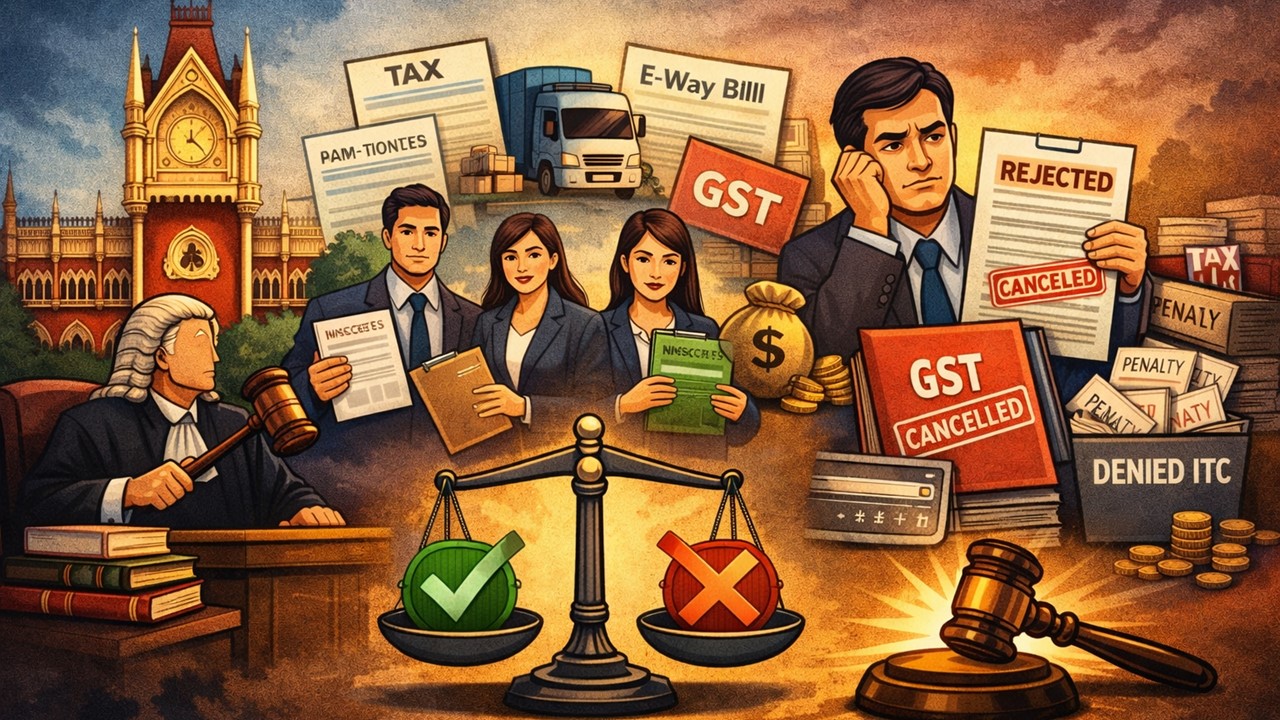
The High Court held that genuine ITC cannot be denied merely due to retrospective cancellation of a supplier’s GST registration when proper documents prove the transaction.
HC Sets Aside Non-Speaking GST Appellate Order
 Saloni Kumari
 Dec 25, 2025
Retrospective GST Cancellation Cannot Result in Denial of Genuine ITC Claims: Rules High Court
The Calcutta High Court ruled that the GST department cannot deny the claim of Input Tax Credit (ITC) merely on the retrospective cancellation of a supplier’s GST registration, despite furnished documents proving that the purchases were genuine.
The present case has been filed by Shyamalmay Paul in the Calcutta High Court, challenging an appellate order, which had confirmed an earlier adjudication order passed by the GST authorities, which disallowed the petitioner's ITC claim. The case is related to assessment year (AY) 2020-21.
During the year in consideration, the petitioner filed its GST returns. The GST department chose the returns for scrutiny and issued a show cause notice (SCN) to the petitioner, flagging four distinct discrepancies in its return and imposing possible tax, interest, and penalty for the same. Also asked the petitioner why the particular demand should not be levied on it. The petitioner filed a detailed reply to the notice explaining all the pointed-out discrepancies and also furnished all supporting documents to their claim. The department only accepted replies to three discrepancies and did not accept a reply to one discrepancy. The officer held that the petitioner failed to prove the genuineness of certain transactions and therefore denied the Input Tax Credit (ITC), along with tax, interest, and penalty.
The aggrieved petitioner filed an appeal before the appellate authority. However, the appellate authority dismissed the petitioner's appeal and confirmed the denial of ITC. Thereafter, the petitioner approached the present Calcutta High Court, challenging the remaining one discrepancy upheld by the appellate authority, i.e., denial of ITC.
The key issue in the present case was that the petitioner had claimed ITC on the purchases made from a supplier whose GST registration was later cancelled after the period of purchase. However, as per the petitioner, the department still denied their ITC claim. The petitioner further claimed that the purchases were genuine, goods were actually received, payments were made through the bank, and all supporting documents, such as tax invoices, e-way bills, transport records, and ledgers, were submitted. He also stated that the supplier’s GST registration was valid on the date of supply and was cancelled only later, though with retrospective effect.
The High Court examined the claims of the petitioner and found them all correct. The court found that the appellate authority had simply upheld the denial of Input Tax Credit only on the ground that the invoices were issued after the effective date of retrospective cancellation of the supplier’s registration, although the petitioner furnished all the relevant documents; however, the appellate authority did not explain the reason why the documents produced were not acceptable.
In the final ruling, the High Court ruled that an appellate authority cannot uphold a denial of ITC merely for the reason that invoices were issued after the effective date of retrospective cancellation of the supplier’s registration, without explaining why the documents produced by the petitioner were not acceptable.
Therefore, in the final hearing, even though the petitioner did not appear for the personal hearing before the appellate authority, the High Court held that this did not absolve the authority from its duty to consider the documents already on record and to give proper reasons. The appellate order was found to be a non-speaking order, as it did not deal with the evidence or explain why the petitioner’s claim was rejected. The High Court set aside the appellate order and remanded the case to the appellate authority for fresh consideration. This time directed appellate authority, to properly hear the petitioner and examine all the documents furnished.
About Author


Saloni Kumari
Content Writer
Saloni is a Content Writer with 2+ years of experience at studycafe.in. She writes legal, taxation, and finance related content including GST, Income Tax etc. Skilled in translating complex judicial pronouncements and regulatory developments into clear, and reader-friendly articles. Experienced in covering judgements of ITAT, High Court, GSTAT, and news related to Income Tax, GST, and corporate law. She can be reached at [email protected].
Saloni is a Content Writer with 2+ years of experience at studycafe.in. She writes legal, taxation, and finance related content including GST, Income Tax etc. Skilled in translating complex judicial pronouncements and regulatory developments into clear, and reader-friendly articles. Experienced in covering judgements of ITAT, High Court, GSTAT, and news related to Income Tax, GST, and corporate law. She can be reached at [email protected].
 StudyCafe
 Delhi, Delhi, India
 2924
2924My Recent Articles
- Major Relief in Arbitration Case: MCIA Denies Rs 908 Crore Statement Claim Made by Allied Silica Against Tata Chemicals
- MCA and ICSI to Hold User Awareness Session on Form AOC-4 Filing Amid Glitches on MCA-21 Version-3 Portal
- GSTN Introduces New E-Invoicing Facility for Self-Invoices Under Reverse Charge Mechanism
- Flexi Cap vs Multi Cap Funds: What's the Real Difference?
- IBA Recommends Public Sector Banks to Reduce Ambit of Physical Branch Audits to 50% of Total Business
Up Next
Loading suggestions…


Recent Posts
All Posts

Recent Posts
All Posts