SC: Breach of Income Tax Act Section 269SS Doesn't Invalidate Debt for NI Act Section 138:
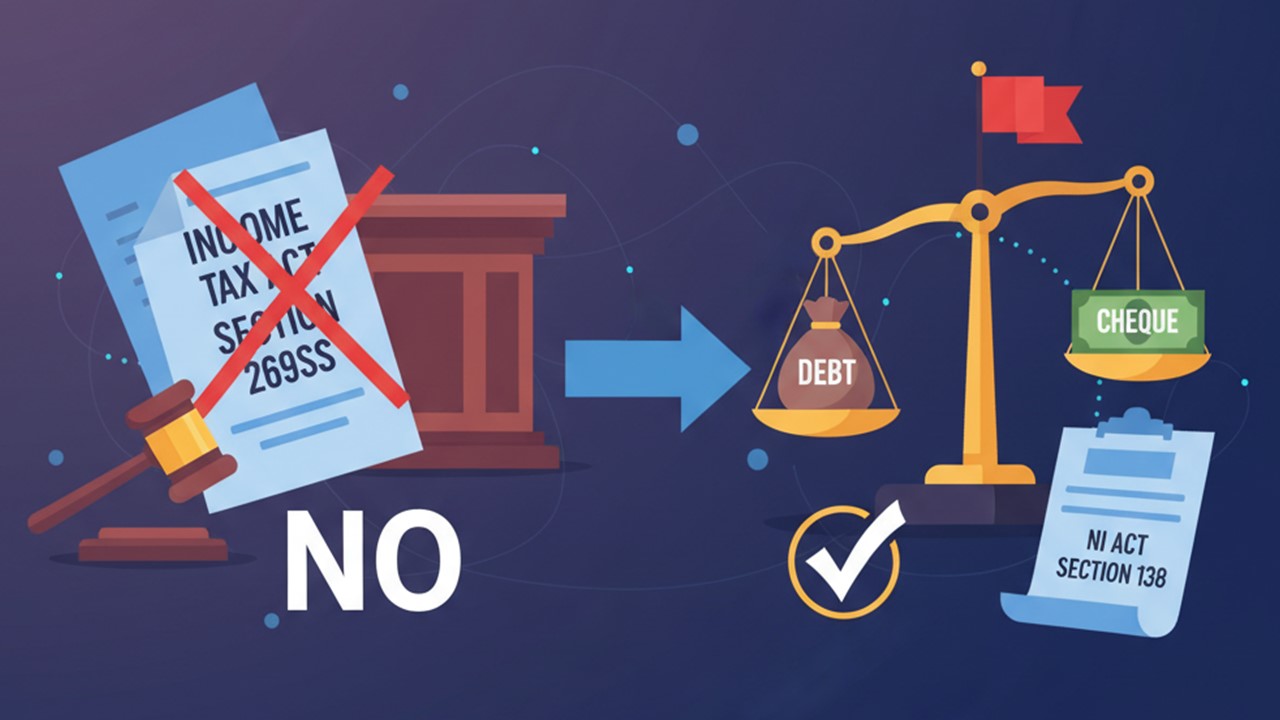
SC sets aside HC's acquittal in a cheque bounce case, holding that violation of Section 269SS of the Income Tax Act does not render the debt unenforceable under Section 138 NI Act
Supreme Court restored the conviction and directed payment of Rs. 7.5 lakh
 Meetu Kumari
 Oct 14, 2025
SC: Breach of Income Tax Act Section 269SS Doesn't Invalidate Debt for NI Act Section 138
The complainant had extended a friendly cash loan of Rs. 6,00,000 to the accused (Respondent No. 1). accused issued a cheque to discharge this liability, which was dishonoured upon presentation. As a result, the complainant initiated proceedings under Section 138 of the Negotiable Instruments Act, 1881. Both the Trial Court and the Sessions Court held the accused guilty u/s 138 and convicted him.
HC Held: The High Court, while exercising its revisional jurisdiction, set aside these findings and acquitted the accused ex parte. The High Court held that since the loan had been advanced in cash, it violated Section 269SS of the Income Tax Act, 1961, which prohibits cash loans exceeding Rs. 20,000, and therefore did not constitute a “legally enforceable debt.” Aggrieved, the complainant approached the Supreme Court.
Issue Raised: Whether a cash loan advanced in violation of Section 269SS of the Income Tax Act would render the transaction unenforceable for prosecution under Section 138 of the Negotiable Instruments Act, and whether HC was justified in changing/interfering with the concurrent findings of the lower courts while exercising its revisional powers.
SC Held: The Supreme Court allowed the appeal and set aside the lower court’s acquittal, thereby restoring the conviction recorded by the Trial Court and affirmed by the Sessions Court. The Court clarified that contravention of Section 269SS merely attracts a penalty under Section 271D of the Income Tax Act and does not render the underlying transaction void, illegal, or unenforceable. A loan advanced in cash, even if in breach of Section 269SS, is a “legally enforceable debt” under Section 138 of the NI Act.
The Court held that once the issuance of the cheque is admitted, the statutory presumptions under Sections 118 and 139 of the NI Act operate in favour of the complainant, and the burden shifts to the accused to rebut the same. In the present case, the accused neither adduced any oral nor documentary evidence to disprove the complainant’s financial capacity or the statutory presumption.
The Apex Court observed that the HC had exceeded the scope of its revisional jurisdiction by re-appreciating evidence and interfering with factual findings by lower courts. Thus, the conviction was restored, and the accused was directed to pay Rs. 7,50,000 (inclusive of the cheque amount) in 15 monthly instalments of Rs. 50,000 each. The Court also issued directions to ensure expeditious disposal and effective compounding of cheque dishonour cases to curb the mounting pendency in criminal courts.
To Read Full Judgment, Download PDF Given Below
About Author


Meetu Kumari
Content Manager
Meetu Kumari is an Experienced Advocate and Content Writer with 4+ years of demonstrated history of working in the law practice industry. Skilled in Developing Content, Researching, and Drafting. Strong professional with a Bachelor of Science (B.Sc.) focused on Law from Gujarat National Law University.
Meetu Kumari is an Experienced Advocate and Content Writer with 4+ years of demonstrated history of working in the law practice industry. Skilled in Developing Content, Researching, and Drafting. Strong professional with a Bachelor of Science (B.Sc.) focused on Law from Gujarat National Law University.
 Studycafe
 Jodhpur, Rajasthan, India
 2264
2264My Recent Articles
- ITAT Condones 302-Day Delay, Restores Salary Assessment for Fresh VerificationPremium
- ITAT Condones Delay After Tax Consultant's Death, Restores Appeals for Fresh HearingPremium
- ITAT Remands Salary Addition, Says Taxability Depends on Salary Becoming Due, Not Mere ReceiptPremium
- ITAT Deletes TP Royalty Adjustment, Orders Fresh Review of Commission BenchmarkingPremium
- ITAT Quashes Reassessment Over Unsigned Section 148 Notice Issued to AssesseePremium
Up Next
Loading suggestions…


Recent Posts
All Posts
Recent Posts
All Posts