Section 41(1) Cannot be Invoked Without P&L Credit Proof: ITAT Deletes Cessation Addition:
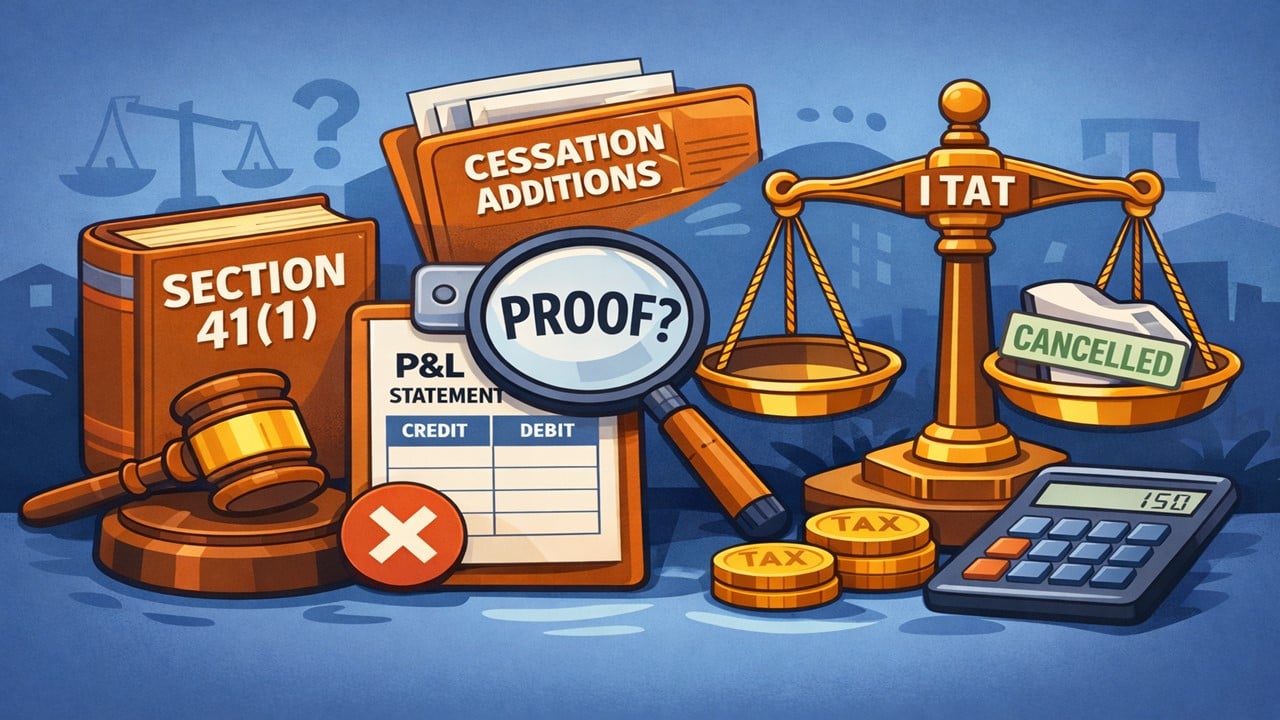
The Tribunal cited that to invoke Section 41(1), the assessee must credit the said liability to its profit and loss account, which was not the case here.
ITAT Rules on Cessation of Liability
 Nidhi
Nidhi Dec 19, 2025
Section 41(1) Cannot be Invoked Without P&L Credit Proof: ITAT Deletes Cessation Addition
The assessee, J L G Developers Ltd, received Rs 8,22,08,000 from Sethi Housing, which was used to repay a loan from the Bank of India. The amount was still returnable to M/s Sethi Housing. However, the AO treated the amount received by the assessee as cessation of liability, which resulted in making an addition to the assessee's income. The AO argued that this liability had ceased under Section 41(1) of the Act, citing the striking off of the company in 2017.
However, the assessee argued that being struck off under section 248 of the Companies Act due to non-compliance does not mean the company is winding up under the Act, and it is just a temporary removal from the ROC. However, the company's legal obligation and its liabilities do not end.
The assessee also submitted detailed documentary evidence, including the Profit & Loss Account, Balance Sheets, and ITR acknowledgements for the F.Ys 2010-11 to 2018-19, which proved that the assessee had not claimed any deductions towards this liability in the earlier years, and the said liability was still outstanding in the books.
The CIT(A) ruled in favour of the company, deleting the addition. Aggrieved by this order, the revenue filed an appeal before the ITAT, Delhi.
The Tribunal stated that to invoke Section 41(1), the assessee must credit the said liability to its profit and loss account, which was not the case here, as the assessee neither wrote back nor credited the liability in the P&L account. Therefore, the assessee did not violate the provisions of section 41(1).
Further, the tribunal found that the said liability is not a trading liability but a capital liability, which was used to repay the loan. The Tribunal ruled in the assessee's favour, holding that the liability is a loan which is outstanding and is not written back in the P & L account. Therefore, the revenue's appeal was rejected.
About Author


Nidhi
Content Writer
Nidhi is a skilled content writer specializing in personal finance. She creates clear, engaging articles on mutual funds, investments, insurance, and wealth-building strategies. With a passion for simplifying complex financial topics, Nidhi helps readers make informed money decisions with confidence. She can be reached at [email protected]
Nidhi is a skilled content writer specializing in personal finance. She creates clear, engaging articles on mutual funds, investments, insurance, and wealth-building strategies. With a passion for simplifying complex financial topics, Nidhi helps readers make informed money decisions with confidence. She can be reached at [email protected]
 Studycafe
 New Delhi, Delhi, India
 1832
1832My Recent Articles
- Karnataka High Court Gives Another Chance in GST Matter Due to Lack of Hearing
- Delay Should Be Condoned if Explanation is Unrefuted: ITAT
- Non-Service of Income Tax Notice, Ill health of taxpayer, ITAT condones Appeal filing delay
- Books of Accounts Cannot be Rejected Without Any Specific Defect: ITAT Kolkata
- Karnataka High Court Sends ITC Matter Back to GST Authorities for Reconsideration
Up Next
Loading suggestions…


Recent Posts

All Posts
Tags
Recent Posts
All Posts