Senior Citizens’ ITR Filing Guide AY 2026-27: How to Choose Right Form and Avoid Costly Mistakes:
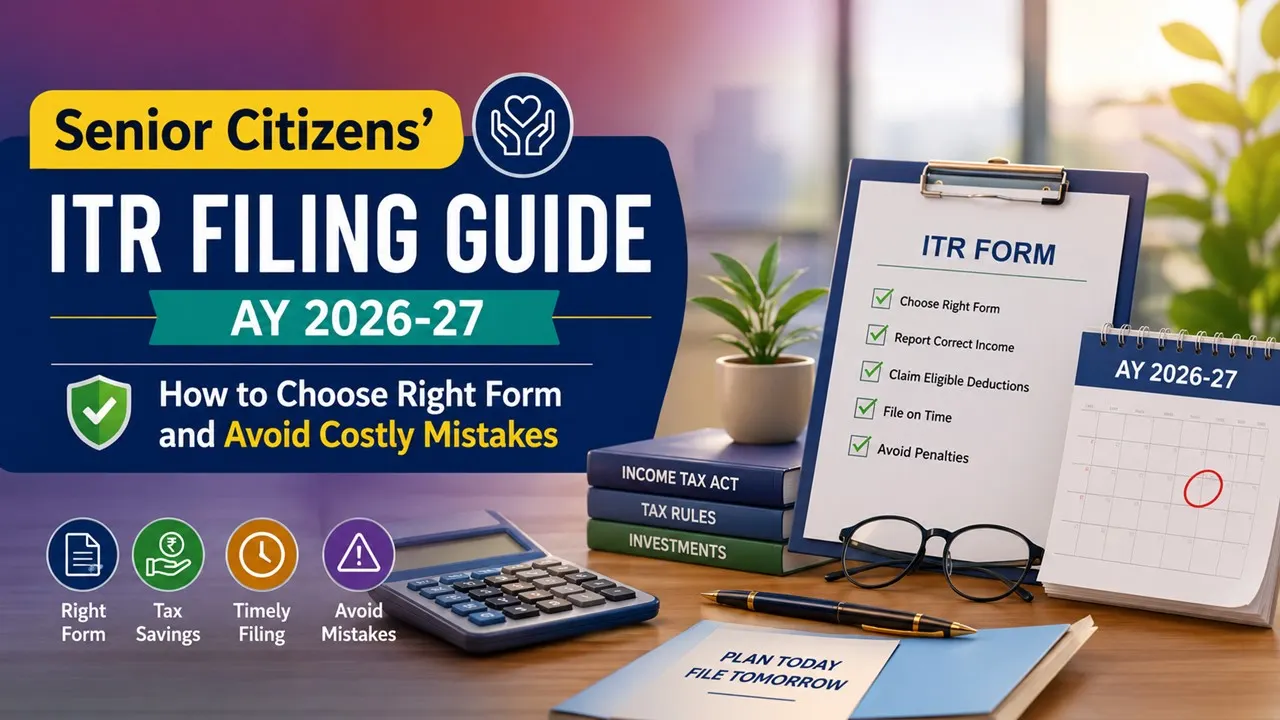
A comprehensive guide for senior citizens on selecting the correct ITR form for AY 2026-27, understanding eligibility rules, exemptions, and avoiding common tax filing mistakes.
Which ITR Form Should Senior Citizens File?
 Saloni Kumari
 Jun 8, 2026
Table of Contents

Senior Citizens’ ITR Filing Guide AY 2026-27: How to Choose Right Form and Avoid Costly Mistakes
Senior citizens should select their Income Tax Return (ITR) forms for the Assessment Year 2026-27, as per their nature of income instead of their ages. Senior citizens earning income from sources including a pension, house properties up to two, and a total income under the limit of 50 lakh can choose the ITR-1 form to file their tax returns. However, they cannot use the same form if they have earned capital gains beyond a certain limit, own more than two properties, or have foreign assets.
Those earning income from a business or profession must file the ITR-3 form, and the ITR-4 form is required to be furnished in presumptive taxation cases.
Why It Is Important to Have Knowledge About ITR Forms
Taxpayers should be aware of which form they are required to file as per their nature of income because filing a wrong form can render the ITR defective, lead to delayed refunds, and result in the issuance of penalty notices. Sometimes, retirees may also require changing their ITR form if they make investments in mutual funds or property or continue consultancy work. Super senior citizens aged 75 years or above, earning income from pensions and interest on bank accounts, can completely skip filing an annual income tax return (ITR). In place of it, you can submit a formal declaration using Form 125 (historically known as Form 12BBA) to your bank. However, if they have any extra income source, they become ineligible for this relief.From Capital Gains to Foreign Assets
Even a small capital gain earning from mutual funds or shares can restrict you from filing ITR-1, except for limited LTCG exemptions. In case of foreign pensions, overseas bank accounts, or inherited foreign investments, taxpayers are required to file ITR-2 or ITR-3 and extra disclosures. A common mistake, according to experts, is ignoring these details or depending only on the pre-filled information in the AIS without checking it against bank statements and Form 16/16A.
Advice for Senior Citizens
Senior citizens are recommended by the tax professionals to review Form 26AS, AIS, and TIS for mismatches in pension, interest, dividend, or capital gains data. Prior to the submission of the Income Tax Return (ITR), all high-value transactions, property deals, and TDS records should be reconciled. As discussed above, a small change in property sales or new investments can change the applicable ITR form; hence, annual reassessment of the income profile becomes essential.About Author


Saloni Kumari
Content Writer
Saloni is a Content Writer with 2+ years of experience at studycafe.in. She writes legal, taxation, and finance related content including GST, Income Tax etc. Skilled in translating complex judicial pronouncements and regulatory developments into clear, and reader-friendly articles. Experienced in covering judgements of ITAT, High Court, GSTAT, and news related to Income Tax, GST, and corporate law. She can be reached at [email protected].
Saloni is a Content Writer with 2+ years of experience at studycafe.in. She writes legal, taxation, and finance related content including GST, Income Tax etc. Skilled in translating complex judicial pronouncements and regulatory developments into clear, and reader-friendly articles. Experienced in covering judgements of ITAT, High Court, GSTAT, and news related to Income Tax, GST, and corporate law. She can be reached at [email protected].
 StudyCafe
 Delhi, Delhi, India
 2931
2931My Recent Articles
- Rs 843.97 Crore Bogus Political Party Donation Racket Unearthed in Gujarat, Income Tax Dept Files Complaint With CID (Crime)
- Retired Central GST Commissioner Kidnapped by Unknown Persons, Assailants Nabbed Within Hours
- Madhya Pradesh HC Quashes Section 74 GST Show Cause Notice Passed Against G R Infraprojects
- GSTAT Introduces SOP for Branch Officer-to-Branch Officer (BO-to-BO) Case Transfer Ensuring Seamless Reassignment of Cases
- GSTAT: E-Way Bills Cannot Be Invalidated Merely Because They Were Not Generated by Original Supplier
Up Next
Loading suggestions…


Recent Posts
All Posts
Tags
Recent Posts
All Posts