Supreme Court of India Slams NCERT Textbook Over 'Judicial Corruption' Claim; Bench Orders Ban:
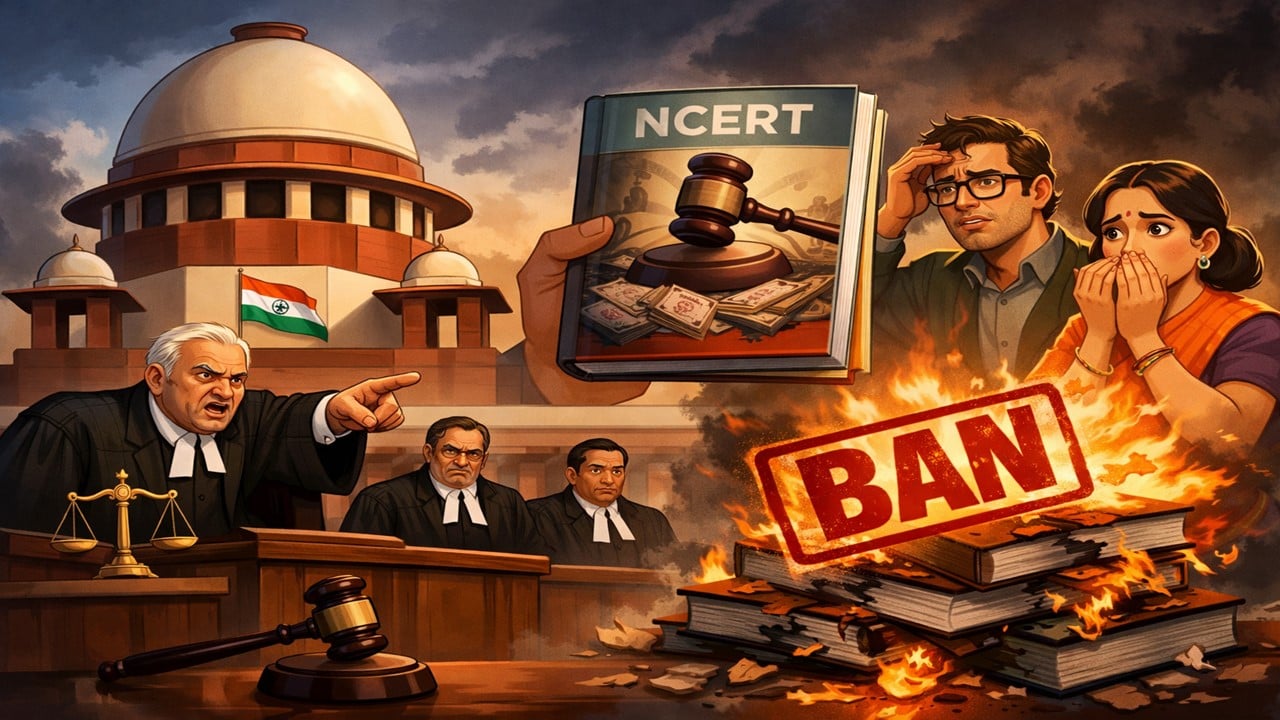
The Supreme Court of India criticised NCERT and ordered a ban on a Class 8 textbook over references to judicial corruption.
Supreme Court Cracks Down on Controversial School Chapter
 Vanshika verma
 Feb 26, 2026
Supreme Court of India Slams NCERT Textbook Over 'Judicial Corruption' Claim; Bench Orders Ban
The Supreme Court of India has strongly criticised a Class 8 social science textbook published by NCERT, which refers to "corruption in the judiciary". The Court has sent a notice to senior officials, including the Secretary of School Education in the Ministry of Education and the NCERT Director, asking them to explain why legal action should not be taken against them.
The judges said that publishing such content could be considered serious misconduct and might even amount to criminal contempt of court if it was intentionally written to damage the reputation of the judiciary.
A bench led by Chief Justice Surya Kant, along with Justices Joymalya Bagchi and Vipul M. Pancholi, passed orders in a suo motu case related to the book. The court completely banned the book, stopped any reprinting or digital sharing, and ordered authorities to seize all physical copies. It also warned that sharing the content in any form would be taken seriously.
The Court directed the NCERT Director to provide the names and qualifications of everyone involved in writing the problematic chapter. It also asked for the original meeting records where the chapter was discussed and approved to be presented at the next hearing.
The judges criticised the NCERT director's response, calling it "contemptuous and reckless". They said the explanation appeared to be a planned attempt to weaken the authority of the judiciary. The Court was concerned that the chapter mentioned complaints against judges in a way that suggested no action was taken and that remarks by former Chief Justice BR Gavai were quoted out of context to create an impression that corruption existed in the judiciary.
The bench said that if such material were allowed to circulate freely, it could damage the reputation of the judiciary, especially among young students. They also noted that the book’s impact would not be limited to schoolchildren but could influence parents, society, and even future generations.
The bench said, "The silence is particularly egregious given the sheer volume of high-ranking officials who have been censured by this court for corrupt practices and siphoning of public funds. It seems to us that the choice of words and expression in the book may be a simplicator inadvertence or a bona fide error. We may, however, hasten to add that we do not propose to initiate the suo motu proceedings to stifle any legitimate criticism or to stop any individual from exercising the right to scrutinize public institutions, including the judiciary."
When the hearing began, Solicitor General Tushar Mehta told the court that the National Council of Educational Research and Training (NCERT) had removed a Class 8 social science chapter that mentioned corruption in the judiciary. He also said NCERT had apologised for the mistake.
However, Chief Justice Surya Kant said the press release issued by NCERT did not contain any actual apology. He added that when the Supreme Court’s Secretary General earlier asked NCERT about the issue, NCERT had defended the chapter instead of admitting fault.
The Solicitor General assured the court that the people who supported or defended the chapter would not be associated with NCERT or any government ministry in the future. But the Chief Justice responded that this was not enough, saying the judiciary had already been harmed. The SG also promised that the chapter would be rewritten and that he himself would review it before publication.
He further told the court that only 32 printed copies had reached the market and that they would all be taken back. He also mentioned another chapter called "Justice delayed is justice denied", which had incorrect data about court case backlogs. According to him, children should not be taught that justice is denied in India.
The Chief Justice described the situation as a serious and possibly planned attempt to damage the judiciary’s image. Senior lawyer Kapil Sibal pointed out that PDF copies of the chapter were already spreading widely on social media. Justice Bagchi suggested that the government should take steps to remove these copies from the internet.
Finally, the Chief Justice said it was important to identify who was responsible for publishing the chapter and to hold them accountable. He made it clear that the court would continue the proceedings and take strict action if needed.
About Author


Vanshika verma
Content Writer
Vanshika Verma is a Content Writer with 1+ year of experience at Studycafe.in. A B.Com graduate from Delhi University, She writes articles on Finance, Tax, ICAI, GST, and the latest financial news, with a focus on making complex topics easy for readers and professionals.
Vanshika Verma is a Content Writer with 1+ year of experience at Studycafe.in. A B.Com graduate from Delhi University, She writes articles on Finance, Tax, ICAI, GST, and the latest financial news, with a focus on making complex topics easy for readers and professionals.
 Studycafe
 Delhi, Delhi, India
 2082
2082My Recent Articles
- Received a WhatsApp Message Saying Money Was Debited From Your Bank Account? Hyderabad Police Commissioner Issues a Major Cyber Fraud Warning
- 57th GST Council Meeting 2026: Complete Details of Key Recommendations on GST Compliance, Refunds, Registration and Penalty Rationalisation
- JSW Dulux Gets Major Relief as Madhya Pradesh GST Appellate Authority Cancels Entire Rs 77.13 Lakh Demand
- Centre to Set Up Monitoring Mechanism to Ensure Proper Implementation of GST Reforms Across States
- JK Tyre Receives Rs 94.86 Crore GST Show-Cause Notice for FY23 Over ITC Claims, Tax Classification and Supply Disputes
Up Next
Loading suggestions…


Recent Posts

All Posts
Tags
Recent Posts
All Posts