Supreme Court Holds Rooh Afza is Fruit Drink, Not Unclassified Item; Liable to Attract 4% VAT:
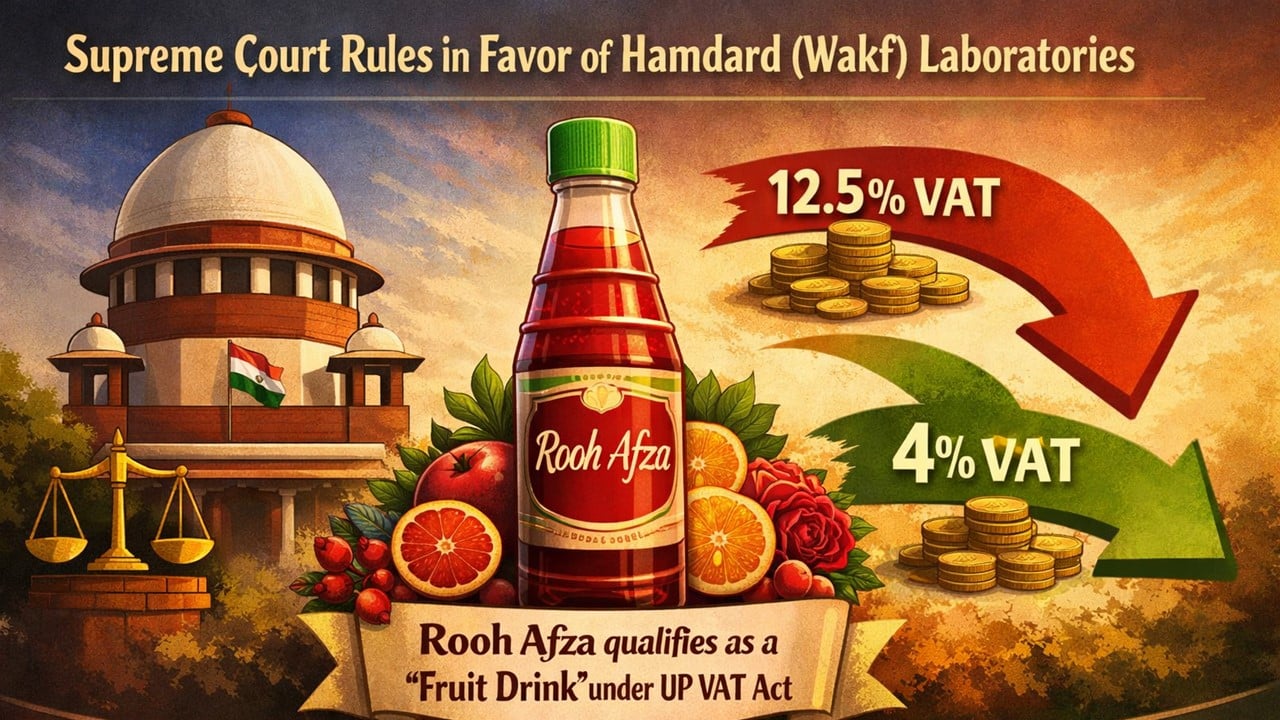
The Supreme Court of India has ruled that Rooh Afza qualifies for the category of fruit drink under the UP VAT Act, making it liable to 4% VAT instead of 12.5%.
Sharbat or Fruit Drink? Rooh Afza Tax Classification Dispute Resolved
 Saloni Kumari
 Feb 25, 2026
Supreme Court Holds Rooh Afza is Fruit Drink, Not Unclassified Item; Liable to Attract 4% VAT
The Supreme Court of India, in its recent judgement, has classified the popular drink concentrate “Sharbat Rooh Afza” of Hamdard (Wakf) Laboratories as a fruit drink/processed fruit product. Being a fruit drink, it should attract VAT at 4% and not 12.5%, under the Uttar Pradesh Value Added Tax Act, 2008 (UP VAT Act).
The judgement has been delivered by the Supreme Court's bench comprising Honourable Justices BV Nagarathna and R Mahadevan.
The key issue involved the tax classification of Hamdard (Wakf) Laboratories’ popular drink concentrate “Sharbat Rooh Afza” under the Uttar Pradesh Value Added Tax Act, 2008. The key dispute was regarding whether the good in question should be classified as a “fruit drink/processed fruit," attracting VAT at 4% under Entry 103 of Part A of Schedule II of the UP VAT Act, or as an unclassified commodity, attracting VAT at 12.5% under the residuary entry in Schedule V.
The case pertains to the assessment years 2007-08 and 2008-09. During the years in consideration, the appellant had paid VAT at 4% on Rooh Afza sales, claiming the drink falls under the category of fruit drink/processed fruit product.
However, the tax department disagreed with the claim of the appellant and treated the good in question as an unclassified item, which is liable to attract a higher VAT at 12.5%. Being aggrieved with the decision of the tax authorities, the appellant filed an appeal before the first appellate authority and the Commercial Tax Tribunal, but they both dismissed its appeal.
Thereafter, the appellant approached the Commercial Tax Tribunal, but the tribunal also ruled against the company. The tribunal said that in everyday and business language, people understand the product as “sharbat,” not as a fruit drink. In July 2018, the Allahabad High Court dismissed several revision petitions filed by Hamdard and agreed with the tribunal’s decision. After that, the appellant filed an appeal before the Supreme Court of India, challenging the aforesaid rulings.
The court held that the position of Hamdard across several states has been reinforced due to the continuous concessional classification of its product in them. This indicates that their interpretation was neither artificial nor untenable but bona fide and commercially recognised. According to the findings of the court, the product is entitled to be classified under a fruit drink/processed fruit product and therefore falls under Entry 103 of Schedule II of the Act and attracts a concessional rate of 4% during the assessment year in consideration.
As a result, the court quashed the impugned order of the Allahabad High Court, which had classified Rooh Afza as a non-fruit drink, and allowed the appeal of the company.
About Author


Saloni Kumari
Content Writer
Saloni is a Content Writer with 2+ years of experience at studycafe.in. She writes legal, taxation, and finance related content including GST, Income Tax etc. Skilled in translating complex judicial pronouncements and regulatory developments into clear, and reader-friendly articles. Experienced in covering judgements of ITAT, High Court, GSTAT, and news related to Income Tax, GST, and corporate law. She can be reached at [email protected].
Saloni is a Content Writer with 2+ years of experience at studycafe.in. She writes legal, taxation, and finance related content including GST, Income Tax etc. Skilled in translating complex judicial pronouncements and regulatory developments into clear, and reader-friendly articles. Experienced in covering judgements of ITAT, High Court, GSTAT, and news related to Income Tax, GST, and corporate law. She can be reached at [email protected].
 StudyCafe
 Delhi, Delhi, India
 2923
2923My Recent Articles
- MCA and ICSI to Hold User Awareness Session on Form AOC-4 Filing Amid Glitches on MCA-21 Version-3 Portal
- GSTN Introduces New E-Invoicing Facility for Self-Invoices Under Reverse Charge Mechanism
- Flexi Cap vs Multi Cap Funds: What's the Real Difference?
- IBA Recommends Public Sector Banks to Reduce Ambit of Physical Branch Audits to 50% of Total Business
- ITAT Directs AO to Reconsider Rs 16.44 Lakh Capital Gains and Rs 25.87 Lakh Stamp Duty Value Addition
Up Next
Loading suggestions…


Recent Posts


All Posts
Recent Posts
All Posts