Taxpayer not required to prove irrecoverability for claiming bad debts written off from books: ITAT:
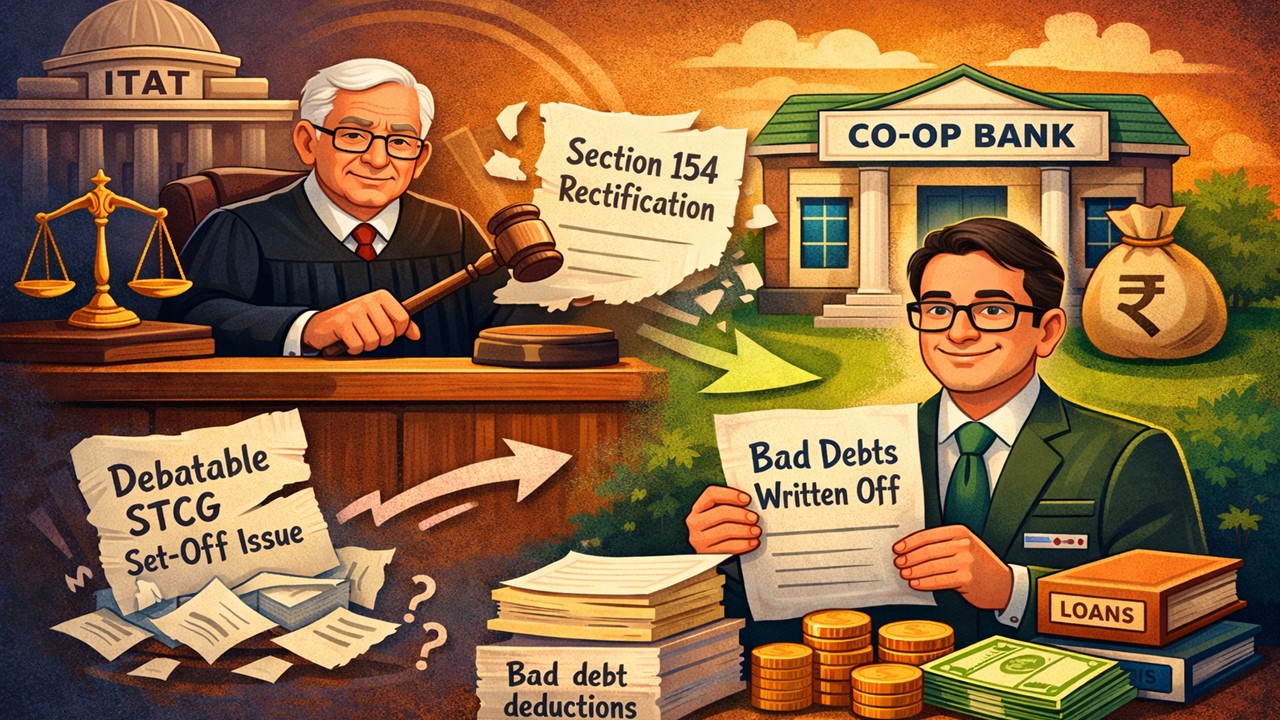
The ITAT granted partial relief to Co-Op Bank by invalidating Section 154 rectification on a debatable STCG set-off issue and allowing deduction of bad debts written off in the normal course of banking business.
ITAT Ahmedabad Clarifies Section 154 Limits
 Saloni Kumari
 Apr 12, 2026
Taxpayer not required to prove irrecoverability for claiming bad debts written off from books: ITAT
The Income Tax Appellate Tribunal (ITAT), Ahmedabad, granted significant relief to the company in key issues such as taxation of gains on the sale of assets, applicability of rectification under Section 154, and allowability of bad debts.
The assessee, Madhavpura Mercantile Co Op Bank Limited, had challenged two separate orders dated September 30, 2025, passed by the National Faceless Appeal Centre (NFAC), Delhi [CIT(A)], pertaining to the two separate Assessment Years 2016-17 and 2017-18.
ITA No. 2241/Ahd/2025 (AY 2016-17)
The assessee had filed its income tax return (ITR) for the Assessment Year 2016-17, declaring its total income at Rs. Nil, after setting off a brought-forward loss amounting to Rs 54.28 crore. The return was accepted by the tax official. Later, it was noticed that during the relevant year, the assessee had earlier earned a short-term capital gain (STCG) of Rs 8.15 crore on the sale of depreciable assets, which was adjusted with the brought-forward business loss. Later, the tax officer rectified the mistake through an order dated August 06, 2021, passed under Section 154/143(3) of the Act, holding that such setting off of the brought-forward business loss is not allowed.
The assessee, being aggrieved with the tax officer's order, approached the ITAT Ahmedabad. The tribunal held that whether STCG can be adjusted against brought-forward business losses is a debatable issue. Since Section 154 applies only to obvious mistakes, the rectification was invalid. Thus, the Tribunal quashed the tax authorities' rectification order and ruled in favour of the assessee on this issue.
The bank also argued that its income should not be taxable due to the diversion of income to DICGC under an overriding obligation. The Tribunal rejected this claim, clarifying that while DICGC has priority in repayment, the income still accrues to the bank and cannot be considered fully diverted at source.
ITA No. 2242/Ahd/2025 (AY 2017-18)
The assessee had filed its income tax return (ITR) for the Assessment Year 2017-18, declaring its total income at Rs 4.05 crore. The key dispute was regarding the disallowance of the deduction claimed for bad debt of Rs. 54.36 lakh. The tax official completed the assessment by making an addition of the complete amount and assessed the total income at Rs 4.59 crore.
When the assessee approached the ITAT Ahmedabad. The tribunal noted that the bank had written off the bad debts in its books and that such loans were given in the ordinary course of banking business. As per law and CBDT circulars, it is sufficient if bad debts are written off; proving irrecoverability is not required. Since the AO did not provide valid reasons for disallowance, the Tribunal allowed the claim.
The tribunal observed that, "In the present case, the amount written off was money lent by the assessee in the ordinary course of its banking business. Further, as per CBDT Circular 2016 dated 30.08.2016, it was not necessary for the assessee to establish that the debt had become irrevocable. It was enough if the bad debt was written off as irrevocable in the books of account of the assessee, which was duly complied in the present case. Therefore, the AO was not correct in disallowing the claim for bad debt."
In conclusion, both appeals were partly allowed, providing relief to the assessee on key issues.

About Author


Saloni Kumari
Content Writer
Saloni is a Content Writer with 2+ years of experience at studycafe.in. She writes legal, taxation, and finance related content including GST, Income Tax etc. Skilled in translating complex judicial pronouncements and regulatory developments into clear, and reader-friendly articles. Experienced in covering judgements of ITAT, High Court, GSTAT, and news related to Income Tax, GST, and corporate law. She can be reached at [email protected].
Saloni is a Content Writer with 2+ years of experience at studycafe.in. She writes legal, taxation, and finance related content including GST, Income Tax etc. Skilled in translating complex judicial pronouncements and regulatory developments into clear, and reader-friendly articles. Experienced in covering judgements of ITAT, High Court, GSTAT, and news related to Income Tax, GST, and corporate law. She can be reached at [email protected].
 StudyCafe
 Delhi, Delhi, India
 2880
2880My Recent Articles
- ITAT Deletes Rs 2.67 Crore Section 68 Addition, Rejects Retrospective Source-of-Source Requirement
- RBI Eases Foreign Exchange Compliance for Small Exporters and Freelancers
- GST Council Proposes Major Reforms in Registration, ITC, Refunds and Arrest Rules
- Govt Fixes 7.1% Interest Rate on Special Deposit Scheme for Non-Government PF Funds From Oct to Dec 2026
- CBI Apprehends Principal of Eklavya Model Residential School, Nuapada, for Demanding Rs 20,000 Bribe
Up Next
Loading suggestions…


Recent Posts

All Posts

Recent Posts
All Posts