UIDAI Onboards 100 Entities for Aadhaar-Based Offline Verification Within 3 Months:
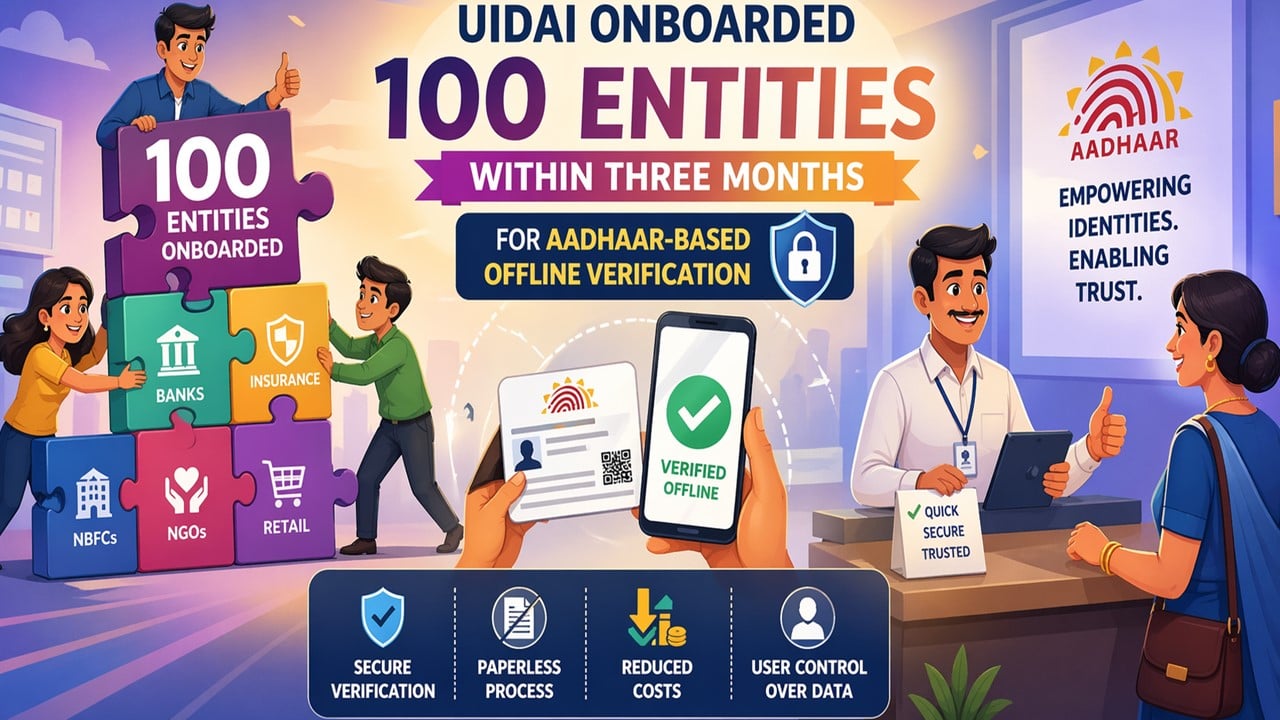
UIDAI onboarded 100 entities within three months for Aadhaar-based offline verification, enabling secure, paperless identity checks, improving service delivery, reducing costs, and giving users greater control over their personal data.
UIDAI Successfully Expanded Aadhaar Offline Verification System
 Kashish Bhardwaj
 Apr 21, 2026
UIDAI Onboards 100 Entities for Aadhaar-Based Offline Verification Within 3 Months
On April 20, 2026, the Unique Identification Authority of India (UIDAI) accomplished a major achievement. Within just three months of the implementation of the Aadhaar-based offline verification system, 100 institutions have joined this system. These entities have been onboarded as Offline Verification Seeking Entities (OVSEs).
Firstly, this initiative was started with the aim of making identity verification through Aadhaar easy, secure, and paperless. Under this, people do not need to submit documents again and again to prove their identity, and the process can be sped up. After this, organizations from different sectors showed interest in it. These include central and state government departments, fintech companies, the hospitality sector, event management companies, education and examination-related institutions, background verification agencies, and workforce validation companies.
When these institutions joined this system, the process of providing services started becoming faster and easier than before. Now, both the time and expense involved in handling physical documents and manual verification are being reduced. The special thing about this system is that the offline verification technology of Aadhaar is used in it. It uses QR code-based verification and digitally signed documents. This means that it is not important to connect to UIDAI's central database every time for identity verification.
Along with this, the “Show, Share, and Verify” model has been adopted. In this, the Aadhaar holder can control their own information. He shares only as much information as is necessary, which protects his privacy. In this initiative, user consent has been given utmost importance. The entire process has been kept transparent and easy, due to which people's trust is also increasing. This system works on a distributed model, which makes it secure, scalable, and reliable. This is also considered a big step towards strengthening India's digital public infrastructure.
Ultimately, this initiative will directly benefit the common people. Now it will take less time to avail services, paperwork will be reduced, and people will be able to have better control over their personal information. This is the reason why it is being considered an important initiative towards improving “Ease of Living".
About Author


Kashish Bhardwaj
Content Writer
 StudyCafe
 Delhi, Delhi, India
 176
176My Recent Articles
- Supreme Court Judge Strength to Increase from 33 to 37 for Faster Justice
- Builder Cleared of Profiteering Charges After Passing Excess ITC Benefit to Homebuyers: GSTAT
- Jubilant Ingrevia to Challenge Rs 2.03 Crore GST Demand Before GSTAT
- Rs 70 Crore Claim Row: Ex-CFO Gobind Jain Moves Bombay High Court Against IndusInd Bank Over Alleged Wrongful Dismissal
- Dream Sports Launches Dream Street: AI-Powered Entry into India’s Retail Broking Market
Up Next
Loading suggestions…


Recent Posts


All Posts



Recent Posts
All Posts