Union Budget 2026: Major Expectations, Tax Reforms, and Key Economic Priorities:
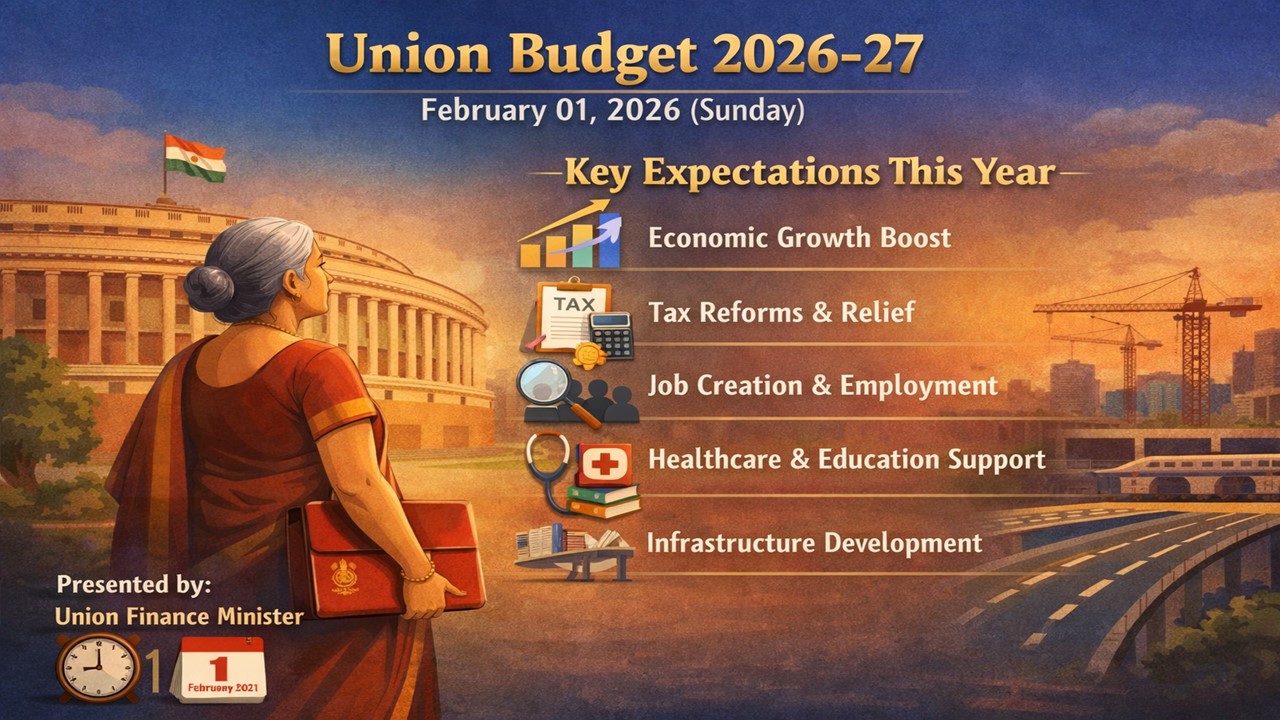
The Union Finance Minister is about to present the Union Budget 2026-27 on February 01, 2026 (Sunday); know the key expectations this year.
Budget 2026: Key Hopes on Taxes, Economy, and Reforms
 Saloni Kumari
 Jan 28, 2026
Table of Contents

Union Budget 2026: Major Expectations, Tax Reforms, and Key Economic Priorities
The Union Finance Minister, Nirmala Sitharaman, is about to present the Union Budget 2026-27 on February 01, 2026 (Sunday). Earlier, a debate arose over presenting the budget on Sunday; however, the decision has now been confirmed, and the budget will be presented on Sunday only. Yesterday, on January 27, 2026, the Halwa Ceremony was held at North Block, marking the final stage of the Budget 2026 preparations.
This Budget 2026 will have a significant impact on the new Income Tax Act 2025, which aims to simplify the language of tax rules and compliance. However, these changes were just aimed at simplifying tax language, not at introducing significant changes to the tax policy.
Presently, the economy of India is performing steadily, with stable growth, controlled inflation, and strong investment in infrastructure. The government is also working hard towards long-term plans to support sustainable economic development. The Union Budget 2026 is likely to overcome both short-term financial pressures and long-term structural reforms, aimed at supporting economic growth while keeping government spending under control.
The 2026 budget may reflect that the government will continue to spend on infrastructure projects, social welfare schemes, technology, and clear business regulations. Key areas of focus may include agriculture, healthcare, women's empowerment, start-ups, and emerging sectors like digital assets.
Major Expectations from Budget 2026
1. The government may bring some adjustments into the tax slabs and thresholds, while major reductions in the tax rates are not anticipated. The aim is to improve disposable income and consumption demand. 2. The government is reviewing the current capital gains tax rules. There is an expectation that these rules may be simplified or adjusted to encourage more people to invest and increase participation in financial markets. 3. The government has also received proposals to rationalise TDS (Tax Deducted at Source) rates, aimed at decreasing the tax compliance burden for businesses and taxpayers. 4. The government may introduce budget measures to reduce the tax burden on ESOPs (employee stock options) for employees working across different countries. This could help avoid double taxation when global employees pay tax in both India and abroad. The aim is to simplify ESOP taxation, support global employees, and prevent paying tax twice. 5. The upcoming Budget 2026 is highly expected to announce initiatives focused on women's empowerment, mainly focused on employment, skill development, and safety nets. 6. The Budget 2026 is likely to take effective steps for the agricultural sector or the rural economy of the nation, like improved credit support, modernisation schemes, and income support mechanisms for farmers. 7. The government is likely to continue concessions for senior and super senior citizens in the country concerning their health and tax benefits.
About Author


Saloni Kumari
Content Writer
Saloni is a Content Writer with 2+ years of experience at studycafe.in. She writes legal, taxation, and finance related content including GST, Income Tax etc. Skilled in translating complex judicial pronouncements and regulatory developments into clear, and reader-friendly articles. Experienced in covering judgements of ITAT, High Court, GSTAT, and news related to Income Tax, GST, and corporate law. She can be reached at [email protected].
Saloni is a Content Writer with 2+ years of experience at studycafe.in. She writes legal, taxation, and finance related content including GST, Income Tax etc. Skilled in translating complex judicial pronouncements and regulatory developments into clear, and reader-friendly articles. Experienced in covering judgements of ITAT, High Court, GSTAT, and news related to Income Tax, GST, and corporate law. She can be reached at [email protected].
 StudyCafe
 Delhi, Delhi, India
 2920
2920My Recent Articles
- Flexi Cap vs Multi Cap Funds: What's the Real Difference?
- IBA Recommends Public Sector Banks to Reduce Ambit of Physical Branch Audits to 50% of Total Business
- ITAT Directs AO to Reconsider Rs 16.44 Lakh Capital Gains and Rs 25.87 Lakh Stamp Duty Value Addition
- ITAT Remands Rs 3.33 Crore Demonetisation Cash Deposit Case to AO, Directs Rs 10,000 Relief Fund Payment
- Income Tax Dept Increases Scope for Saksham Nudge Initiative to Further Include Professional Insuring Timely Compliance
Up Next
Loading suggestions…


Recent Posts



All Posts
Tags
Recent Posts
All Posts