ITAT Mumbai Allows Gratuity and Leave Provisions as Valid Income Application for Charitable Trust:
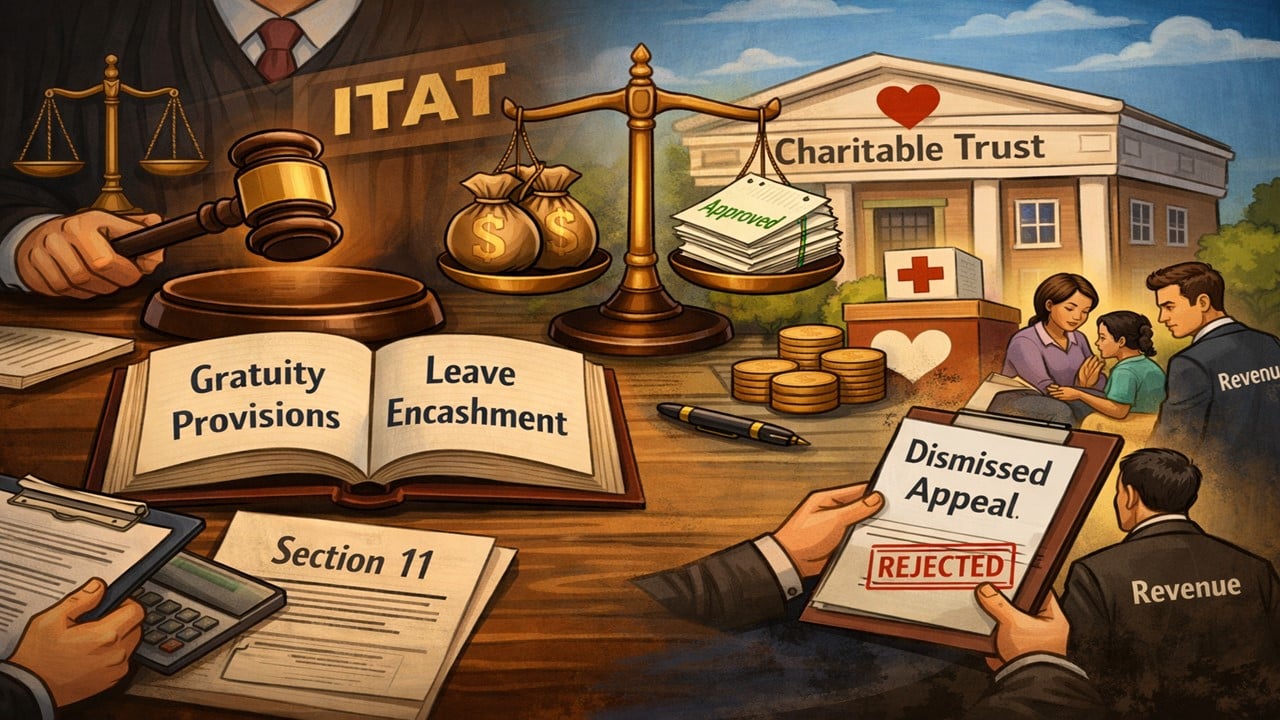
ITAT held that gratuity and leave encashment provisions qualify as a valid application of income for charitable trusts under Section 11, dismissing the Revenue’s appeal.
ITAT Upholds Section 11 Benefit for Gratuity and Leave Encashment Provisions
 Saloni Kumari
 Jan 28, 2026
ITAT Mumbai Allows Gratuity and Leave Provisions as Valid Income Application for Charitable Trust
ITAT Mumbai upheld the CIT(A)’s ruling and permitted the charitable trust to treat gratuity and leave encashment provisions as valid applications of income under Section 11, recognising them as mandatory liabilities and allowing deficit carry-forward. Dismissed the appeal of the Income Tax Department.
The ACIT, Income Tax Department, has filed the present appeal in the ITAT Mumbai against Anandilal and Ganesh Podar Society, challenging an order dated March 17, 2025, passed by the CIT(A) Mumbai. The case is related to the Assessment Year 2015-16.
The assessee is a charitable trust involved in running educational institutions. The trust is registered under Section 12A of the Income-tax Act. The assessee had declared NIL income for the year in consideration, claiming exemption under Section 11 of the Income Tax Act. During the assessment of the return, the Assessing Officer (AO) observed that the assessee had created provisions for gratuity and leave encashment for employees, which had increased to Rs. 33,450,281 and Rs. 57,587,027, respectively, from the opening provisions of Rs. 14,684,315 and Rs. 46,078,354.
These provisions increased significantly during the year and amounted to an additional Rs. 3.02 crore. The Assessing Officer treated these amounts as contingent liabilities and not as actual spending. In conclusion, the AO disallowed the entire amount as “application of income” under Section 11.
The aggrieved assessee filed an appeal before the CIT(A), where it claimed these provisions as obligatory, based on actuarial valuation, and required under Accounting Standard 15, the Payment of Gratuity Act, and employee leave policies. The trust further flagged that a similar issue has already been decided by the ITAT in its own case, where the tribunal favoured the trust. The CIT(A), after analysing the case deeply, deleted the disallowance made by the AO on the grounds that these liabilities had already crystallised, were legally required, and were necessary to reflect a true and fair financial position of the trust. Dismissed the appeal of the tax department.
The dissatisfied tax department thereafter filed the present appeal before the ITAT Mumbai. However, the tribunal also endorsed the CIT(A)'s ruling, holding that a similar issue had already been resolved by them only in earlier years, where the final decision was announced in favour of the trust. The Tribunal explained that “application of income” under Section 11 should not be limited only to actual cash spending. Provisions like gratuity and leave encashment, though book entries, represent real and mandatory liabilities, similar to depreciation, which is allowed despite not involving an immediate cash outflow.
The Tribunal also allowed the trust to carry forward excess expenditure (deficit) of approximately Rs. 2.91 crore to future years, citing an earlier ruling of the Bombay High Court that permits charitable trusts to adjust earlier-year deficits against future income. In conclusion, the tribunal dismissed the appeal of the tax department and granted full relief to the trust.
About Author


Saloni Kumari
Content Writer
Saloni is a Content Writer with 2+ years of experience at studycafe.in. She writes legal, taxation, and finance related content including GST, Income Tax etc. Skilled in translating complex judicial pronouncements and regulatory developments into clear, and reader-friendly articles. Experienced in covering judgements of ITAT, High Court, GSTAT, and news related to Income Tax, GST, and corporate law. She can be reached at [email protected].
Saloni is a Content Writer with 2+ years of experience at studycafe.in. She writes legal, taxation, and finance related content including GST, Income Tax etc. Skilled in translating complex judicial pronouncements and regulatory developments into clear, and reader-friendly articles. Experienced in covering judgements of ITAT, High Court, GSTAT, and news related to Income Tax, GST, and corporate law. She can be reached at [email protected].
 StudyCafe
 Delhi, Delhi, India
 2860
2860My Recent Articles
- RBI Introduces New EDF Filing Rule for Freelancers, Influencers and Other Service Exporters, Effective October 1, 2026
- Sun Pharma Advanced Research Wins Rs 27.51 Crore CENVAT Credit Refund Dispute, Tribunal Dismisses Revenue's Appeal
- CBI Arrests Delhi Police Sub-Inspector in Rs 1 Lakh Bribery Case, Accused Caught While Accepting Rs 80,000
- Anup Engineering Secures Complete Relief in GST Dispute, Rs 3.32 Crore Demand Quashed
- Next-Gen GST 2.0 Reforms: GST Council May Ease Compliance Rules, Free Up Thousands of Crores in ITC
Up Next
Loading suggestions…


Recent Posts


All Posts


Tags
Recent Posts
All Posts