New Income Tax Act 2025 Replacing Earlier 60 Year Old Income Tax Rules to Effect from April 01:
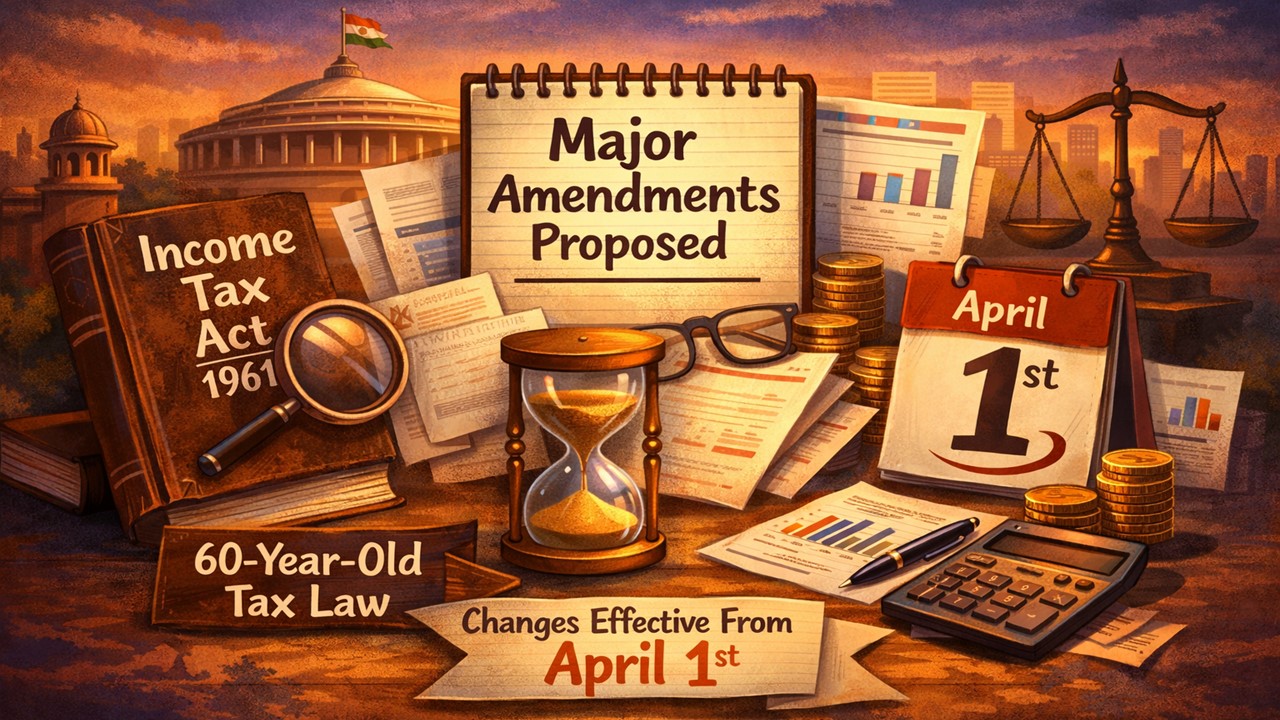
The government has proposed significant amendments to the earlier 60-year-old Income Tax Act of 1961, scheduled to effect from April 01.
Here's What All Taxpayers Should Be Aware Of
 Saloni Kumari
 Jan 28, 2026
New Income Tax Act 2025 Replacing Earlier 60-Year-Old Income Tax Rules; Effective April 01
The government of India has proposed significant amendments to the 60-year-old Income Tax Act 1961. These revisions in the income tax rules are scheduled to take effect from April 01, 2026, i.e., from the start of the new financial year 2026-27. These changes are aimed at simplifying tax rules, reducing disputes, and making the compliance process easier to understand through clearer language and technology-driven processes.
Here are mentioned some of these key income tax changes to take effect from April 01, from the Financial Year 2026-27:
1. Simplified Law and Fewer Sections
The new income tax act of 2025 will include a reduced number of sections. Previously, there were a total of 819 sections available under the Income Tax Act 1961; now this number has been reduced to 536. On the other hand, chapters have been reduced from 47 to 23. If we talk about the overall word count of earlier income tax rules, now the total words have been reduced to almost half, from 5.12 lakh words to around 2.6 lakh words.
For the first time in Indian history, the use of tables and formulas in lawmaking is more common than long legal paragraphs. To make concepts easier to understand, this time, a total of 39 tables and 40 formulas have been inserted in the new Income Tax Act 2025.
2. Introduction of New ‘Tax Year’ Concept
This is one of the key changes proposed in the Income Tax Act 1961. The new concept of 'Tax Year' has been introduced, with an aim to replace earlier confusion between ‘Financial Year’ and ‘Assessment Year.’
In this new concept tax year, income earned within the year in which it is reported and assessed will be amalgamated. Resulted in earlier compliance for taxpayers.
3. Simpler Process of ITR Filing
Several tax experts believe that since most of the information is already available through AIS and pre-filled returns, the return filing process will become simpler.
From the next financial year, it is anticipated that simplified ITR forms will be introduced, which will require clearer reporting and fewer confusing disclosures.
4. Higher Exemptions and Better Relief
Under the New Tax Regime, taxpayers earning income up to Rs. 12 lakh are not required to pay any tax on it due to the introduction of a new rebate under Section 87A, effective from Assessment Year 2024-25. Salaried taxpayers are also being offered a higher standard deduction.
The New Income Tax Act 2025 clearly shows the government’s intention to encourage taxpayers to choose the new tax regime while slowly reducing the importance of the old tax regime.
5. Tech-enabled Compliances
Simplified tech-enabled compliances are expected in the New Tax Act 2025, including faceless assessments. The key objective of the new act is to make tax laws simpler by using standard rules and technology.
Experts believe that by using pre-filled tax data and limiting investigation to only rare cases, the government is showing that it trusts salaried and genuine taxpayers and wants a more trust-based tax system.
About Author


Saloni Kumari
Content Writer
Saloni is a Content Writer with 2+ years of experience at studycafe.in. She writes legal, taxation, and finance related content including GST, Income Tax etc. Skilled in translating complex judicial pronouncements and regulatory developments into clear, and reader-friendly articles. Experienced in covering judgements of ITAT, High Court, GSTAT, and news related to Income Tax, GST, and corporate law. She can be reached at [email protected].
Saloni is a Content Writer with 2+ years of experience at studycafe.in. She writes legal, taxation, and finance related content including GST, Income Tax etc. Skilled in translating complex judicial pronouncements and regulatory developments into clear, and reader-friendly articles. Experienced in covering judgements of ITAT, High Court, GSTAT, and news related to Income Tax, GST, and corporate law. She can be reached at [email protected].
 StudyCafe
 Delhi, Delhi, India
 2922
2922My Recent Articles
- GSTN Introduces New E-Invoicing Facility for Self-Invoices Under Reverse Charge Mechanism
- Flexi Cap vs Multi Cap Funds: What's the Real Difference?
- IBA Recommends Public Sector Banks to Reduce Ambit of Physical Branch Audits to 50% of Total Business
- ITAT Directs AO to Reconsider Rs 16.44 Lakh Capital Gains and Rs 25.87 Lakh Stamp Duty Value Addition
- ITAT Remands Rs 3.33 Crore Demonetisation Cash Deposit Case to AO, Directs Rs 10,000 Relief Fund Payment
Up Next
Loading suggestions…


Recent Posts


All Posts

Tags
Recent Posts
All Posts