What Happens If You Don't File Your ITR? Here's What You Need to Know:
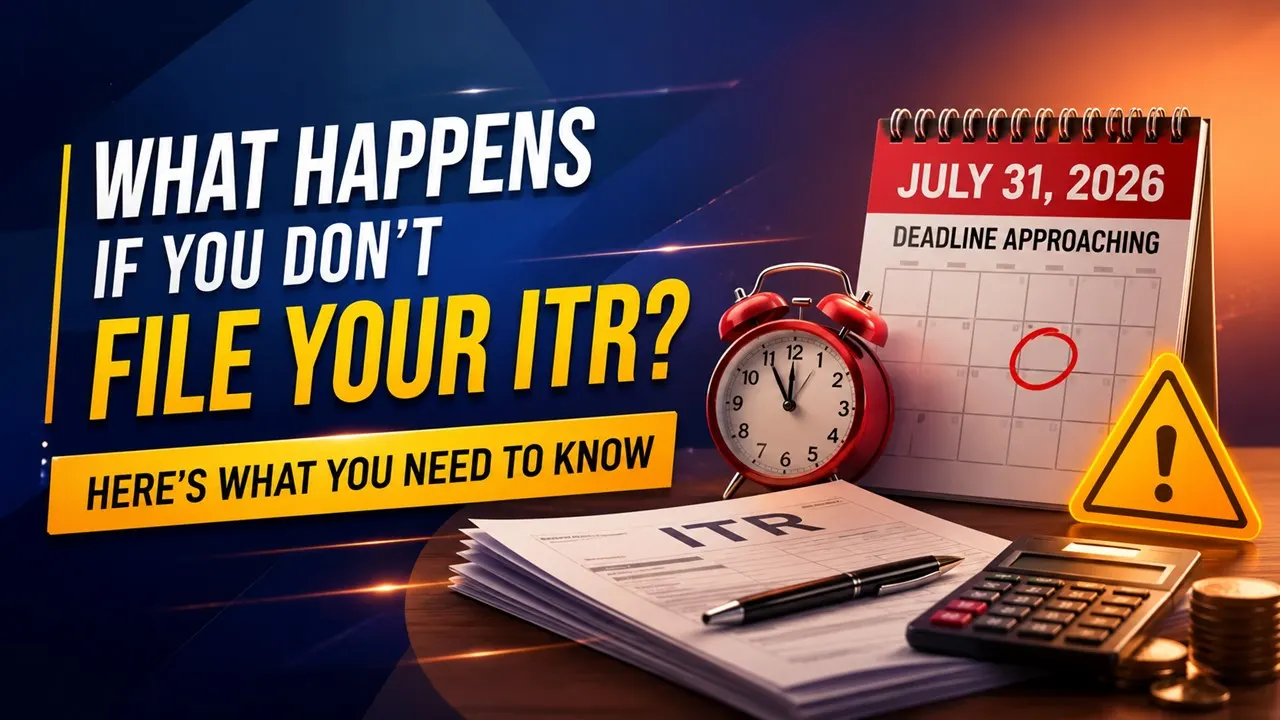
Missing your ITR filing could mean notices, penalties, and lost tax refunds – here's what you need to know.
Here's Why You Shouldn't Delay
 Vanshika verma
 Jul 30, 2026
Table of Contents

The deadline of July 31, 2026 is fast approaching and those who have not filed their Income Tax Return (ITR) for Assessment Year (AY) 2026-27 must do so soon. But business or professional income taxpayers get a little more time. The deadline for filing tax returns for non-audit cases is August 31, 2026 and for audit cases is October 31, 2026.
Many people are confused about whether they have to file ITR or not. As a general rule you have to make a return if your taxable income exceeds the basic exemption limit. Under the new tax regime, income up to Rs 4 lakh will be tax free. Under the old tax regime, income up to Rs 2.5 lakh will be tax free. You may not have to pay any tax after taking benefit of section 87A rebate but you still have to file an ITR if your taxable income is above the exemption limit.

Besides income, an ITR also becomes mandatory if you meet certain conditions. For instance, if you spend Rs 1 lakh or more on electricity in a year or spend more than Rs 2 lakh on foreign travel, you may be required to file your return.
Tax experts also advise that people file their ITR regularly even if they are not liable to pay tax. Filing of ITR is an important proof of income while applying for loans, credit cards or visas It is also useful for people working abroad, as it helps them claim foreign tax credits under tax treaties and avoid paying tax twice on the same income.
What Happens If You Do Not File ITR?
Not filing an ITR when required can lead to several problems:

Notices can be issued by the Income Tax department asking why the return was not filed if high-value financial transactions are found in Form 26AS or the Annual Information Statement (AIS).
If taxpayers do not file their returns, there is a possibility of losing any income tax refund due to them on account of excess Tax Deducted at Source (TDS). In some cases, the department may reach back to earlier years to determine income that may have escaped taxation, within the time limits set by law.
If the taxpayer keeps on ignoring the notices and does not comply, the tax department can make a "best judgment assessment" on the information it has. In the case of serious wilful non-filing, prosecution may also be initiated.
Depending on the amount of tax evaded, this can lead to rigorous imprisonment from six months to two years and a fine. However, prosecution is normally not launched if belated return is filed or if the outstanding net tax payable does not exceed Rs. 10,000.
About Author


Vanshika verma
Content Writer
 Studycafe
 Delhi, Delhi, India
 2114
2114My Recent Articles
- Rajasthan Police Warns of WhatsApp Account Hacking Scams, Urges People to Beware of Fake QR Codes and OTP Fraud
- Man Carrying Rs 25,000 Reward Arrested in Rs 1.22 Crore GST Evasion Case Involving Fake Firms in Bulandshahr
- Star Paper Mills to Challenge Rs 1.55 Crore GST Demand Order Over Disallowance of Input Tax Credit on Raw Materials Destroyed in Fire
- Delhi CBI Arrests Hospital Doctor and Contractual Nursing Orderly Supervisor for Alleged Rs 1 Lakh Bribery in Tender-Related Case
- ITAT Condones 2,107-Day Delay, Directs CIT(A) to Reconsider Rs 16.54 Lakh Section 80PA Deduction Claim
Loading suggestions…


Recent Posts



All Posts



Tags
Recent Posts
All Posts