Who Needs to File ITR in 2025? Know the Income Tax Exemption Limits:
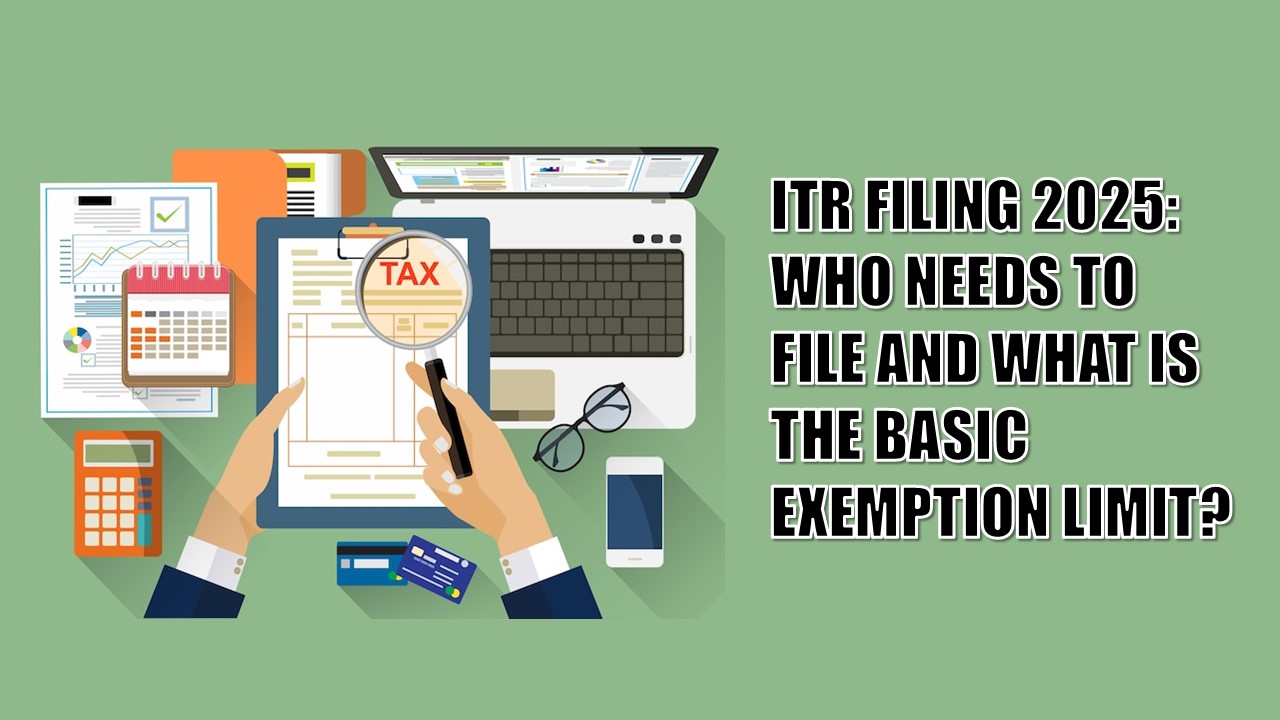
Know who must file ITR in FY 2024-25, the latest exemption limits under old and new tax regimes, key filing rules, deadlines, and benefits of income tax return filing.
Know Latest Tax Exemption Limits for ITR Filing 2025
 Saloni Kumari
 Jun 26, 2025
Table of Contents

Who Needs to File ITR in 2025? Know the Income Tax Exemption Limits
Are you awaiting for income tax return (ITR) filing? At what income level is an individual required to file an ITR? What is the basic exemption limit in ITR filing for FY 2024-25?
These are the basic questions that generally arise in most taxpayers' minds. Specially related to the basic tax exemption limit, as the exemption limit varies depending on the tax regime you would have opted for.
According to recent reports, the Income Tax Department has extended the due date for ITR filing 2025. The date has now been shifted to September 15, 2025, from July 31, 2025.
ITR Filing 2025: When is ITR Filed?
According to a related field expert, the income tax return is generally filed when you earn an income amount that is taxable. Meaning aggregate income exceeds the basic exemption limit. For instance, for the financial year 2024-25, the basic exemption limit for the new tax regime and the old tax regime is Rs. 3 lakh and Rs. 2.5 lakh, respectively. According to the income tax department, the basic tax exemption limit for senior and super senior citizens (those who have an age equal to or above 80 years) is Rs. 3 lakh and 5 lakh, respectively. However, under the new tax regime in the present financial year 2025-26 (for which you will file ITR next year), the basic tax exemption limit has increased to Rs. 4 lakh. Apart from taxable income, the government has made additions to the rules for filing tax returns. Now, if you make certain deposits or spend a major amount of your income during the year, you may also have to file a tax return, even if your income is not taxable.- Depositing Rs. 1 crore or more in one or more current accounts, or
- Depositing Rs. 50 lakh or more in one or more savings bank accounts
- Expenses incurred exceeding 2 lakh on foreign travel for yourself or any other person, or
- Electricity bills paid exceeded 1 lakh in aggregate.
ITR Filing 2025: ITR Filing Benefits
There are several benefits of filing ITR:- Carryforward of losses is permitted if you file your ITR by the deadline (house property loss is excluded).
- One can only refund his/her extra TDS on income through filing ITR.
- ITR is also considered a proof document for numerous purposes, such as taking loans, visa applications, and others. Hence, it is advised to file ITR even if it is not compulsorily required for any particular financial year.
About Author


Saloni Kumari
Content Writer
Saloni is a Content Writer with 2+ years of experience at studycafe.in. She writes legal, taxation, and finance related content including GST, Income Tax etc. Skilled in translating complex judicial pronouncements and regulatory developments into clear, and reader-friendly articles. Experienced in covering judgements of ITAT, High Court, GSTAT, and news related to Income Tax, GST, and corporate law. She can be reached at [email protected].
Saloni is a Content Writer with 2+ years of experience at studycafe.in. She writes legal, taxation, and finance related content including GST, Income Tax etc. Skilled in translating complex judicial pronouncements and regulatory developments into clear, and reader-friendly articles. Experienced in covering judgements of ITAT, High Court, GSTAT, and news related to Income Tax, GST, and corporate law. She can be reached at [email protected].
 StudyCafe
 Delhi, Delhi, India
 2922
2922My Recent Articles
- GSTN Introduces New E-Invoicing Facility for Self-Invoices Under Reverse Charge Mechanism
- Flexi Cap vs Multi Cap Funds: What's the Real Difference?
- IBA Recommends Public Sector Banks to Reduce Ambit of Physical Branch Audits to 50% of Total Business
- ITAT Directs AO to Reconsider Rs 16.44 Lakh Capital Gains and Rs 25.87 Lakh Stamp Duty Value Addition
- ITAT Remands Rs 3.33 Crore Demonetisation Cash Deposit Case to AO, Directs Rs 10,000 Relief Fund Payment
Up Next
Loading suggestions…


Recent Posts


All Posts


Tags
Recent Posts
All Posts