Deepak Gupta | May 20, 2018 |


Filling 15CA in case of foreign remittance in Income Tax Act
As per Section 195 of the Income Tax Act 1961, every person liable for making a payment to non residents shall deduct TDS from the payments made or credits given to non-residents at the rates in force.
Therefore the mechanism of form 15CA was introduced via rule 37BB of the Income Tax Act, so as to enable the person responsible for making foreign remittance to give information on foreign remittance & deduct TDS at the rates in force.
We can also say that the role of TDS return is played by form 15CA in case of foriegn remittance.

Also the Reserve Bank of India has also mandated that except in cases of certain personal remittances which have been specifically exempted, no remittance should be made to a nonresident without furnishing an undertaking in Form 15CA accompanied by a certificate from an Chartered Accountant in Form 15CB if applicable.
PART A – To be filled up if the remittance is chargeable to tax under the provisions of the Income-tax Act,1961 and the remittance or the aggregate of such remittances, as the case may be, does not exceed five lakh rupees during the financial year.
PART B – To be filled up if the remittance is chargeable to tax under the provisions of the Income-tax Act,1961 and the remittance or the aggregate of such remittances, as the case may be, exceeds five lakh rupees during the financial year and an order/ certificate u/s 195(2)/ 195(3)/ 197 of Income-tax Act has been obtained from the Assessing Officer.

PART C – To be filled up if the remittance is chargeable to tax under the provisions of Income-tax Act, 1961 and the remittance or the aggregate of such remittances, as the case may be, exceeds five lakh rupees during the financial year and a certificate in Form No. 15CB from an accountant as defined in the Explanation below sub-section (2) of section 288 has been obtained.
PART D – To be filled up if the remittance is not chargeable to tax under the provisions of the Income-tax Act,1961 {other than payments referred to in rule 37BB(3)} by the person referred to in rule 37BB(2).
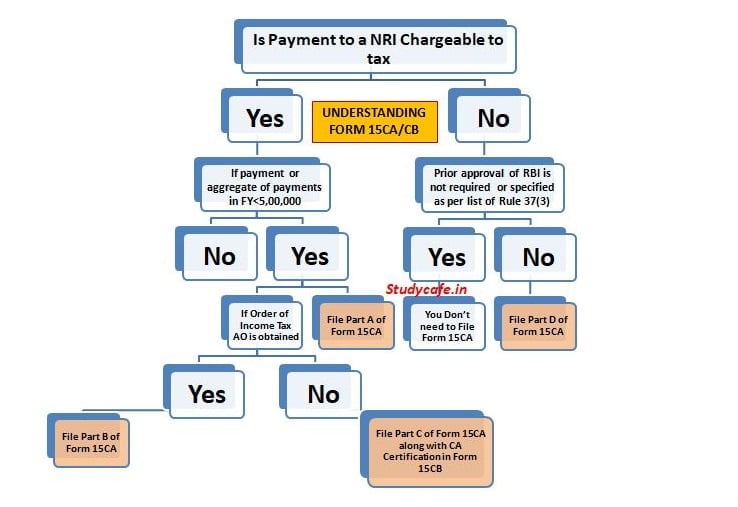
Filling 15CA in case of foreign remittance in Income Tax Act
| Sl. No. | Purpose code as per RBI | Nature of payment |
| (1) | (2) | (3) |
| 1 | S0001 | Indian investment abroad – in equity capital (shares) |
| 2 | S0002 | Indian investment abroad – in debt securities |
| 3 | S0003 | Indian investment abroad – in branches and wholly owned subsidiaries |
| 4 | S0004 | Indian investment abroad – in subsidiaries and associates |
| 5 | S0005 | Indian investment abroad – in real estate |
| 6 | S0011 | Loans extended to Non-Residents |
| 7 | S0101 | Advance payment against imports |
| 8 | S0102 | Payment towards imports – settlement of invoice |
| 9 | S0103 | Imports by diplomatic missions |
| 10 | S0104 | Intermediary trade |
| 11 | S0190 | Imports below Rs.5,00,000 – (For use by ECD offices) |
| 12 | SO202 | Payment for operating expenses of Indian shipping companies operating abroad |
| 13 | SO208 | Operating expenses of Indian Airlines companies operating abroad |
| 14 | S0212 | Booking of passages abroad – Airlines companies |
| 15 | S0301 | Remittance towards business travel |
| 16 | S0302 | Travel under basic travel quota (BTQ) |
| 17 | S0303 | Travel for pilgrimage |
| 18 | S0304 | Travel for medical treatment |
| 19 | S0305 | Travel for education (including fees, hostel expenses etc.) |
| 20 | S0401 | Postal services |
| 21 | S0501 | Construction of projects abroad by Indian companies including import of goods at project site |
| 22 | S0602 | Freight insurance – relating to import and export of goods |
| 23 | S1011 | Payments for maintenance of offices abroad |
| 24 | S1201 | Maintenance of Indian embassies abroad |
| 25 | S1202 | Remittances by foreign embassies in India |
| 26 | S1301 | Remittance by non-residents towards family maintenance and savings |
| 27 | S1302 | Remittance towards personal gifts and donations |
| 28 | S1303 | Remittance towards donations to religious and charitable institutions abroad |
| 29 | S1304 | Remittance towards grants and donations to other Governments and charitable institutions established by the Governments |
| 30 | S1305 | Contributions or donations by the Government to international institutions |
| 31 | S1306 | Remittance towards payment or refund of taxes |
| 32 | S1501 | Refunds or rebates or reduction in invoice value on account of exports |
| 33 | S1503 | Payments by residents for international bidding. |
Rate on which TDS is to be deducted
Deciding Rate is important Factor while filing for 15CA and 15CB. Some of the points that should be kept in mind while deciding the rate are given below.
a. Rate specified in Income Tax Act or in Double Taxation Avoidance Agreement, which ever is lower should be the rate on which TDS should deducted.
b. If income is chargeable to tax in India and relief is claimed under the DTAA, whether TRC has been obtained from the recipient
c. If remittance is on account of capital gains details of amount of short-term, long-term capital gains and the basis of arriving at the taxable income.
d. Provisions of Section 206AA will be applicable, if remittance is chargeable to tax and PAN of remittee is not available.
Suppose 100 Dollars are required to be remitted . RBI reference rate for 1 Dollar is 50 Rupees. This means 5000 Rupees are required to be remitted.
Now let us assume that the rate of TDS is 20%.
Here 5000/(100-20)% = 6250 is the Gross Remittance. 6250 * 20% = 1250 is the TDS and 5000 is remittance net of TDS.
This concept is called “Concept of Grossing up”.
No specific mechanism of converting foreign currency in to Indian currency has been specified , therefore it is advised that RBI reference rate should be taken for converting foreign currency into Indian currency.
A lot of people are confused about as to what is the difference Between Form 15CA and Form 15CB. Form 15CA is filed by the tax deductor/ remittor where as form 15 CB is a certificate by practicing chartered accountant that :
To file Form 15CB, taxpayer is required to Add CA in his account. CA can be added by using the following steps:
Process of filing Form 15CB by Chartered Accountants is as follows:
Note: DSC is Mandatory to file Form 15CB.

In case of any Doubt regarding Membership you can mail us at [email protected]
Join Studycafe's WhatsApp Group or Telegram Channel for Latest Updates on Government Job, Sarkari Naukri, Private Jobs, Income Tax, GST, Companies Act, Judgements and CA, CS, ICWA, and MUCH MORE!"