Meetu Kumari | Jun 11, 2025 |
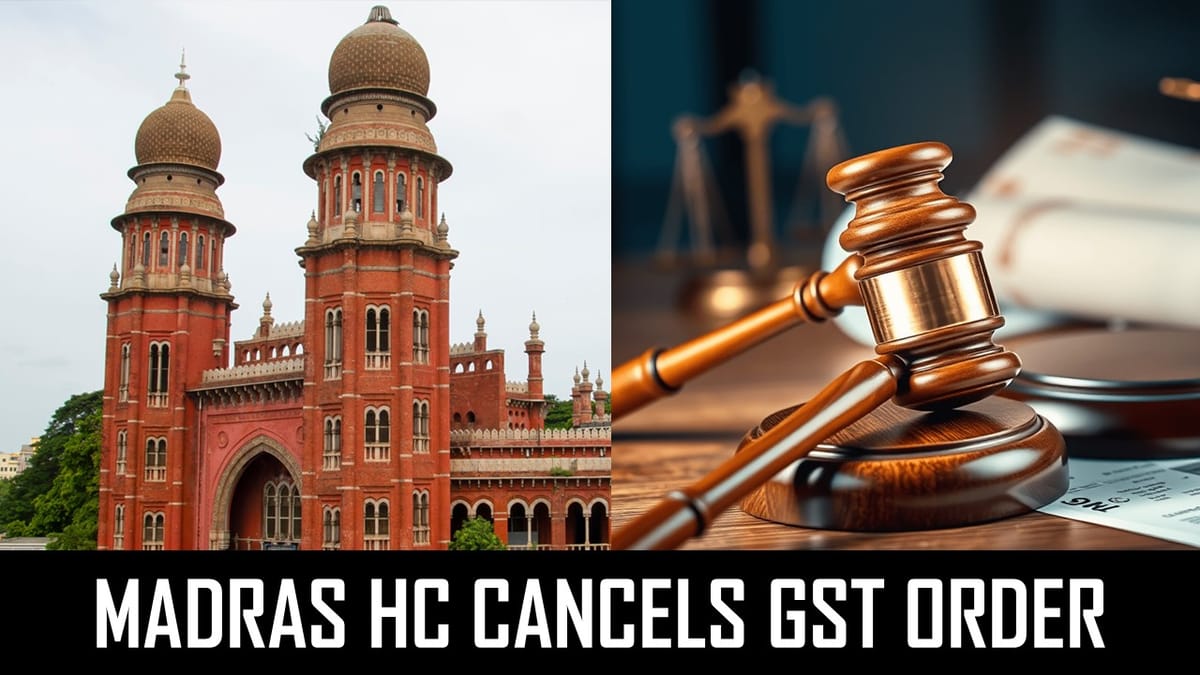

Madras High Court Sets Aside Ex Parte GST Assessment Order for Lack of Proper Service
Under the Goods and Services Tax (GST) regime, Tvl. Iyarkai, on behalf of its owner, R. Gavaskar, filed a writ petition in the Madras High Court contesting an assessment order issued on December 13, 2024, for the Assessment Year 2018–19. The petitioner argued that the assessment order violated principles of natural justice and was issued without adequate notice.
The petitioner contended that although a show cause notice (DRC-01) and its notification (DRC-01A) had been posted on the GST portal, he was not aware of the proceedings because he had not accessed the portal. The GST registration had previously been cancelled due to business closure. Consequently, neither a personal hearing nor a reply was filed.

Issue Raised: Whether the assessment order passed solely based on notices uploaded on the GST portal, without adopting alternate service methods prescribed under Section 169 of the CGST Act, was valid.
Hon’ble Madras High Court’s Decision: The matter was remanded to the assessing officer for a new decision after the Hon’ble High Court invalidated the contested order dated December 13, 2024. The Court ruled that while a portal service is legitimate, the goal of fair adjudication is undermined by merely following the procedure without guaranteeing actual notice. When portal notices are not answered, it advises the respondents to look into alternative service options, such as RPAD.

The Hon’ble Court granted a conditional remand with the following instructions after acknowledging the petitioner’s willingness to pay 25% of the contested tax. The petitioner must deposit 25% of the disputed tax within two weeks. Post that the petitioner must file a thorough reply with supporting documentation within two weeks.
The respondent must give a clear 14-day notice for a personal hearing and pass a fresh order after due consideration.
The writ petition was thus disposed of with no order as to costs.
To Read Judgment, Download PDF given below.

In case of any Doubt regarding Membership you can mail us at [email protected]
Join Studycafe's WhatsApp Group or Telegram Channel for Latest Updates on Government Job, Sarkari Naukri, Private Jobs, Income Tax, GST, Companies Act, Judgements and CA, CS, ICWA, and MUCH MORE!"