The Income Tax Department introduced Form 121 to replace Forms 15G and 15H, simplifying TDS exemption. It allowed eligible taxpayers to declare low income and prevent tax deductions efficiently.
Kashish Bhardwaj | Apr 16, 2026 |
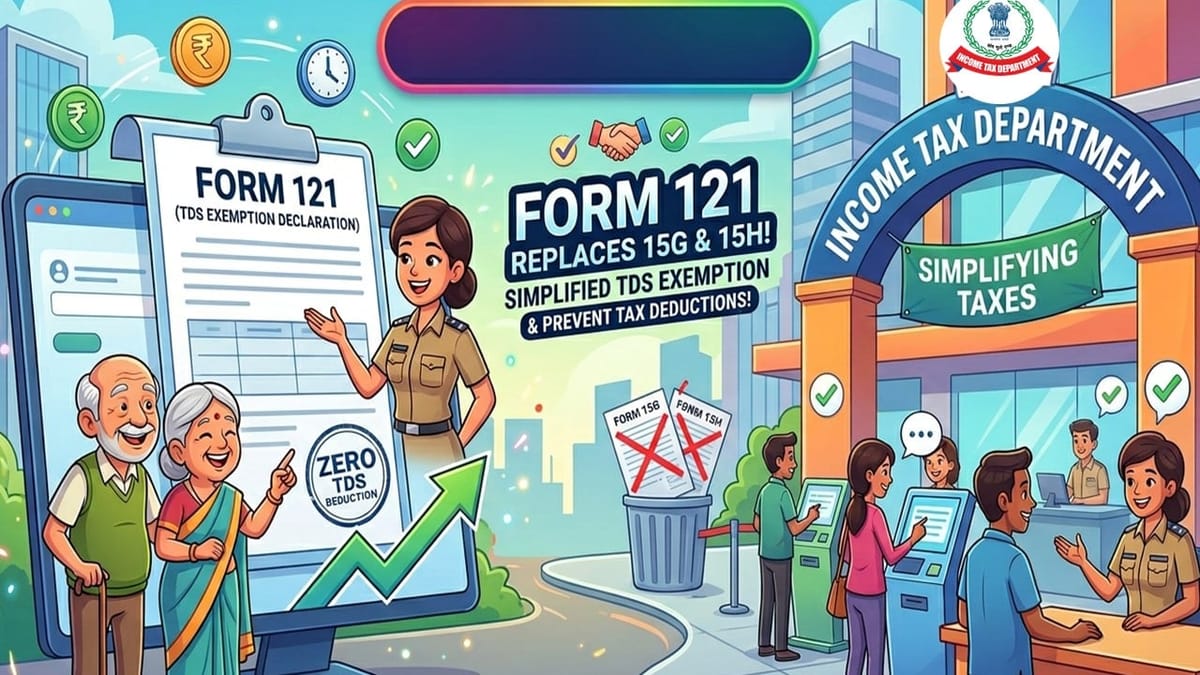

New Income Tax Act 2025 Replaces Form 15G and 15H With Form 121; A Simple Way to Avoid TDS
Making a major change, the Income Tax Department has implemented the new Form 121 under the Income Tax Act, 2025. This new form will replace the old Form 15G and 15H. The purpose of this change is to simplify the process for taxpayers so that they can easily declare that their total income is below the taxable limit, and TDS (Tax Deducted at Source) should not be charged on them. This new provision has been implemented under Section 393(6) and Rule 211.
Purpose of Form 121

The main purpose of Form 121 is to enable taxpayers to declare in advance that their estimated total income is less than the taxable limit. In such a situation, banks or other institutions should not deduct TDS on their income.
Who can use Form 121?
Allowed:

Resident Individuals and HUF (Hindu Undivided Family) can use this form.
Not Allowed:
To which income does Form 121 apply?
Below are the types of income and their limits where TDS is applicable and can be avoided through Form 121:
| S. No. | Nature of Payment | Threshold Limit (Financial Year) |
| 1 | Premature withdrawal of EPF | Rs 50,000 |
| 2 | Interest on securities (debentures, govt. bonds, etc.) | Rs 5,000 / Rs 10,000 |
| 3 | Dividend income | Rs 10,000 |
| 4 | Interest from Bank, FD, RD | Rs 50,000 (Rs 100,000 for senior citizens) |
| 5 | National Saving Scheme (NSS) withdrawal | Rs 2,500 |
| 6 | Insurance commission | Rs 20,000 |
| 7 | Maturity proceeds of life insurance | Rs 100,000 |
| 8 | Rent (land/building/plant/machinery) | Rs 50,000 per month or Rs 600,000 annually |
| 9 | Income from mutual fund units | Rs 10,000 |
An important thing that every taxpayer should understand
What is the structure of Form 121?
Part A (To be filled by the Taxpayer):
Part B (To be filled by the Payer):
When is it necessary to submit the form?
| Activity | Timeline |
| Submission by the taxpayer | The taxpayer must submit the form before the income is credited |
| Monthly reporting by payer | By 7th of next month |
| TDS return reporting | TDS return is filed on a quarterly basis |
How does the whole process work?
Taxpayer’s Responsibility:
First of all, the taxpayer has to ensure that his final tax liability is nil (NIL). After this step, fill Form 121 with the correct information. This form is required to be submitted separately to each payer (such as a bank) from which the income is being received.
Payer’s Responsibility:
The payer verifies the received form, then generates a Unique Identification Number (UIN) for the form. Also, they has to upload the relevant information every month, and it is mandatory to report this detail in the TDS return (Form 140) also.
Special features of the new Form 121
Important rules to keep in mind
Form 121 is being considered a big relief step for taxpayers. This has not only made the process easier, but now a single simple form will be enough to avoid TDS. However, it is very important to give correct information while using it; otherwise, it may cause problems.

In case of any Doubt regarding Membership you can mail us at [email protected]
Join Studycafe's WhatsApp Group or Telegram Channel for Latest Updates on Government Job, Sarkari Naukri, Private Jobs, Income Tax, GST, Companies Act, Judgements and CA, CS, ICWA, and MUCH MORE!"